Britain is being told to accept the unacceptable.
Across the country, productive farmland is being covered by solar panels, battery storage sites are being pushed near homes and villages, treasured landscapes are being industrialised, and communities are being expected to stay quiet while it happens.
All of it is dressed up in the language of necessity. All of it is sold as inevitable. And anyone who dares to question it is too often dismissed as selfish, backward, or anti-environment.
But people are waking up.
They can see that this is not balanced planning. They can see that this is not honest environmentalism. And they can see that much of what is being imposed on rural Britain is not a serious energy strategy at all. It is a one-sided model of development that asks ordinary communities to bear the cost while others claim the credit.
That is why the HOPE campaign matters.
HOPE is about standing up before it is too late. It is about protecting our countryside, defending our communities, and demanding an energy future built on common sense rather than slogans. It is about restoring something that has been missing from public life for too long: the belief that ordinary people still have the right to say enough is enough.
The Countryside Is Not a Sacrifice Zone
One of the most dangerous assumptions in modern planning is that rural land is somehow empty, spare, or expendable.
It is not.
The countryside is not just open space waiting to be filled. It is where food is grown. It is where wildlife survives. It is where landscapes shape identity and belonging. It is where villages and rural communities still hold together the character of Britain. Once it is industrialised, fenced off, fragmented, and altered beyond recognition, it cannot simply be put back.
Yet too many developments are now treated as if land is nothing more than a blank surface on a developer’s map.
A field is marked out for solar.
A hillside is marked out for turbines.
A rural location is marked out for battery storage.
And local people are expected to adapt to the consequences.
The HOPE campaign rejects that mindset completely.
Our countryside is not disposable. It is not a convenience. It is not a sacrifice zone for poor planning and political box-ticking.
People Are Being Forced to Carry the Burden
Time and again, ordinary communities are told these developments are in the national interest. Yet it is local people who must live with the disruption, the visual damage, the environmental risk, the construction traffic, the stress, and the uncertainty.
They are told large solar schemes are harmless, even when farmland disappears under panels. They are told battery storage sites are safe, even when serious public concerns remain about fire risk, emergency planning, and unsuitable locations. They are told landscapes can absorb endless infrastructure, even when cumulative harm is obvious to anyone living there.
And still they are expected to be grateful.
That is one of the deepest injustices in this whole debate. Communities are being asked to surrender peace, place, and stability for projects that often come with exaggerated promises, weak scrutiny, and no meaningful guarantee of local benefit.
HOPE says that people matter more than glossy brochures.
It says local communities are not an obstacle to be managed. They are the people who know these places best, care for them most deeply, and will still be living with the consequences long after the consultants have gone.
Britain Needs Reality, Not Energy Theatre
The present energy debate is too often built on appearance rather than reality.
We hear endless talk about ambition, transition, clean growth, and targets. But we hear far less about the hard questions that should come first.
Can the grid actually support what is being approved?
What happens when solar generation drops in winter, exactly when demand is highest?
What is the true cost of reinforcement, balancing, backup, and curtailment?
How much countryside is being lost for schemes that cannot function as promised without massive supporting infrastructure?
And why are communities expected to accept industrial sprawl while energy bills remain high?
These are not side issues. They are the central issues.
A serious country would start with engineering reality. It would build policy around what is deliverable, affordable, and reliable. It would not approve project after project on the assumption that the details can be sorted out later. It would not pretend that every scheme is automatically justified because it carries a green label.
The HOPE campaign exists because too much of what is happening now is energy theatre: headline politics, corporate opportunism, and planning pressure dressed up as national necessity.
Britain deserves better.
Hope Means Having the Courage to Say No
There is a deliberate pressure in public life to make people feel guilty for objecting.
If you oppose the loss of farmland, you are told you oppose progress.
If you question battery storage near homes, you are told you do not understand modern energy needs.
If you challenge the industrialisation of the countryside, you are told you are standing in the way of the future.
But saying no to the wrong development in the wrong place is not ignorance. It is judgement.
Saying no to bad planning is not denial. It is responsibility.
Saying no to the destruction of landscapes, peatland, farmland, and community amenity is not anti-environment. In many cases, it is the most environmentally responsible position of all.
Hope is not passive. Hope is not soft. Hope is the determination to defend what matters before it is lost. It is the refusal to be intimidated by jargon, process, or the assumption that everything has already been decided behind closed doors.
That is the spirit this campaign wants to build.
There Is a Better Way Forward
The choice is not between covering the countryside in infrastructure or doing nothing. That is a false choice, and people should stop accepting it.
There are better ways to think about Britain’s energy future.
We should be using the right land first, not the easiest land.
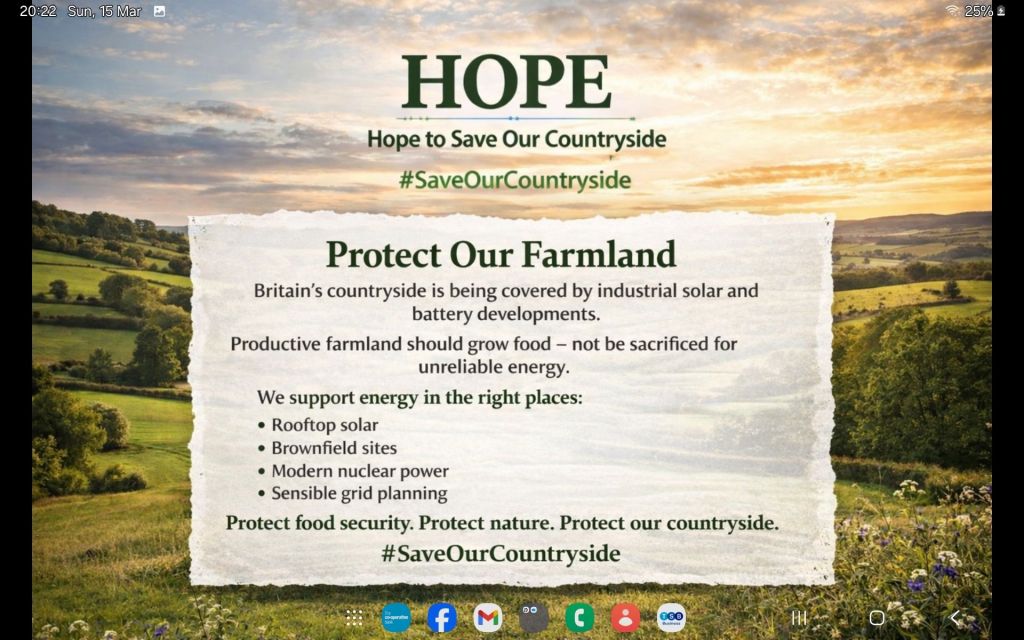
We should prioritise rooftops, commercial buildings, industrial sites, warehouses, car parks, and genuine brownfield opportunities before taking more agricultural land.
We should focus on reliable generation and grid strength, not just headline capacity.
We should stop pretending that every local objection is unreasonable.
And we should protect carbon-rich and environmentally sensitive landscapes instead of damaging them in the name of sustainability.
Most of all, we need an energy policy that respects the country it is supposed to serve.
That means respecting the people who live in rural Britain. Respecting the value of farmland. Respecting the beauty and ecological importance of our landscapes. Respecting the need for food security, local democracy, and long-term national resilience.
That is what HOPE stands for.
This Campaign Is About People
At its heart, HOPE is not just about policy. It is about people who feel they have been ignored for too long.
It is about the family looking out across countryside that may soon be industrialised.
It is about the farmer watching productive land disappear under speculative schemes.
It is about the resident who feels decisions are always made somewhere else, by people who will never have to live with the consequences.
It is about the communities who are tired of being patronised every time they raise reasonable concerns.
And it is about bringing those people together.
Because one of the strongest weapons used against the public is isolation. Each village is made to feel alone. Each campaign is made to feel local, separate, temporary, and small. But taken together, these fights reveal something much bigger: a national pattern of bad decision-making, weak accountability, and growing public frustration.
HOPE says clearly that people are not alone.
Across Britain, communities are beginning to recognise the same story in different places. They are seeing the same arguments used, the same pressure applied, the same promises made, and the same concerns brushed aside.
That recognition matters. Because once people realise they are part of something wider, confidence grows.
HOPE Will Speak Clearly and Without Apology
This campaign will not whisper. It will not dress up hard truths to make them more comfortable for those in power.
It will challenge poor planning.
It will question bad evidence.
It will stand with local communities.
It will defend countryside, farmland, peatland, and landscape.
It will demand an energy future that is rational, affordable, accountable, and rooted in reality.
This is not opposition for the sake of opposition. It is defence of what should never have been treated as disposable in the first place.
The countryside matters.
The people who live there matter.
The truth matters.
And the future of Britain’s energy system matters too much to be handed over to ideology, pressure tactics, and careless development.
Hope Is Resolve
Hope is often mistaken for softness. In reality, hope is resolve.
It is the refusal to give in to the idea that nothing can be changed.
It is the determination to keep speaking when others want silence.
It is the confidence to believe that bad policy can still be challenged and better policy still demanded.
It is the belief that communities have a right not just to endure decisions, but to shape them.
That is why this campaign matters.
Because when people lose hope, they stop resisting.
And when they stop resisting, everything becomes easier to take away.
So HOPE stands for something simple, strong, and necessary:
Hope for our countryside.
Hope for our communities.
Hope for accountability.
Hope for common sense.
Hope for an energy future that works for Britain instead of against it.
That is a cause worth building.
That is a cause worth defending.
And that is exactly what HOPE intends to do.
Shane Oxer. Campaigner for fairer and affordable energy
 SAY NO TO THE DESTRUCTION OF OUR LAND
Leave a comment