Most people assume food will always be there.
The shelves may change. Prices may rise. Certain items may disappear for a few days. But beneath all that is a quiet public assumption that the system itself will hold. Ships will still arrive. Lorries will still move. Imports will still come. Somewhere, somehow, the global machine will continue to feed us.
But what if it does not?
That is the question Britain should be asking now.
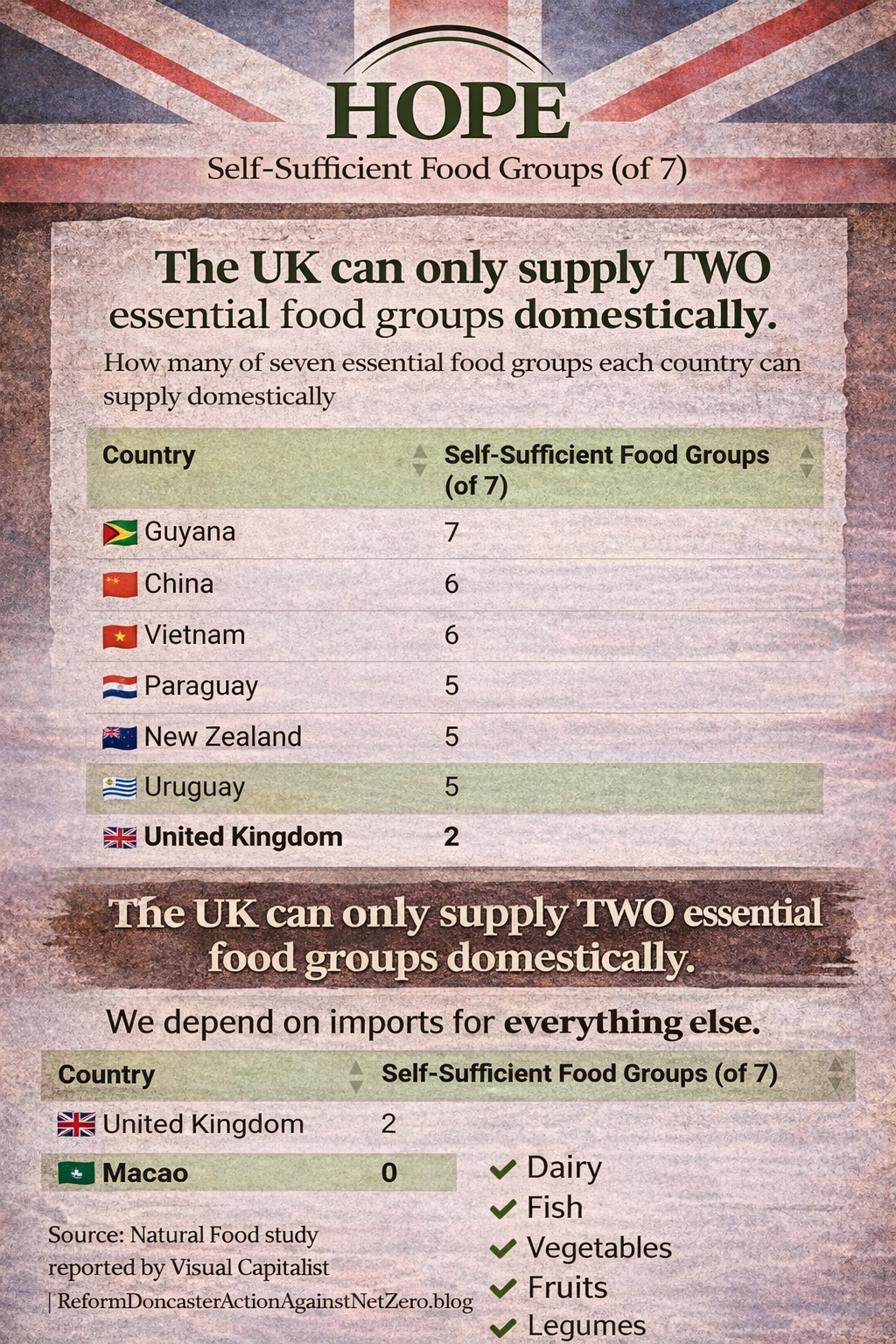
A recent analysis based on a Nature Food study looked not just at calories, but at whether countries could meet a healthy diet across seven essential food groups from their own domestic production. Its conclusion was stark: only one country, Guyana, was self-sufficient across all seven groups. More than a third of countries could not meet more than two, and many are heavily exposed to import dependency and supply shocks. The study’s authors warned that low self-sufficiency and overdependence on a few suppliers leave countries vulnerable to global disruption. �
Nature +1
In the data shown in the screenshots above, the United Kingdom appears as able to supply only two out of seven essential food groups domestically.
If that is true, then Britain is not standing on a secure foundation. It is standing on a supply chain.
And supply chains are not permanent facts of nature. They are systems of trust, stability, fuel, shipping, finance, and political order. Once those things begin to break down together, food security becomes a very different question.
The official definition of food security used by government is broad: food must be physically and economically accessible, safe, nutritious, and available at all times. Defra’s own 2025 Food Security Digest also accepts that food security cannot be reduced to a single number, and explicitly notes that conflict, shocks to international trade, energy prices, climate pressures, and supply-chain resilience all affect the UK’s position. �
GOV.UK
That matters because Britain does not live in a calm world.
Recent years have already shown how fragile the international system can be. The Nature Food paper points to COVID-19 and the war in Ukraine as clear examples of how long supply chains can be disrupted. It also highlights how reliance on a narrow range of trading partners increases vulnerability when shocks occur. � Defra’s 2025 Digest similarly notes that geopolitical tensions, disrupted shipping routes, trade uncertainty, and rising energy and agri-food input costs all feed directly into food security risks for the UK. �
Nature
GOV.UK
Now imagine not one disruption, but several at once.
A wider war in the Middle East. Shipping disruption through key maritime routes. Fuel price spikes. Fertiliser costs rising. Currency instability. Weather shocks hitting major exporters. Industrial unrest at ports. Cyber-attacks on logistics. Panic buying in response to media coverage. A weak harvest at home. Importing countries suddenly choosing to hold back supply for their own populations.
That is what “the world system falls apart” actually means. Not one cinematic collapse, but a chain reaction of pressure points across trade, energy, transport, and food.
In that kind of world, a country that cannot feed itself from its own land is not merely exposed. It is dependent.
That dependence would show itself quickly. Prices would rise first. Then choice would narrow. Then certain categories would become harder to source at scale. Retailers would prioritise margin and logistics. Governments would issue reassurances. Consumers would start adapting downward. The poor would feel it first, then the rest. And all the while, a country like Britain would be competing on the world market with other import-dependent states for access to what remains available.
This is why the argument about farmland is not cosmetic.
If a country is weak in food self-sufficiency, the protection of productive land becomes a matter of national resilience, not lifestyle branding. Yet Britain is still taking good agricultural land out of use for large-scale energy schemes, speculative development, and policy choices that often assume the global system will continue to provide whatever domestic production no longer can.
That is an extraordinary gamble.
The Nature Food study makes an important point on this. Current production levels are not a perfect measure of theoretical potential, but they are a strong indicator of what a country can do quickly in response to disruption. In other words, even if a nation could improve production over time, what matters in a shock is what it can produce now, using the land, infrastructure, and farming base it has not already surrendered. �
Nature
Defra’s own reporting points in the same direction. The UK Food Security Report 2024 was published to meet the Agriculture Act duty to analyse food security, and the 2025 Digest specifically links resilience to domestic production, sources of imports, energy costs, labour, trade conditions, and wider global events. � This is not fringe thinking. It is built into the government’s own framework.
GOV.UK +1
And yet public policy still behaves as though food security can be treated as an abstract background issue while productive rural land is repurposed.
That is where the contradiction becomes impossible to ignore.
We are told to trust the global market, while the global market becomes more unstable. We are told to trust imports, while the government itself lists conflict, trade disruption, port closures, commodity volatility, and shipping problems as relevant food-security events. We are told that land can be lost without consequence, while the evidence increasingly suggests that resilience begins with what a nation can still produce for itself. �
GOV.UK
So what happens when the world system falls apart?
Britain discovers, too late, that food security is not a slogan. It is not an app. It is not a spreadsheet. It is land, water, soil, farmers, infrastructure, and the capacity to produce enough of what people actually need when the world outside becomes unreliable.
If the UK can really supply only two of seven essential food groups domestically, then the warning could hardly be clearer.
A nation that cannot feed itself should not be sacrificing the land that still can.
And a government that speaks endlessly about resilience should not be sleepwalking into deeper dependence.
Because when the world system cracks, countries do not survive on promises.
They survive on what they can still grow.
Sources
Nature Food, “Gap between national food production and food-based dietary guidance highlights lack of national self-sufficiency” (2025). �
Nature
Defra, United Kingdom Food Security Digest 2025. �
GOV.UK
Defra, United Kingdom Food Security Report 2024. �
GOV.UK
 SAY NO TO THE DESTRUCTION OF OUR LAND
Leave a comment