The quiet line buried in the lease between Doncaster Council and Peel Group explains more about the real delay to reopening Doncaster Sheffield Airport than any public statement so far: electricity use on the site must not exceed 1 MVA at any time. That figure is not a planning technicality. It is an electrical ceiling that makes the entire vision of a modern airport and “South Yorkshire Airport City” physically impossible without major grid reinforcement.¹
One MVA equates to roughly 800 kW of usable load. In real terms, that is the demand of a supermarket or small retail park, not an airport terminal, freight facility, electrified ground fleet, modern security systems, HVAC across large buildings, and a logistics and manufacturing park at Gateway East. For comparison, London City Airport publicly confirmed in 2019 that it was expanding its supply from 3.6 MVA to 7 MVA to handle 3.6 million passengers. Doncaster is being modelled at nearly two million passengers on one seventh of that capacity.²
The former airport “managed” on this limit because it was a low-intensity, early-2000s operation with limited electrification, little freight refrigeration, no advanced manufacturing, and minimal night logistics. The proposed reopening is fundamentally different. The plans for Gateway East include logistics depots, aviation engineering, cold-chain storage, warehousing, and advanced manufacturing , all of which are megawatt-scale electricity users. A single modern refrigerated warehouse can draw 2–3 MVA on its own.³
Council and SYMCA reports have already acknowledged that up to £160 million of infrastructure works are required at Gateway East, “particularly power”. That figure is not about convenience. It is the cost of making the site electrically viable. Without that reinforcement, the airport and the surrounding development cannot operate at the scale being discussed.⁴
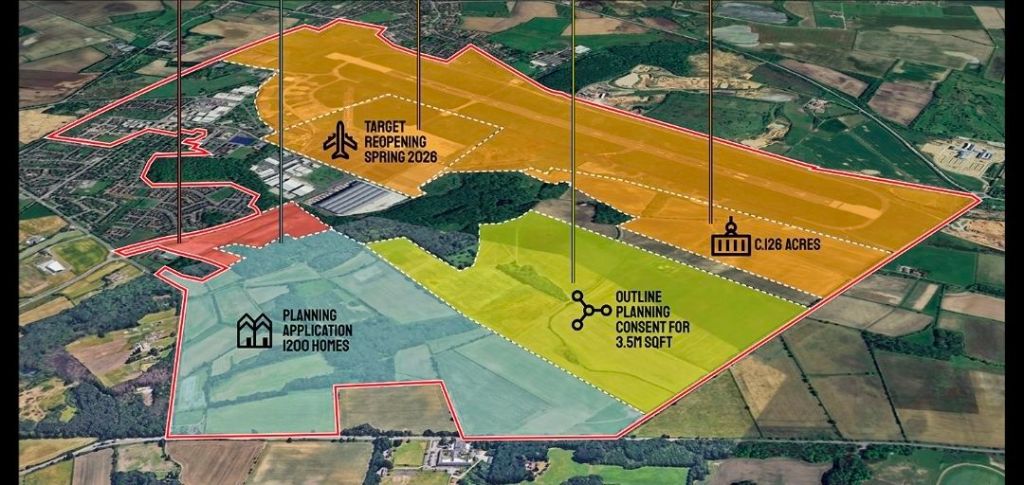
The reason this problem exists becomes clear when you examine where the airport sits on the network. DSA connects into the same constrained corridor as Thorpe Marsh Power Station, West Melton Substation, and Brinsworth Substation , substations that appear repeatedly in Northern Powergrid’s Appendix G data as locations requiring reinforcement, with restricted capacity and multiple queued schemes running into the 2030s. This is the same electrical bottleneck affecting solar farms, BESS sites, and industrial connections across South Yorkshire.⁵
The 1 MVA clause exists because that is what the Distribution Network Operator can currently guarantee at that connection point without upgrades that do not yet exist. This is why officials talk about “medium to long term” solutions. In grid terms, that means new transformers, new cabling, and possibly new substations.⁶
Passenger forecasts, freight targets, and regeneration ambitions are being debated in public. The electrical capacity required to make them possible is not. Yet the lease wording exposes the reality: the power needed for South Yorkshire Airport City does not presently exist.⁷
This is not primarily an aviation story. It is a grid constraint story. The same story already visible across Fenwick, Marr, Thorpe Marsh, Whitestone, Thurcroft and beyond. The difference here is that, for once, the limitation has appeared in black and white.⁸
Footnotes
1. Lease wording reported in The Yorkshire Post, 31 January 2026, confirming 1 MVA peak electricity cap between Doncaster Council and Peel Group.
2. London City Airport development announcement, 2019, confirming expansion from 3.6 MVA to 7 MVA for passenger growth.
3. UK industrial electrical load profiles for refrigerated warehousing and logistics facilities (typical 1–3 MVA per unit).
4. SYMCA Gateway East infrastructure assessment referencing £160m required works, particularly power capacity.
5. Northern Powergrid, Appendix G Long Term Development Statement, constraint listings for West Melton, Brinsworth, Doncaster B / Thorpe Marsh corridor showing restricted capacity and reinforcement timelines into the 2030s.
6. Standard DNO connection practice where firm capacity is limited pending primary/substation reinforcement.
7. SYMCA passenger and cargo modelling for DSA reopening (September reports referencing revised achievable targets).
8. Cross-reference with other South Yorkshire schemes affected by the same corridor constraints in Northern Powergrid data.
Shane Oxer. Campaigner for fairer and affordable energy
 SAY NO TO THE DESTRUCTION OF OUR LAND
Leave a comment