Solar energy has been sold to the public as the clean symbol of modern progress. Silent, emission-free in operation, and powered by sunlight, it feels like the perfect antidote to fossil fuels. Panels now cover rooftops, car parks, deserts, and increasingly, farmland. For many, solar is not just technology it is virtue made visible.
But beneath this clean image lies a growing materials problem that has received far less attention than installation targets, subsidy schemes, or capacity milestones. Solar panels do not last forever. Most are designed for a working life of 25–30 years. The first large fleets installed in the early 2000s are now reaching the end of that lifespan. What happens next is becoming impossible to ignore.
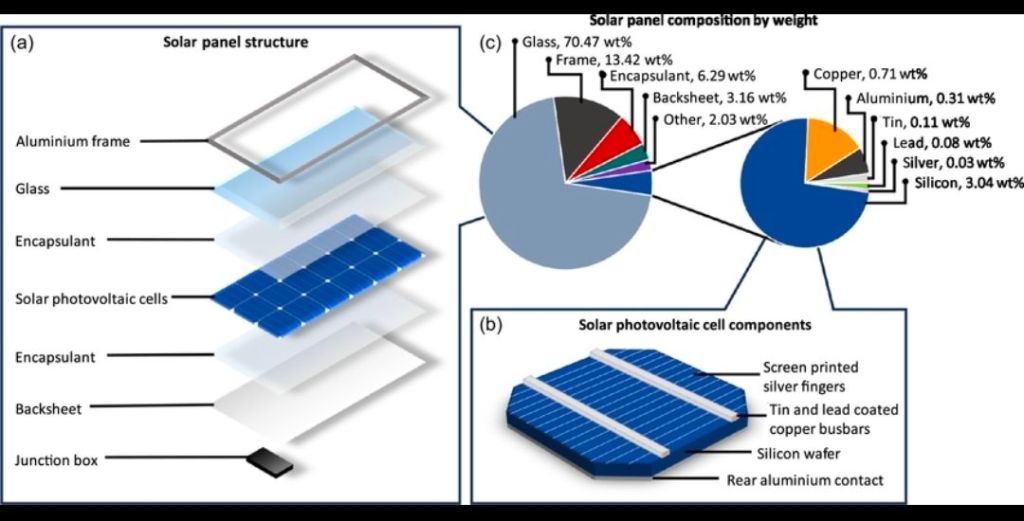
A standard crystalline silicon panel is not a simple sheet of glass. It is a tightly fused sandwich of glass, polymers, silicon cells, silver paste, copper ribbons, and aluminium framing. These layers are heat-bonded together to survive decades of weather exposure. Ironically, this durability is exactly what makes panels extremely difficult to dismantle once they degrade. The very feature that allows them to function outdoors for decades now complicates their disposal.
The Waste Curve That’s Starting to Rise
The world has installed solar at extraordinary speed over the last two decades. Success has been measured by gigawatts added per year. Far less attention was paid to what happens when those gigawatts age together.
Projections from the International Renewable Energy Agency estimate that cumulative global solar panel waste could reach between 60 and 78 million tonnes by 2050 under standard assumptions. Under accelerated repowering scenarios , where older panels are replaced early with more efficient ones , estimates rise far higher, with upper projections exceeding 200 million tonnes.¹
This is not a distant future problem. The curve has already started.
Why Panels Don’t Recycle Like People Assume
Most people assume solar panels can be recycled like glass bottles or aluminium cans. In reality, current recycling processes focus on what is easiest to recover, not what is most valuable.
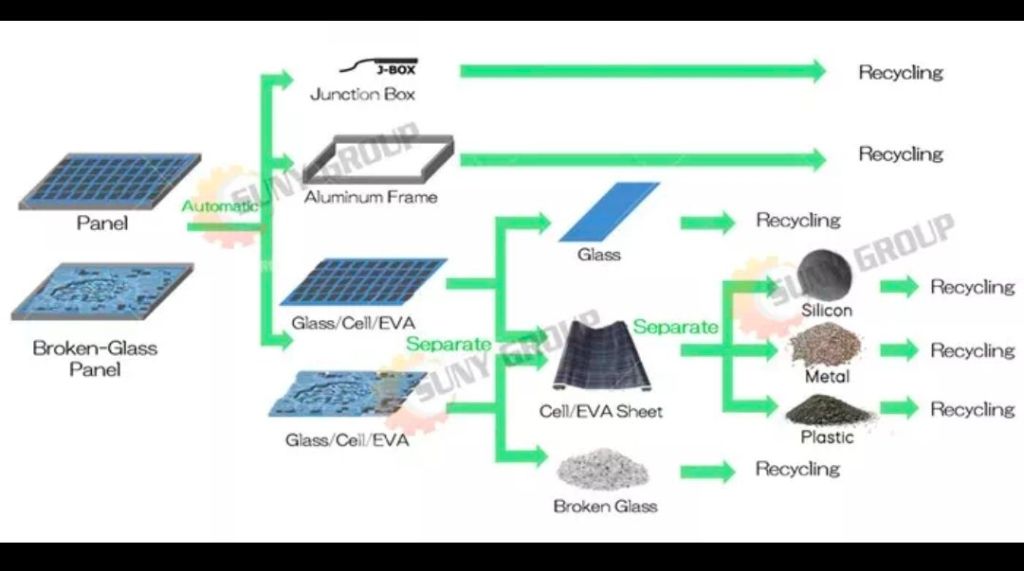
The aluminium frame and junction box are removed quickly because they have immediate scrap value. The laminated panel is then often crushed. Glass is recovered. The rest — a complex mixture of silicon, silver, copper, plastics, and encapsulants — becomes low-grade mixed waste from which recovering high-value materials is currently uneconomical.²
This is the heart of what researchers describe as a materials “black hole.” Valuable resources that required energy-intensive mining and refining effectively disappear from the supply chain. They are not reused in new panels. They are lost.
The Environmental Trade-Off Few Discuss
Solar panels produce electricity for decades without emitting carbon during operation. That is a genuine advantage. Over their lifetime, they generate far more energy than was used to manufacture them.
But that is only half the lifecycle story.
Panels require:
Quartz mining for silicon
Silver and copper extraction
Aluminium smelting
Petrochemical plastics
High-temperature manufacturing processes
When end-of-life recovery fails to recapture these materials, new mining must replace them. This shifts part of solar’s environmental footprint from emissions to resource extraction and waste.³
The issue is not that solar is “dirty.” It is that solar is materials-intensive, and the circular economy needed to support it at scale is not yet in place.
Policy Is Only Just Catching Up
The European Union already includes photovoltaic panels under its Waste Electrical and Electronic Equipment (WEEE) regulations, meaning producers carry responsibility for recycling.⁴ Dedicated PV recycling facilities are emerging, and research into chemical and thermal delamination methods is advancing.
Engineers are now discussing:
Design for disassembly
Reversible bonding materials
Modular panel construction
Digital material passports to track components
In simple terms, the industry is realising it scaled first and asked lifecycle questions later.
The Crossroads Solar Now Faces
None of this means solar power should be abandoned. It does mean the narrative around it needs to mature.
Solar is not a zero-impact technology. It is a lower-emissions, higher-materials technology. If panel design does not change, the world risks facing one of the largest engineered waste streams in modern history. If design does change, much of this waste can be prevented, materials can be recovered, and solar can become genuinely circular.
That decision is being made now, quietly, in research labs and policy rooms , long after millions of panels were already installed.
The real issue is not whether solar is green. It is whether the industry can redesign itself fast enough to deal with the consequences of its own success.
Footnotes
1. International Renewable Energy Agency (IRENA), End-of-Life Management: Solar Photovoltaic Panels, projections to 2050.
2. Current PV recycling practices documented in academic materials science and waste management studies (e.g., thermal delamination and mechanical separation limits).
3. Life-cycle assessment studies of crystalline silicon PV modules, including materials and embodied energy analysis.
4. European Union WEEE Directive (2012/19/EU) including photovoltaic panels under producer responsibility rules.
Shane Oxer. Campaigner for fairer and affordable energy
 SAY NO TO THE DESTRUCTION OF OUR LAND
Leave a comment