For nearly two decades, the British public has been told that economic sacrifice was both necessary and morally justified. We were told that higher energy bills, industrial restructuring, carbon taxes, planning restrictions, and the relentless expansion of grid infrastructure were the unavoidable price of climate leadership. Britain, we were assured, would lead by example. If we moved first, others would follow. If we accepted short-term pain, future generations would inherit a cleaner, stronger, and more secure nation.
Now the data tells a different story.
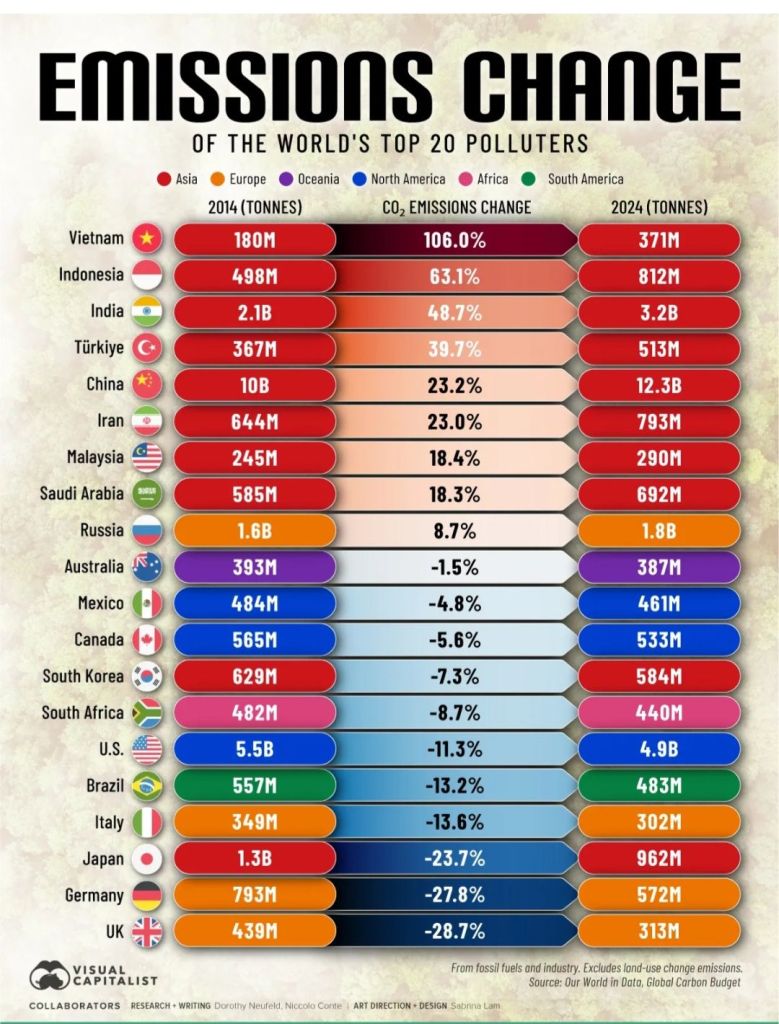
According to newly published international emissions figures, Britain reduced its carbon dioxide emissions from 439 million tonnes in 2014 to just 313 million tonnes in 2024 , a fall of 28.7 per cent over a single decade.[1]
By international standards, that is extraordinary. Among the world’s major industrial economies, few have cut emissions at anything close to that pace. On paper, Britain has delivered exactly what climate campaigners, policymakers, and successive governments demanded.
And yet, outside Westminster briefing rooms and international climate conferences, the national mood tells a different story entirely.
Households are still facing some of the highest electricity prices in the developed world. Heavy industry continues to contract. Energy-intensive sectors, from steel to chemicals to advanced manufacturing, face mounting competitive pressures. Communities that once built, mined, forged, and exported now increasingly watch production move overseas while being told this represents progress. It is hardly surprising that many people are beginning to ask a difficult question: if Britain has cut emissions so aggressively, why does the country feel economically weaker rather than stronger?
The answer may lie in what these emissions statistics do,and do not , measure.
Britain’s official carbon figures record emissions produced within UK borders. They measure what leaves British power stations, British factories, British transport systems, and British industrial sites. What they do not fully capture are the emissions embedded in the goods Britain increasingly imports. Steel produced overseas. Solar panels manufactured in Asia. Battery storage systems assembled in foreign supply chains. Components, machinery, electronics, chemicals, and industrial products that Britain once had greater capacity to produce domestically are now often sourced from countries with far higher carbon intensity.
This is not necessarily decarbonisation in the pure sense. In many cases, it may simply be carbon relocation.
While Britain has spent years driving down domestic emissions, the rest of the world has not stood still. India increased emissions by nearly 49 per cent over the same period.[2] China, already the largest emitter on Earth, increased emissions by over 23 per cent.[2] Vietnam more than doubled its output. Indonesia saw emissions surge by over 60 per cent.[2] In other words, while Britain was dismantling parts of its industrial base in pursuit of climate targets, global emissions continued rising elsewhere.
That raises a deeply uncomfortable possibility: Britain may have reduced emissions at home while paying other nations to produce the same carbon-intensive goods abroad.
If that is true, then the economic consequences are profound. British workers lose jobs. Domestic tax revenues fall. Strategic industrial capacity weakens. Supply chains become dependent on imports. Energy security becomes more fragile. Yet the environmental gain, on a global scale, becomes far less certain. Emissions may disappear from Britain’s ledger while continuing elsewhere in the world , often at higher carbon intensity than if those goods had been produced here.
Even Britain’s own consumption-based emissions accounts suggest the picture is more complicated than politicians often admit. The Office for National Statistics has repeatedly shown that when imported emissions are included, Britain’s true carbon footprint is significantly higher than the territorial figures commonly used in political debate.[3]
That matters because Britain now accounts for less than one per cent of global CO₂ emissions.[4] Yet despite contributing such a small share of the world’s total, British consumers continue to absorb the rising costs of decarbonisation , through energy bills, network charges, balancing costs, renewable support mechanisms, and billions of pounds of infrastructure investment.
So the public has every right to ask what exactly all this sacrifice was for.
If Britain had cut emissions while lowering bills, strengthening industry, creating resilient domestic supply chains, and improving energy security, the case would be easier to defend. But if emissions have simply been displaced abroad while communities here carry the economic pain, then the policy deserves far more scrutiny than it has received.
Because climate leadership is one thing.
Industrial self-harm disguised as leadership is something very different.
Footnotes
[1] Visual Capitalist, based on emissions data from Global Carbon Budget.
[2] Our World in Data, national CO₂ emissions database.
[3] Office for National Statistics, UK consumption-based greenhouse gas emissions accounts.
[4] UK territorial emissions versus global annual CO₂ emissions, latest international estimates.
Shane Oxer. Campaigner for fairer and affordable energy
 SAY NO TO THE DESTRUCTION OF OUR LAND
You must be logged in to post a comment.