Repeal Net Zero and the Climate Change Act Now  The True Cost of Britain’s Energy Policy

The Future Must Be Built on Reality
Affordable energy drives growth. Reliable energy underpins security.
A sustainable future requires both , not one at the expense of the other.

https://petition.parliament.uk/petitions/756685

Britain Is Paying the Price
Across the country, households and businesses are feeling the consequences of decisions made years ago under very different assumptions.
Energy bills have surged. Standing charges have soared. Businesses face some of the highest electricity costs in the developed world.
The promise was cheaper, greener power. The reality for many has been rising costs and growing uncertainty.
Energy policy is no longer an abstract debate — it is a cost-of-living issue affecting every family and every employer.

A Policy Locked Into Targets , Not Reality
The Climate Change Act created legally binding carbon targets that effectively removed flexibility from future governments.


Instead of adapting to changing economic conditions or technological realities, policy has been driven by the need to meet targets regardless of cost.


Net Zero has become a framework that prioritises compliance over practicality , forcing rapid transformation without always considering affordability or infrastructure readiness.
The Hidden Costs of the Energy Transition
Behind the headlines lies a massive infrastructure challenge.
The electricity grid must be rebuilt to accommodate large volumes of intermittent generation, requiring new pylons, substations, transformers, converters, and balancing systems.
These costs ultimately fall on consumers through bills and taxes.
What is often presented as a simple transition is, in reality, one of the largest infrastructure programmes in modern British history.

The growing support for this petition signals that many believe the time has come to rethink assumptions, restore balance, and put practicality back at the heart of energy policy.


Shane Oxer — Campaigner for fairer and affordable energy


Comments

4 responses to “Repeal Net Zero and the Climate Change Act Now  The True Cost of Britain’s Energy Policy”

  1. Alan Husband avatar
    Alan Husband

    so how are you going to produce this energy and using what fuel, and from where will you get the fuel?

    Like

    1. You ask a fair question — how would we actually produce the energy, using what fuel, and where it would come from.
      My position is straightforward.
      The UK should prioritise nuclear power, particularly Small Modular Reactors (SMRs) such as those being developed by Rolls-Royce. Nuclear provides reliable baseload electricity, operates regardless of weather, and has one of the lowest lifecycle carbon footprints of any energy source. It is proven, scalable, and can be built close to existing grid infrastructure.
      Alongside nuclear, we must continue to use domestic gas generation as a transition fuel. Gas plants are dispatchable, flexible, and essential for maintaining grid stability, especially during winter peaks when demand is highest and renewable output is lowest. Phasing out gas before viable alternatives exist risks supply insecurity and higher costs for consumers.
      On renewables, it’s important to be honest about the full lifecycle. Wind turbines, solar panels, batteries, and associated infrastructure are manufactured, transported, and installed using significant amounts of steel, concrete, plastics, and petrochemical products. They are not “zero impact” technologies, and they require backup generation and grid balancing — which currently relies heavily on gas.
      This doesn’t mean renewables have no role, but it does mean they are not a complete solution on their own, particularly in a country with highly seasonal demand like the UK.
      The realistic path to affordable and secure energy is therefore:
      • Nuclear (SMRs and large reactors) as the backbone
      • Gas as the stabilising transition fuel
      • Renewables where appropriate, but not at the expense of farmland, reliability, or affordability
      Energy policy should be driven by engineering reality, not slogans.

      Like

      1. Alan Husband avatar
        Alan Husband

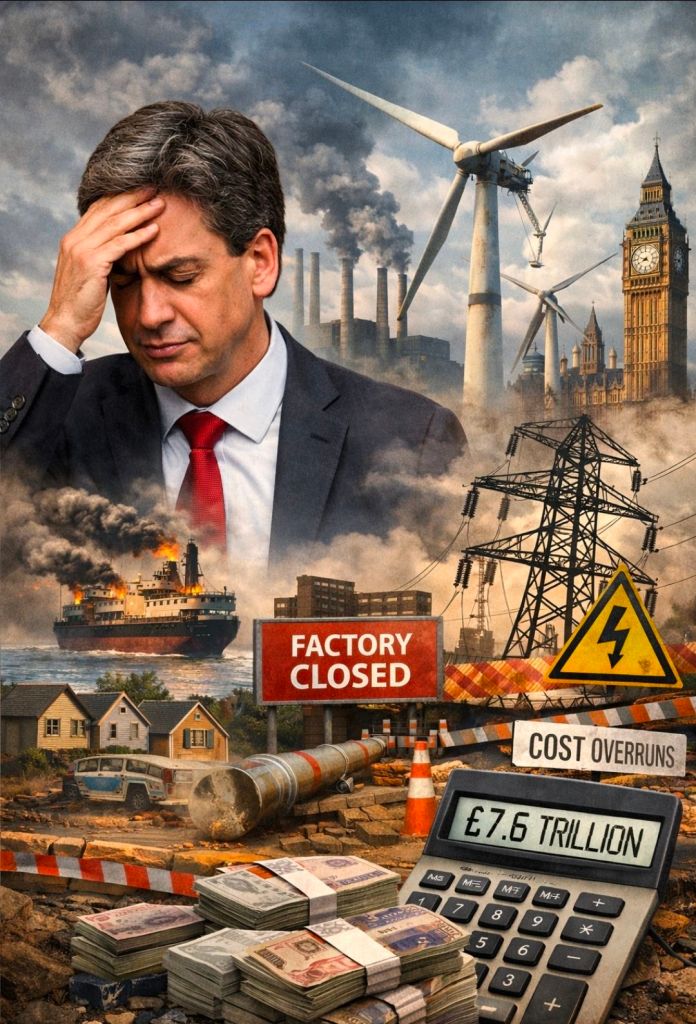
        That’s fair enough. So what is the significance of the AI image showing a ship belching out smoke, a rusty looking wind generator, smoke billowing from chimneys, American style houses and a strange car with what looks like bullet holes, and all the other signs and images which bear no connection to how things are? This is just a sort of ‘scare tactic’ to make things look worse than they are!
        If you’re going to use AI to produce your posters then at least make them realistic!

        Like

      2. I understand your point, and to be clear — the image isn’t meant to be a literal snapshot of Britain today.
        It’s a visual illustration of the wider global reality behind the energy transition — the mining, heavy industry, shipping, manufacturing, and infrastructure that sit behind the technologies we’re told are “clean”. Those impacts often happen out of sight, but they are very real.
        The point isn’t to scare people, it’s to remind us that energy policy has consequences across the whole supply chain, not just at the point of generation.
        No energy system is impact-free — whether that’s fossil fuels, nuclear, or renewables — and we should be honest about that when having this debate.
        If the image sparked discussion, then it’s done its job, because this is exactly the kind of conversation we should be having — grounded in reality, evidence, and engineering rather than slogans.

        Like

Leave a reply to Sh4ne024 Cancel reply