The climate change debate in Parliament on 19 March 2026 should have been an opportunity for honesty.
At a time when households are under sustained financial pressure, industry is struggling, and questions around energy security are becoming more urgent, the country deserved a serious and open discussion. Instead, what unfolded in the Commons was something far more concerning:
the absence of meaningful debate itself.[1]
For many watching, the exchange lacked the fundamental ingredients of democratic scrutiny. There was little engagement with the real-world consequences of current energy policy , no sustained examination of cost, no serious challenge on efficiency, and no detailed consideration of long-term security.
Instead, the discussion remained confined to broad targets, political consensus, and reaffirmations of existing commitments.
The result was not a debate, but a reinforcement of an already established narrative.[1]
This detachment from reality is becoming increasingly difficult to ignore.
Across the United Kingdom, households continue to face rising energy costs, with many forced into difficult decisions about heating and daily living expenses. Fuel poverty remains a persistent issue, and the gap between political messaging and lived experience is widening.
At the same time, industrial pressures are mounting, with energy-intensive sectors facing higher operating costs and increasing uncertainty about long-term viability.The public is entitled to ask fundamental questions:
what is the true cost of the current energy transition, how efficient is it in practice, and does it genuinely enhance national resilience?
These are not abstract concerns. They go to the heart of economic stability, national security, and the basic functioning of society.
A central issue that remains largely unaddressed in Parliament is the growing reliance on intermittent energy sources, particularly solar generation. While often presented as a cornerstone of future energy supply, solar power is inherently limited by seasonal variation.
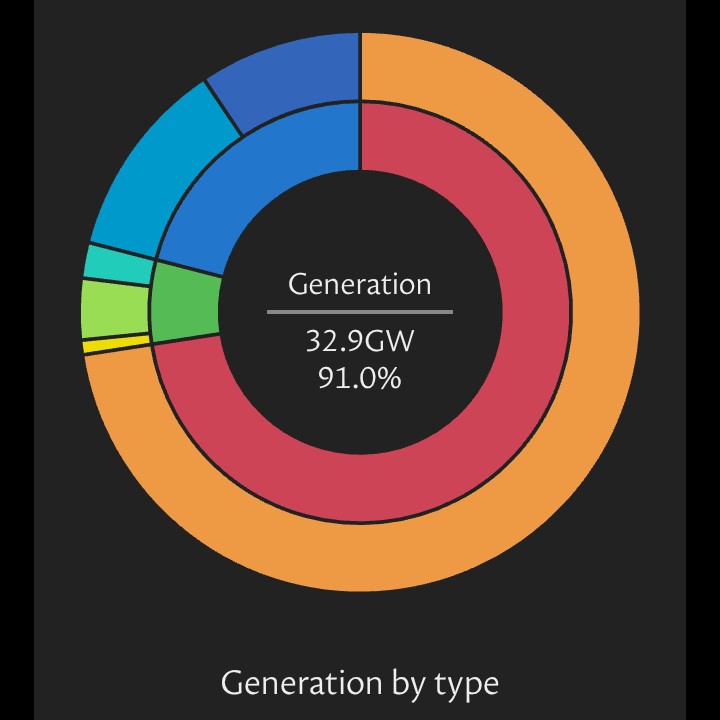
During winter months , when demand is at its highest , solar output is at its lowest. This creates an unavoidable dependency on alternative sources of generation, most notably gas, to ensure system stability and meet demand.[2]
This is not a marginal technical detail, but a structural reality of the electricity system. Despite years of investment, expansion, and policy support for renewable infrastructure, gas continues to play a dominant role in maintaining supply, particularly during peak periods. The implication is clear: the current approach does not replace existing systems but layers additional complexity and cost on top of them. Consumers are therefore funding multiple overlapping systems , generation, backup, balancing, and grid reinforcement , rather than a single, efficient solution.[2]
It was in this context that one contribution stood out.
Harriet Cross was among the very few Members of Parliament willing to step outside the prevailing consensus and address these underlying issues. Her intervention acknowledged concerns around affordability, energy security, and economic impact , topics that were otherwise largely absent from the wider discussion.[1]
At a time when many contributions remained within the bounds of established policy positions, her willingness to raise difficult questions demonstrated both realism and independence. It is precisely this kind of scrutiny that is essential if Parliament is to fulfil its role effectively.
Following the debate, I wrote to thank her for that contribution:
Dear Harriet Cross MP,
I wanted to write and thank you for your contribution in the Commons climate change debate on 19 March 2026.
To many watching, this was barely a debate at all. That is why your intervention mattered. You were one of the very few voices prepared to challenge the consensus and raise the issues that affect ordinary people most:
affordability, energy security, industrial decline and the real cost of current policy.
The country cannot go on pretending there are no consequences. Job losses are increasing, fuel poverty remains entrenched, and more households are being forced into a heat-or-eat dilemma. While ministers and campaigners speak in targets and slogans, many families are living with the direct financial burden of decisions made in Westminster.
The minimum that should now be happening is a proper and honest debate on costs and efficiencies. The public have every right to ask what this transition is really costing, how efficient it truly is, and whether it is making Britain more secure or more exposed.
There also needs to be honesty about the overreliance on solar. However it is presented politically, solar generation cannot provide what the country needs during the winter months, when demand is highest and sunlight is lowest. That guarantees the ongoing requirement for gas generation to underpin the system through winter, yet this basic reality is too often ignored in Parliament.
Thank you for refusing to go along with groupthink and for speaking with realism and courage.
Please continue pressing for a serious national discussion on affordability, efficiency, security and the damage being done to jobs, households and industry.
Yours sincerely,
Shane Oxer
This episode highlights a deeper issue than any single policy decision. It raises fundamental questions about how decisions are being made, how scrutiny is being conducted, and whether Parliament is still functioning as a forum for genuine debate.A functioning democracy depends not on unanimity, but on challenge. It requires the testing of assumptions, the examination of consequences, and the willingness to confront uncomfortable truths. When those elements are missing, policy risks becoming detached from reality, and public trust begins to erode.That erosion is already visible. People are not only feeling the effects of policy decisions in their energy bills, but also witnessing broader changes in their communities , from the loss of productive farmland to the increasing pressure on rural landscapes and local economies. These are not isolated developments. They are interconnected outcomes of a wider policy direction that has not been fully examined in public.
The role of Parliament should be to bridge that gap between policy and reality. That requires open discussion, transparency, and the inclusion of diverse perspectives. It requires acknowledging not only the intended benefits of policy, but also its limitations and unintended consequences.
The debate on 19 March demonstrated how far there is to go in achieving that standard. Yet it also showed that individual voices can still make a difference.
Britain does not lack the capacity for serious discussion. What it requires is the willingness to have it.
🔗 Further ReadingFull debate (Hansard):
Support the HOPE campaign:
👉 https://gofund.me/634c833bf
📌 Footnotes
[1] UK Parliament Hansard, Climate Change Debate, House of Commons, 19 March 2026.
[2] National Grid ESO, Daily Electricity Generation Data and System Balancing Requirements (2026).
✍️ AuthorShane Oxer. Campaigner for fairer and affordable energy
 SAY NO TO THE DESTRUCTION OF OUR LAND
Leave a comment