Across Yorkshire and the Humber, a serious problem is being hidden in plain sight.
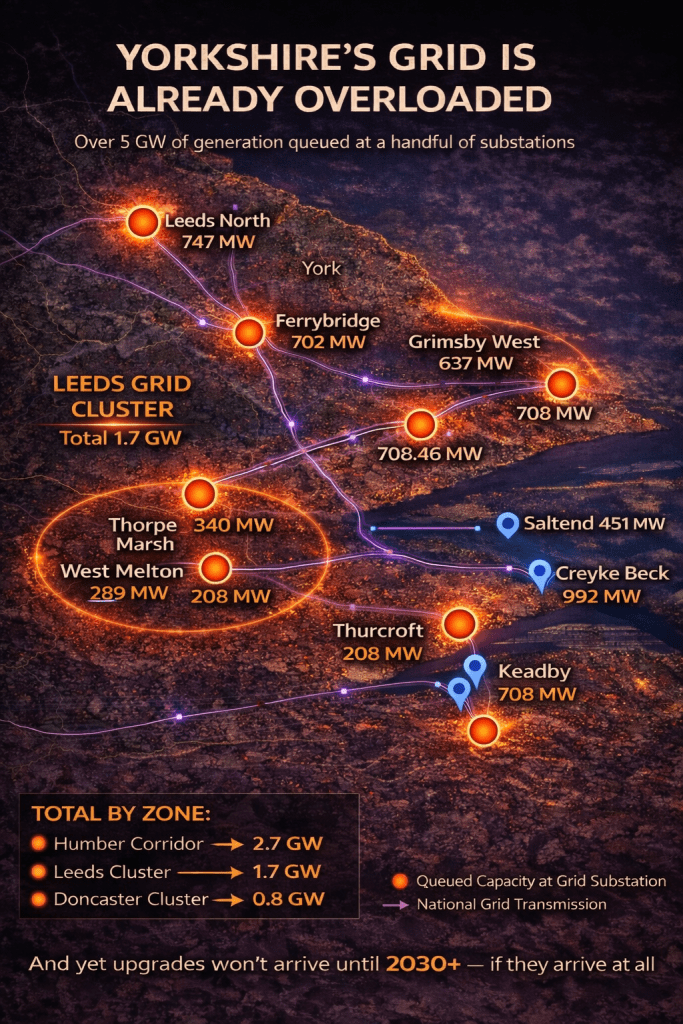
More than 5 gigawatts of electricity generation is already queued at a handful of substations across the region.
Leeds North, Ferrybridge, Thorpe Marsh, Keadby, Creyke Beck and Saltend are all carrying major volumes of pending generation, yet the grid reinforcements needed to accommodate that power are not expected until 2030 or later.
That should stop the current rush in its tracks.
Instead, the opposite is happening.
Across Yorkshire, more solar farms, battery sites and related infrastructure are being approved on farmland and open countryside, even though the physical network they depend on is already under intense strain.
This is not strategic planning.
It is policy running ahead of engineering reality.
The public is constantly told that these schemes are urgent, necessary and in the national interest. But what exactly is the national interest in approving generation that the grid cannot properly absorb?
That is the question ministers, planners and developers keep avoiding.
A grid-first problem being treated as a planning afterthought
The issue is not merely that the grid needs strengthening. Every energy system requires reinforcement over time. The real issue is that development is being pushed forward before the infrastructure exists to support it.
That means projects are being approved into a system that cannot deliver, their promised output in full, or in some cases for years. It means communities are losing land now, while the supposed benefit is deferred, uncertain, or dependent on future upgrades that remain years away.
This is especially serious in Yorkshire because the pressure is not spread evenly. It is concentrated.
The Leeds cluster alone accounts for roughly 1.7 GW.
The Doncaster / Rotherham corridor adds another 0.8 GW.
The Humber corridor, across both north and south banks, exceeds 2.7 GW.
These are not small numbers. They represent the stacking of major generation at a limited number of nodes, creating bottlenecks that increase the risk of constraint, delay, and inefficiency.
In plain English, too much is being pushed into the same places at once.
The hidden cost nobody wants to discuss
When the grid cannot take the power, generators are often curtailed. In other words, electricity is available but cannot be fully transmitted because the system lacks capacity.
That creates one of the great absurdities of modern energy policy: consumers can end up paying for projects to be built, and then paying again when those projects cannot operate as intended.
This is not just a technical inconvenience. It is a financial and political scandal.
Consumers ultimately carry these costs through bills, standing charges, balancing costs and wider system inefficiencies. Yet the public debate remains stuck at the level of slogans. Build more renewables. Go faster. Approve more sites.
But faster towards what?
If the network is already overloaded, then approving more intermittent generation ,without the necessary transmission backbone is not progress. It is congestion by design.
Farmland is being sacrificed without guaranteed benefit
This is where the issue becomes impossible to ignore.
Yorkshire is not just losing grid headroom. It is losing land.
Large areas of productive farmland are being converted for projects whose output may be constrained by the very system used to justify them. Communities are being asked to accept landscape change, industrialisation of open countryside, habitat disruption, and the loss of agricultural use, all on the promise of energy gains that may be delayed or diluted by grid reality.
That is a double injustice.
First, the countryside is changed now.
Second, the claimed system benefit may not materialise when promised.
In any other area of infrastructure policy, this would provoke serious scrutiny. If roads were approved with no route to connect them, or reservoirs built without pipelines, the obvious question would be asked: why are we building this before the network is ready?
Energy policy deserves the same standard.
This is not anti-energy. It is anti-chaos.
There will be those who try to dismiss this criticism as opposition to renewable energy itself. That is lazy and dishonest.
The issue is not whether Britain needs power. It does.
The issue is not whether the grid needs investment. It does.
The issue is whether development is being sequenced intelligently. It is not.
A rational system would start with infrastructure reality, assess network capacity honestly, and only then align generation accordingly. What we have instead is a politically driven rush to approve visible projects, while the less glamorous but essential work of grid readiness lags behind.
That is how you end up with a policy that is expensive, disruptive and inefficient all at once.
Yorkshire is warning the rest of the country
What is happening in Yorkshire and the Humber is not a local anomaly. It is a warning.
It shows what happens when national ambition is imposed without sufficient regard for regional infrastructure limits. It shows what happens when planning policy, energy targets and transmission reality drift apart. And it shows how easily rural communities can be treated as expendable in the process.
Yorkshire’s grid is not preparing for overload.
It is already overloaded.
And until policymakers admit that simple fact, the public will continue to be sold a version of events that engineering reality does not support.
The question is no longer whether the strain exists.
The question is why, knowing that it exists, they are still pressing ahead as if it does not.
Read more and support the campaign
Full campaign analysis:
https://reformdoncasteractionagainstnetzero.blog/2026/03/21/the-debate-that-wasnt-why-one-mp-stood-out-while-westminster-stayed-silent
Support HOPE:
https://gofund.me/634c833bf
Shane Oxer. Campaigner for fairer and affordable energy
 SAY NO TO THE DESTRUCTION OF OUR LAND
Leave a comment