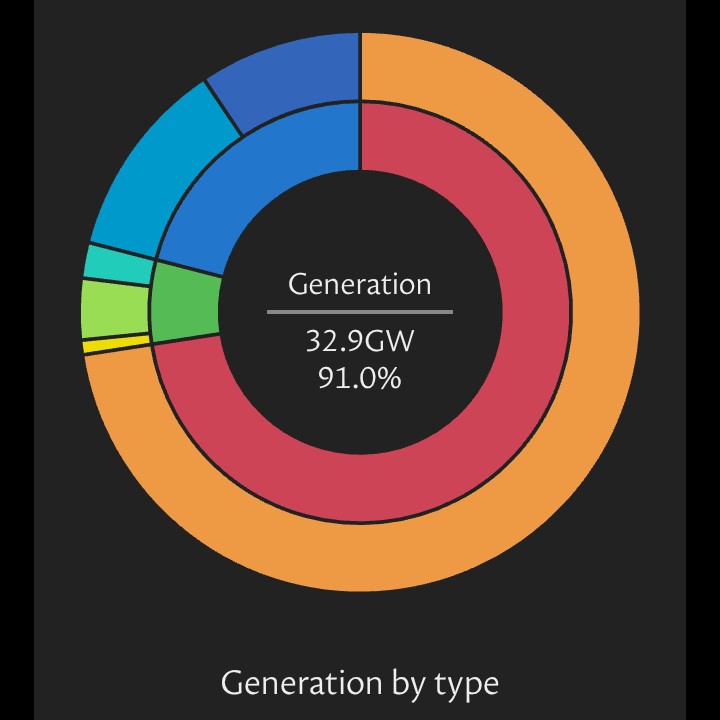
Britain may get its fossil-free Easter moment — but Ofgem’s own review shows key parts of the lower-inertia safety case are still not fully demonstrated.
Britain may yet get its Easter headline.
A short spell with no fossil-fuel generation on the system. A symbolic “first.” A neat Net Zero milestone.
But that is not the same thing as proving the grid is comfortably secure without gas.
It is a narrow operating window, likely helped by low holiday demand, favourable conditions and a system operator pushing the network further into lower-inertia operation. NESO’s own FRCR 2025 work is built around reducing the minimum inertia requirement and relying more heavily on fast-acting response services.
That is why the timing matters.
Because this Easter is not arriving under calm, textbook conditions. Forecasts for the northern half of the UK warned of gale-force winds over the Easter weekend, with gusts of 50–60 mph widely and up to 80–90 mph in some exposed western areas.
And that exposes the weakness in the headline.
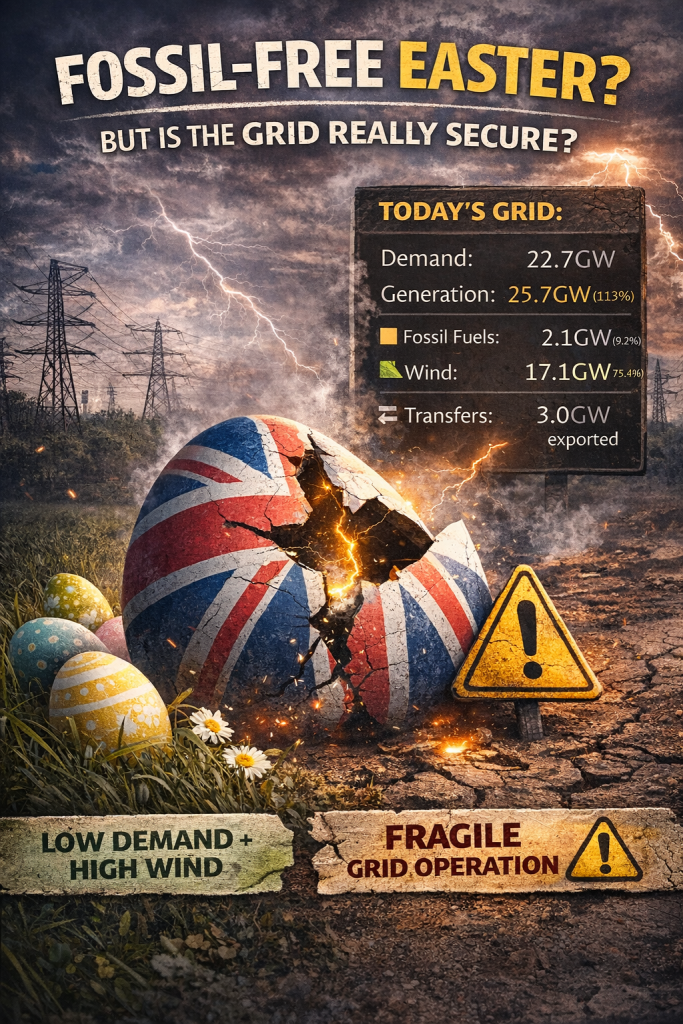
Wind turbines do not simply produce more and more power forever as wind speeds rise. In extreme conditions, turbines can adjust or switch off automatically to protect themselves. RenewableUK says this happens on a turbine-by-turbine or zonal basis during severe weather events.
So while the public is invited to celebrate a possible “fossil-free” Easter moment, the engineering reality is more complicated.
Some wind output may rise. Some may be constrained. Some turbines may reduce output or shut down locally if conditions become too severe. That is not an argument against wind existing on the system. It is simply a reminder that weather-driven generation is not the same thing as guaranteed system security.
And this is where the real issue begins.
NESO is not merely observing the system. It is actively trying to operate it differently.
Its Frequency Risk and Control Report 2025 proposed lowering minimum system inertia from 120 GVA.s to 102 GVA.s, while relying on additional Dynamic Containment-Low to manage the risks and reduce costs. In plain English, that means less traditional spinning support and more dependence on modelling, assumptions and ultra-fast response services.
That might be workable.
But Ofgem’s own independent review did not give that approach a clean bill of health.
The review said the FRCR follows a sound general approach to risk management, but also said it depends on simulations, probability estimates and cost appraisals while lacking detailed validation and using a simplified frequency model that may overlook local issues affecting protection schemes and distributed generation. It concluded that, while reduced inertia may not significantly increase risk, the evidence was still not sufficient to give stakeholders full confidence.
That is the point that should concern everyone.
This is not a case of the regulator saying, “Everything is proven. Carry on.”
It is a case of the regulator’s own commissioned reviewer saying, in effect: the idea may be workable, but the supporting evidence is still not robustly demonstrated in some critical areas. �
Those critical areas are not minor technical footnotes either.
The review specifically called for clearer simulation validation, better transparency around probabilities and system parameters, an update on Low Frequency Demand Disconnection, and more evidence on how the new arrangements behave under real-world conditions.
Ofgem itself then went further. In its consultation outcome, it said it was unable to reach a definitive conclusion on FRCR 2025 at that time and requested further information from NESO.
That should have stopped the Easter triumphalism in its tracks.
It proves only that, for a brief interval, the operator may be able to hold the system together without fossil generation actually running.
That is a much narrower claim.
And a much less impressive one.
The public is being encouraged to read this as a historic breakthrough. But the more accurate reading is that NESO is trying to stretch a lower-inertia, model-led operating approach far enough to deliver a symbolic result — while the regulator is still asking for more evidence behind the safety case.
That is why this matters politically as well as technically.
Because once you strip away the press-release language, what remains is a system operator pursuing a lower-cost, higher-renewables operating model, even though key uncertainties remain under active regulatory scrutiny.
And if that gamble works for a few Easter hours, it will generate headlines.
If it does not, the public will discover very quickly that slogans about “fossil-free firsts” are no substitute for hard engineering margins.
Britain does need a modern electricity system.
It does need innovation.
It does need new technologies.
But it also needs honesty.
A weather-assisted Easter milestone is not proof that the grid’s deeper stability questions have been settled. It is not proof that gas-era system functions have been fully replaced. And it is certainly not proof that modelled confidence is the same thing as real-world resilience.
That is the real Easter story.
Not that Britain has conquered the laws of power engineering.
But that NESO appears willing to gamble on a symbolic moment before the evidence base is fully convincing.
Shane Oxer. Campaigner for fairer and affordable energy
 SAY NO TO THE DESTRUCTION OF OUR LAND
Leave a comment