There is one question at the heart of modern climate politics that almost nobody in the political class wants to answer honestly.
If governments, international bodies and climate elites truly believe we are living through an immediate, existential emergency, why do they behave as though constant air travel, summit tourism, and media spectacle are still perfectly acceptable? �Climate Action UNFCCC
That is not a minor contradiction.
It goes to the heart of credibility.
The same institutions that tell ordinary people to change how they heat their homes, drive their cars, eat their food and live their lives still preside over a culture of mass aviation growth, globe-trotting conferences and carbon-intensive diplomatic theatre. And if this were really being treated as a genuine emergency in the way wartime or pandemic threats are treated, that model would have been abandoned years ago. �Climate Action UNFCCC +2
Britain is under 1% , yet aviation keeps growing
There is an even deeper contradiction at the heart of this debate.
The United Kingdom now accounts for less than 1% of global CO₂ emissions, yet the same political class that lectures the public about sacrifice continues to indulge one of the most carbon-intensive and fast-growing sectors in the world:
aviation. At the same time, international aviation is often treated differently in national accounting than territorial emissions, which helps obscure the scale of the problem in political debate. �
GOV.UK
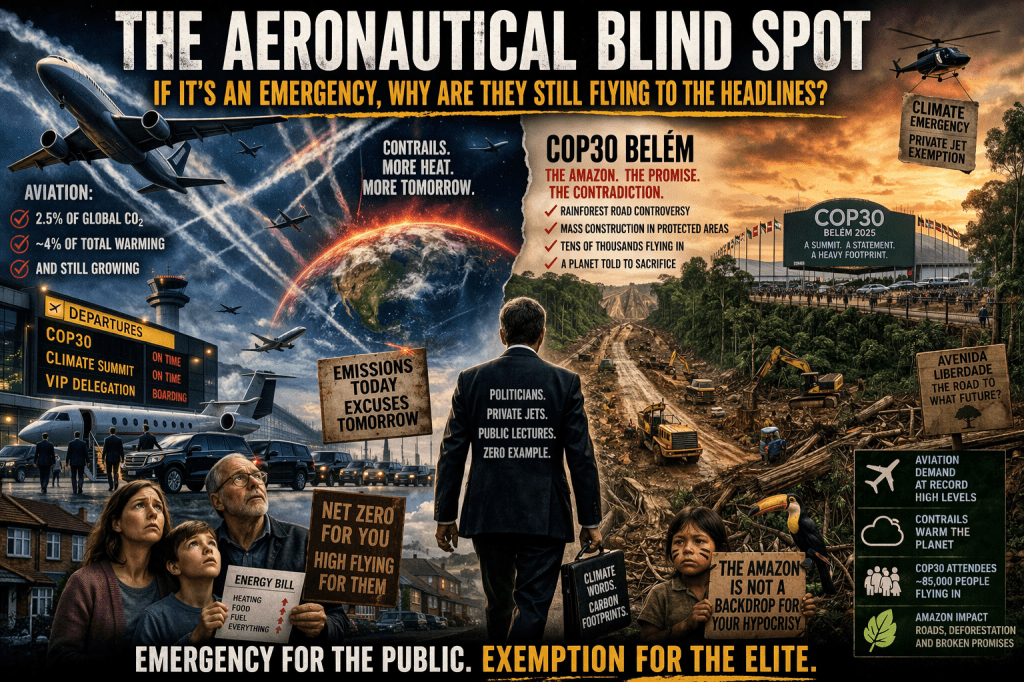
That matters because aviation is not some trivial side issue. Aviation accounts for roughly 2.5% of global CO₂ emissions, but its total contribution to warming is higher , around 4% of global warming to date , once non-CO₂ effects such as contrails and induced cloudiness are included.
So the public is pushed to obsess over shaving fractions from Britain’s already diminished share of world emissions, while the international conference circuit, summit culture and aviation-heavy political class continue expanding a sector whose climate impact is globally significant and still growing. That is the real blind spot. �GOV.UK.
Aviation is not a side issue anymore
Aviation is often spoken about as though it were a small corner of the emissions debate. That is misleading.
Flying is among the most emissions-intensive activities a person can do, and aviation’s climate impact extends beyond fuel burned between departure and arrival. Aircraft emissions at cruising altitude also affect atmospheric chemistry and cloud formation. That means aviation is not only a CO₂ issue. It is also an upper-atmosphere forcing issue.
This is exactly why the sector’s warming impact is larger than its CO₂ share alone would suggest. Contrails and other non-CO₂ effects are not fringe concerns. They are central to the aviation debate.
The growth is relentless
The deeper problem is that global aviation is not shrinking. It is growing.
IATA reported that total full-year passenger traffic in 2024 rose 10.4% compared with 2023 and was 3.8% above pre-pandemic 2019 levels, setting a new record. International traffic alone rose 13.6% year-on-year.
That matters because it exposes a profound policy contradiction. For years, the public has been told that decarbonisation requires deep sacrifice and urgent behavioural change. Yet one of the most carbon-intensive and atmospherically disruptive sectors continues to expand globally, and the political system largely treats that expansion as normal, even desirable.
You cannot keep telling people the house is on fire while adding more flights to the runway.
Britain is told to cut back while aviation gets a pass
This contradiction becomes even harder to ignore when you look at the UK itself.
The UK government’s Annual Statement of Emissions for 2024 says that international aviation emissions rose from 33.3 million tCO2e in 2023 to 36.2 million tCO2e in 2024. It also states that these emissions are reported separately from the UK’s territorial totals under the Climate Change Act framework. �
GOV.UK
So ordinary people are told there is no room for delay, no room for comfort, and no room for dissent , yet a major and growing source of emissions tied to international movement, conferences and elite travel sits partly outside the political storytelling used to discipline the public. That is not clarity. It is selective emphasis. �
GOV.UK
Contrails are real, and they are part of the problem
One reason aviation deserves more attention is that its climate impact is not confined to exhaust gases alone.
Aircraft create contrails, and those contrails can evolve into contrail cirrus that trap heat in the atmosphere. This is one of the reasons aviation’s contribution to warming is larger than its CO₂ share by itself.
The best current public synthesis is straightforward: aviation is about 2.5% of global CO₂ emissions, but about 4% of warming to date once non-CO₂ effects are counted.
So governments and climate institutions can not honestly claim ignorance here. They know aviation has an added warming effect beyond straightforward fuel combustion. They know the sector’s footprint is amplified by what happens at altitude. And yet they continue to build policy theatre around conferences and summit culture that depend on exactly this kind of long-distance, prestige-heavy travel. �
Climate Action UNFCCC +1
COP has become a carbon contradiction
Nothing captures this better than the COP process.
Climate summits are sold as proof of seriousness. In reality, they increasingly look like a ritual of excess: tens of thousands of delegates, world leaders, advisers, campaigners, lobbyists, and media figures flying across the world to discuss cutting emissions. The public is expected to believe two things at once: first, that climate change is so urgent that daily life must be reorganised from the top down; and second, that the people delivering this message must continue to circle the globe in a permanent conference circuit to discuss it. That is not seriousness. That is performance. �
Climate Action UNFCCC +1
COP30 proved the point
COP30 was supposed to symbolise climate seriousness. Instead, it exposed the contradiction.
The UN climate conference was held in Belém, Brazil, from 10 to 21 November 2025. The official UNFCCC pages confirm the dates and location. �Climate Action UNFCCC +1
But in the run-up to the summit, Reuters reported heavy controversy around the city’s preparations, including major construction across Belém, accommodation shortages, and a rush to expand infrastructure for the arrival of world leaders and delegates. Reuters reported that over 30 public works were underway, including roads, parks, drainage systems, airport work, cruise piers and a “leaders village,” while hotel shortages and soaring prices created tensions between diplomats, the UN and Brazilian organisers. �Reuters
That is what makes COP30 such a powerful example for this argument. It was presented as an Amazon climate summit, yet the summit itself became associated with construction, transport pressure, aviation-heavy attendance and the visual contradiction of a vast international gathering descending on the rainforest in the name of saving it. Reuters also reported controversy over the Avenida Liberdade road near Belém, with critics linking it to COP30 preparations even as Pará state officials said the road predated the summit and was not a COP project. �Reuters
If the political class truly believed its own emergency rhetoric, COP30 would have been the moment to show restraint, reduce travel, minimise spectacle, and lead by example. Instead, it reinforced the opposite impression: emergency language for the public, exceptional treatment for the elite. �UNFCCC +1
If they really believed their own rhetoric, the behaviour would change
This is the point polite commentators usually avoid.
If governments and climate bodies truly believed the threat was as immediate and catastrophic as their public language suggests, they would behave very differently.
They would drastically reduce summit travel.
They would default to remote negotiation where possible.
They would restrict or heavily penalise private-jet access for climate conferences.
They would stop treating aviation growth as a symbol of prosperity while preaching austerity to everyone else.
They would prioritise the fastest, highest-leverage reductions in elite and discretionary flying. �Reuters
But they do not do those things.
Instead, aviation demand breaks records, air traffic continues growing, and climate politics carries on as a spectacle of movement, declarations, and exemptions. That does not prove climate change is unreal. It proves something politically more damaging:
The people at the top do not act as though their own declared emergency is binding on them. �Reuters
This is not leadership. It is one rule for them and another for everyone else
The issue here is not whether every plane can be grounded tomorrow. It is whether a political class that talks endlessly about emergency, behaves as though emergency standards apply to itself.
Clearly, it does not.
Ordinary people are told to insulate, retrofit, ration, switch, and pay more.
Meanwhile, the upper tier of climate politics continues to consume aviation as though it were an administrative necessity of moral leadership. That claim becomes harder to defend every year that digital communication improves and summit attendance balloons anyway.
There is a name for that sort of politics. It is not stewardship. It is indulgence. �UNFCCC +1
The aeronautical problem is not just technical. It is moral and political
Aviation’s growth is a scientific issue because it adds CO₂ and non-CO₂ warming.
It is an economic issue because the sector is expanding rapidly.
But , above all, it is a moral and political issue because it reveals the gap between proclaimed belief and actual conduct.
The elites of climate politics want the public to accept emergency language without emergency standards.
They want the symbolism of sacrifice without practising it themselves.
They want the headlines, the declarations, the motorcades, the pavilions, the airport lounges, and the flights.
If they were truly as alarmed as they say, they would not keep burning mass emissions in pursuit of another round of staged concern.
That is the aeronautical blind spot at the heart of climate politics.
And until it is confronted honestly, the public has every reason to question whether this is really about saving the planet , or simply about managing the narrative. �UNFCCC +1
The blunt truth
Britain is now under 1% of global CO₂ emissions. Aviation is roughly 2.5% of global CO₂ emissions, and about 4% of global warming to date once non-CO₂ effects are counted. Meanwhile, international aviation emissions linked to the UK rose again in 2024. �GOV.UK
Yet the public is told to sacrifice while the elite keep flying.
That is not climate leadership.
That is climate hypocrisy.
Shane Oxer. Campaigner for fairer and affordable energy
 SAY NO TO THE DESTRUCTION OF OUR LAND
Leave a comment