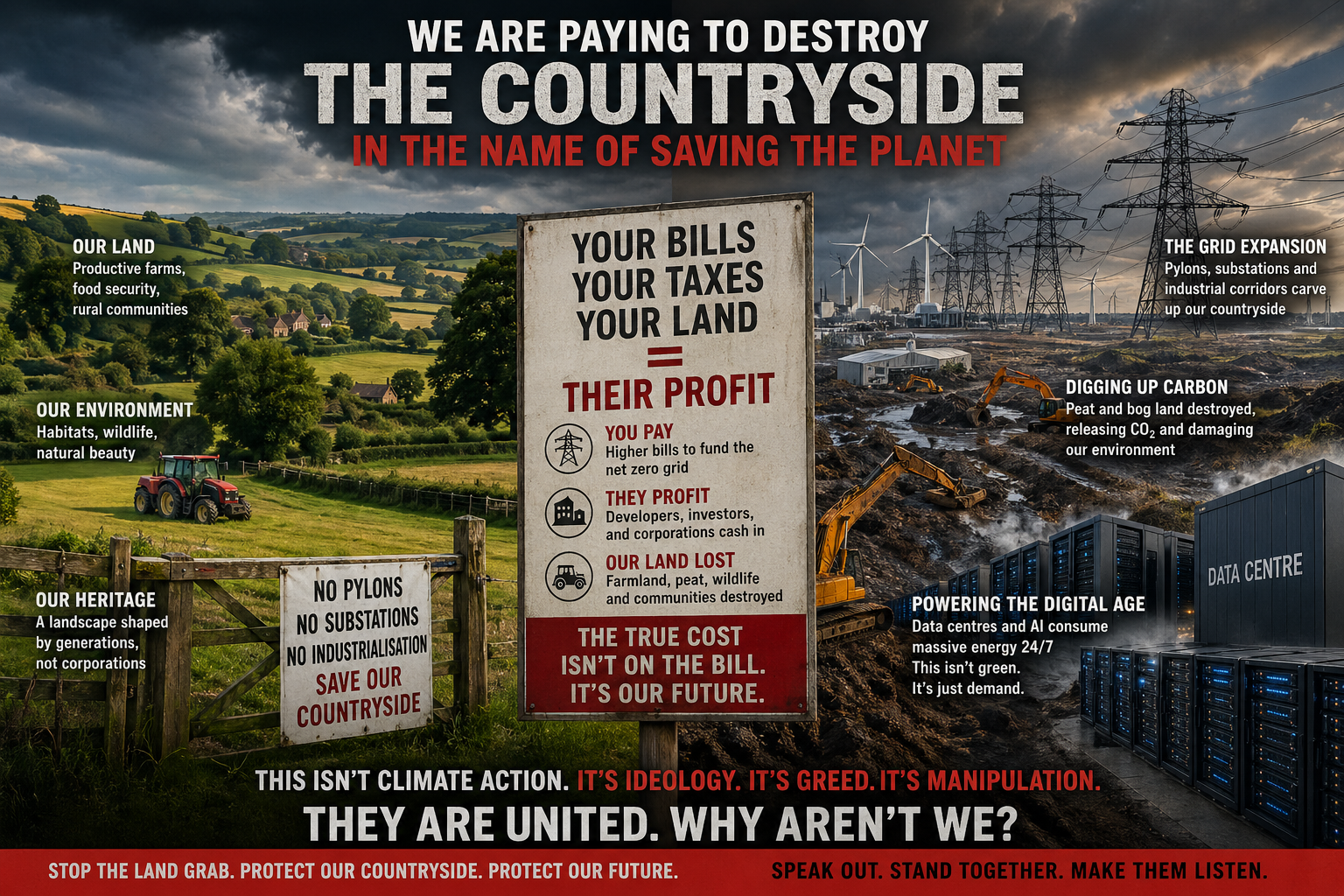
Across Britain, something is happening in plain sight, yet it is rarely described for what it is. Rural communities are fighting individual battles , against pylons, solar farms, substations, battery storage sites and new developments imposed on agricultural land. Each campaign is local. Each is treated as a separate issue. Each is told the same thing: this is necessary, this is national policy, this is for the greater good.
What is missing is the recognition that these are not isolated disputes. They are fragments of a much larger transformation, one that is reshaping the countryside at scale, and doing so under the banner of environmental policy while often producing outcomes that are anything but environmentally straightforward.
At the centre of this process is the legal and policy framework created by the Climate Change Act 2008. That Act, and the carbon budgets that followed it, established a binding pathway towards Net Zero emissions. In doing so, it created a system in which energy policy is driven by legally enforced targets, rather than by a broader balancing of competing national interests. The intention may have been to reduce emissions, but the effect has been to create a one-directional policy machine. Once targets are set, the system moves relentlessly towards them, regardless of the wider consequences.
Those consequences are now becoming visible.
The expansion of renewable energy and the electrification of the economy require an enormous increase in electricity generation and transmission. The existing grid was not designed for this. As a result, Britain is undergoing one of the largest infrastructure programmes in its modern history. Transmission lines are being upgraded from 275kV to 400kV, new substations are being constructed, and long-distance corridors are being established to move electricity from offshore wind and northern generation sites to inland demand centres.¹
This infrastructure is not being built in empty space. It is being built across farmland, through rural landscapes, and around communities that have had little say in the overall direction of travel. The planning system considers each project individually, but the cumulative effect is rarely addressed. What appears as a series of local developments is, in reality, a national restructuring of land use.
The scale of land involved is already significant and is likely to grow. Government-linked estimates suggest that around 500,000 acres may be required for renewable energy generation alone, including solar and onshore wind.² This figure does not include the land required for transmission infrastructure, substations, battery storage, or the industrial development that follows. Nor does it account for the indirect loss of productive land when farms are fragmented, access is restricted, and agricultural operations become less viable.
It is in this cumulative effect that the true impact lies. A single pylon route may be tolerable. A single solar farm may be manageable. But when multiple forms of infrastructure are layered across the same regions , transmission lines, substations, storage sites, industrial developments and housing the character of the land changes fundamentally. What was once countryside becomes part of an energy and infrastructure network.
And it is being paid for by the public.
The cost of grid expansion is recovered through energy bills, meaning that households and businesses fund the creation of this infrastructure.³ At the same time, the opportunities that follow , in the form of development, land value uplift, and industrial activity , are often captured by private investors and developers. This is not unusual in infrastructure economics, but the scale and speed of the current transition make the distribution of costs and benefits far more visible.
The argument presented to the public is that this transformation is necessary to protect the environment. Yet the reality on the ground is more complex. The construction of large-scale infrastructure involves the disturbance of soil, vegetation and ecosystems. In some cases, development encroaches on peatland and other carbon-rich environments, raising questions about whether short-term emissions reductions are being offset by long-term environmental damage.⁴ Agricultural land is removed or degraded, while the UK continues to rely heavily on imported food, increasing exposure to global supply risks.
At the same time, the electricity being generated and transmitted is not used solely for traditional purposes. A growing share of demand comes from energy-intensive digital infrastructure, particularly data centres. These facilities are essential to the modern economy, supporting cloud computing, artificial intelligence and digital services. But they require vast amounts of continuous power. Their environmental impact depends not only on the source of electricity, but on the scale of consumption.
This creates a paradox. Renewable energy is promoted as a way to reduce emissions, yet the expansion of energy-intensive infrastructure increases overall demand, driving further expansion of generation and grid capacity. The system feeds itself. More generation requires more grid. More grid enables more demand. More demand justifies more generation. The cycle continues, and with it, the pressure on land.
What is striking is that this system is not presented as a whole. There is no single document that sets out how energy infrastructure, housing growth, industrial development and land use will interact over the next twenty or thirty years. Instead, decisions are made in separate silos: energy policy at a national level, planning at a local level, investment through private markets. Each decision is justified on its own terms, but the combined outcome is rarely debated.
This fragmentation has consequences. It allows the overall scale of change to remain partially hidden, even as its effects become increasingly visible. It also means that opposition is fragmented. Communities resist individual projects, but they are often told that these projects are necessary parts of a wider system that cannot be challenged. Without a clear picture of that system, it is difficult to question it effectively.
Yet the pattern is now clear enough to be recognised.
Across Yorkshire, the East Midlands, and other regions, grid reinforcement aligns with areas of proposed growth. Former power station sites are repurposed as energy and industrial hubs. Transmission corridors become axes along which development clusters. Rural land is redefined not by its existing use, but by its
This is not a conspiracy. It is a system.
But it is a system that has not been openly explained.
And that matters.
Because the countryside is not an abstract concept. It is a finite resource that supports food production, biodiversity, and the character of the nation. Once it is transformed, it does not easily return to its previous state. The decisions being made now will shape the landscape for generations.
There is a growing sense, particularly in rural areas, that this transformation is being imposed rather than agreed. People see the changes around them, but they are rarely shown the full picture. They are asked to respond to individual proposals, not to the system that connects them. As a result, opposition remains localised, even as the process driving it is national.
That is beginning to change.
More people are starting to recognise that these developments are not isolated. They are part of a broader shift in how land is used and valued. They are beginning to ask not just whether a particular project is justified, but whether the overall direction makes sense.
This is where the debate needs to move.
The question is not whether Britain should reduce emissions or invest in its energy system. Those goals are widely accepted. The question is whether the current approach is the right one, and whether it adequately considers the full range of consequences.
Are we balancing environmental objectives against land use, food production and community impact?
Are we considering alternatives that might achieve similar outcomes with less disruption?
Are we being honest about the scale of change and who benefits from it?
These are not unreasonable questions. They are necessary ones.
Because if the current trajectory continues unchecked, the result will not simply be a cleaner energy system. It will be a fundamentally altered landscape, shaped by infrastructure, industry and development in ways that were never fully debated.
And by the time that becomes obvious, it may be too late to change course.
What is needed now is not simply opposition to individual projects, but a broader understanding of the system that connects them. The countryside is not being changed piece by piece by accident. It is being reshaped by a combination of policy, infrastructure and investment that operates at a national scale.
Recognising that fact is the first step.
The next is deciding what, if anything, should be done about it.
Shane Oxer. Campaigner for fairer and affordable energy
Footnotes
1. National Grid Electricity Transmission, Yorkshire Green Project documentation and Planning Inspectorate examination report; National Grid ESO, Beyond 2030 (2024).
2. UK Government and policy-linked estimates on renewable energy land requirements (solar and onshore wind deployment scenarios).
3. Ofgem regulatory framework and National Grid investment model for cost recovery through consumer bills.
4. DEFRA and Natural England guidance on peatland carbon storage and impacts of land disturbance.

 SAY NO TO THE DESTRUCTION OF OUR LAND
Leave a comment