By Shane Oxer — Campaigner for fairer and affordable energy
For years, the British public has been promised an energy revolution.
We were told that the transition to wind, solar, battery storage, and “smart flexibility” would deliver three things: cheaper bills, cleaner energy, and greater energy security. Politicians repeated it. Energy executives repeated it. Climate bodies repeated it. And much of the media repeated it.
Yet here we are in 2026, and instead of a nation enjoying cheaper, more resilient energy, households are facing rising bills, growing standing charges, mounting network costs, and now,astonishingly, a public debate about whether ordinary people might be willing to accept “the odd blackout” in exchange for lower costs.
That should stop every citizen in Britain in their tracks.
Because when the head of a major supplier like Octopus Energy publicly suggests that some consumers may tolerate occasional outages, the issue is no longer just about tariffs or technology.
It becomes a question of accountability.
Who Built This System?
For over a decade, influential voices across the energy sector have championed a rapid shift toward intermittent generation , primarily wind and solar, supported by batteries, flexible demand, digital balancing, and increasingly complex market mechanisms.
At the centre of that commercial revolution are businesses that have done exceptionally well.
Few have benefited more visibly than Octopus Energy,
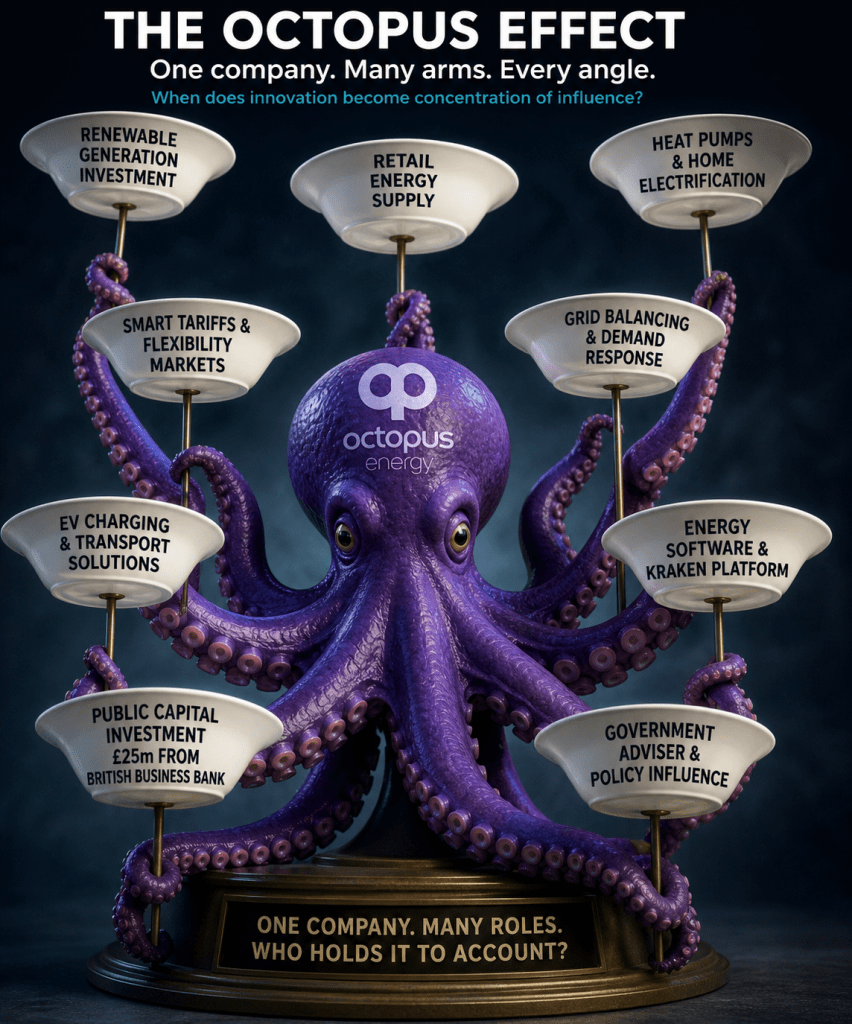

led by founder Greg Jackson. The company has grown into one of Britain’s largest suppliers, building its brand around smart tariffs, renewable integration, heat pumps, home batteries, electric vehicles, and flexibility markets.
That success is not the issue.
Success in business is not something to criticise in itself.
But when those who helped shape the system now appear to be asking whether the public might tolerate lower reliability, tougher flexibility measures, or lifestyle adaptation, people are entitled to ask a simple question:
If you helped shape the system, why are ordinary families being asked to lower their expectations?
Electricity Is Not a Lifestyle Product
Electricity is not a subscription service.
It is not a smartphone upgrade.
It is not a lifestyle choice.
Electricity powers:
home medical equipment
refrigeration for medicines
heating systems
communication networks
small businesses
farms
traffic systems
emergency response infrastructure
When the lights go out, consequences are real.
The widespread blackout across Spain and Portugal in 2025 reminded Europe what power failures actually mean:
No trains.
No traffic lights.
No ATMs.
No communications.
No certainty.
And in some tragic cases, loss of life.
So when executives suggest consumers may accept “the odd blackout,” it raises a deeper concern:
Have parts of the energy industry become so focused on cost models and market optimisation that they have forgotten what electricity actually means to ordinary people?
The Real Failure Is Not Renewable Energy,It Is System Design
This debate is often framed as “pro-renewables versus anti-renewables.”
That misses the real issue.
The issue is not renewable energy itself.
The issue is grid architecture.
If Britain had continued investing in:
flexible gas generation
modern nuclear baseload
domestic grid resilience
synchronous generation and system stability
while using wind and solar as a supplementary source, not the backbone of supply, would we even be having conversations about demand flexibility, curtailment, backup batteries, or whether the public should accept lower reliability?
Probably far less.
Instead, Britain increasingly finds itself trying to build an energy system around weather-dependent generation first, and engineering stability afterwards.
That is backwards.
Consumers Are Paying for the Experiment
Households are now paying not just for energy, but for:
transmission upgrades
substations
balancing services
curtailment payments
network reinforcement
capacity mechanisms
battery integration
system digitalisation
Consumers are being told the future is cheaper, while their bills keep rising.
At what point does the public stop being “customers” and start becoming financiers of a national experiment?
Accountability Matters
If you profit from a system…
If you promote a system…
If you influence policy around a system…
Then you should stand by its outcomes.
Not ask the public to lower expectations.
Not suggest blackouts are manageable because laptops have batteries.
Not imply vulnerable families can simply adapt.
Britain deserves better than that.
We deserve an energy policy built around:
reliability first
affordability second
sustainability through engineering,not ideology
Because the public was promised energy security.
Not managed decline.
And certainly not a future where power cuts become part of the conversation.
If you helped shape the system, you should be accountable for its consequences,not asking the public to lower their expectations.
Shane Oxer. Campaigner for fairer and affordable energy
 SAY NO TO THE DESTRUCTION OF OUR LAND
Leave a comment