There is a moment when a policy failure becomes too obvious to hide.
Britain has just reached it.
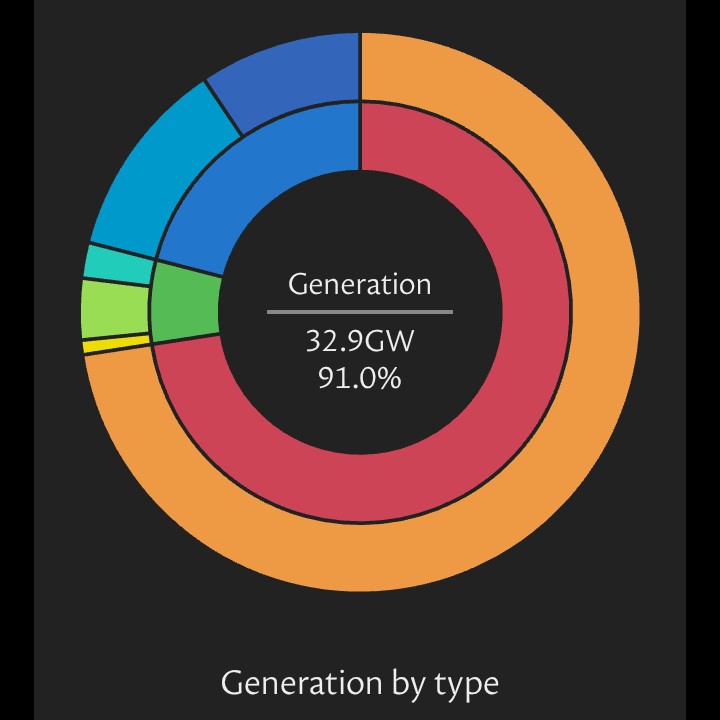
This week, we were told that households may soon be encouraged to use more electricity on sunny days , not because energy is suddenly abundant and cheap, but because the grid cannot cope with the volume of renewable power being produced.[1]
Let that sink in.
After years of being told that solar and wind would bring stability, affordability, and security, the country now faces the absurd reality of having to burn through excess electricity in summer to stop the system from overloading , while still worrying about shortages in winter.
This is not progress.
It is the exposure of a fundamental mistake.
Britain did not build an energy system based on engineering reality.
It built one based on political targets.
The truth ministers will not say
The problem is not that renewable energy exists.
The problem is that it has been deployed recklessly , approved faster than the infrastructure needed to support it, and sold to the public without honest disclosure of its limitations.
At the heart of this failure is a simple but devastating truth:
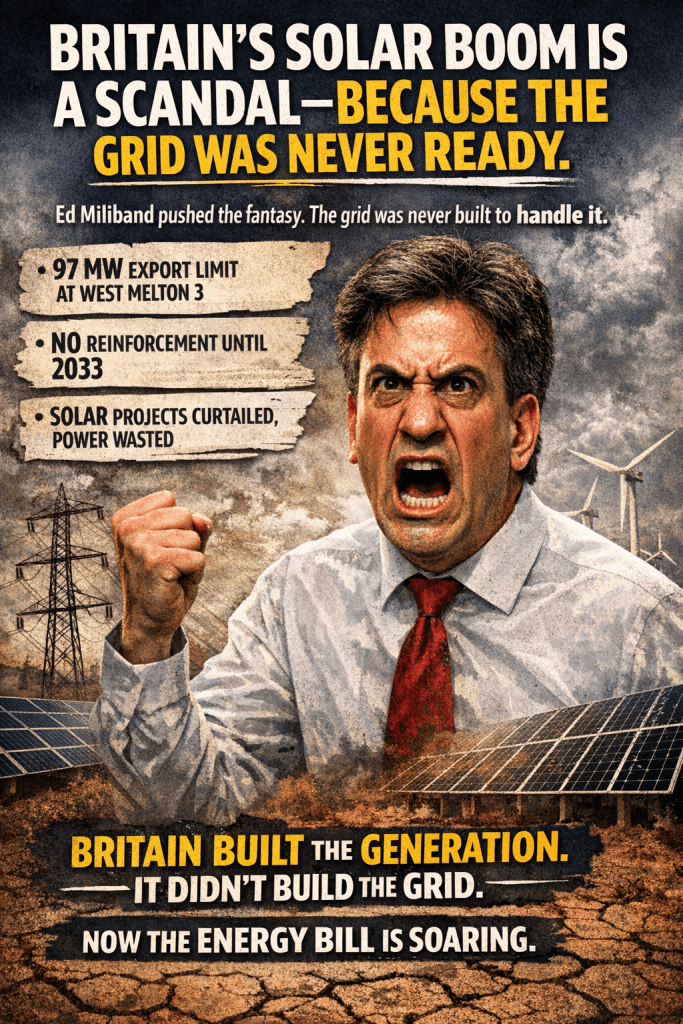
the grid was never ready.
Projects have been waved through on the assumption that connection equals delivery, that megawatts on paper equal electricity in homes, and that future upgrades will somehow catch up with present-day approvals.
They will not , at least not on the timescales being claimed.
Nowhere is that clearer than West Melton Section 3.
West Melton exposes the illusion
At West Melton Section 3, the numbers strip away the rhetoric.
The technical export limit is around 97 MW.[2]
Yet multiple projects , including 49.9 MW solar schemes and far larger battery developments , are already connected or accepted to connect into the same corridor.[3]
That is not expansion.
That is congestion.
And here is the crucial detail:
the reinforcement required to relieve that constraint is not scheduled until October 2033.[2]
October 2033.
That is nearly a decade away.
Yet schemes are still being presented today as if they will deliver immediate, meaningful energy benefit to the public.
How?
Through what network?
On what capacity?
These are questions that should be fatal to the planning case.
Instead, they are quietly sidestepped.
The great deception: capacity versus deliverability
This is how the system has been allowed to drift into absurdity.
Developers talk about installed capacity.
Politicians talk about targets.
Campaigners talk about decarbonisation.
But the only question that matters is the one that is almost never answered:
can the electricity actually get out?
At West Melton, the answer is increasingly conditional.
If the network is already operating at its limits, and if the upgrade needed to unlock real capacity is years away, then any new project connecting into that corridor is not delivering firm energy.
It is delivering conditional energy , dependent on curtailment, constraint, and system intervention.
In plain English, that means the generator may not be able to export freely when it produces power.
That is not a minor technical detail.
That is the difference between a working power station and a speculative one.
A system built on curtailment
This is why the latest “use more electricity” messaging is so revealing.
It is not about consumer empowerment.
It is about system stress.
When too much generation hits a constrained network, the system has only a few options:
reduce output,
pay generators to turn down,
or try to shift demand to absorb the excess.
None of those options are signs of efficiency.
They are signs of imbalance.
And they are the inevitable outcome of approving generation without first ensuring the network can handle it.
Britain is now managing its energy system through workarounds, not through proper infrastructure.
That is not how a serious country runs its power supply.
The 2033 problem
The October 2033 reinforcement date should be front and centre in every planning decision affecting this corridor.
Because it tells you everything you need to know.
It tells you that the constraint is already recognised.
It tells you that the solution is not imminent.
And it tells you that any project approved today is being asked to operate in a system that is already stretched , with meaningful relief still years away.
So what exactly is being approved?
Not firm capacity.
Not guaranteed delivery.
But the hope that the system will somehow cope in the meantime.
Hope is not a strategy.
And it is certainly not a justification for industrialising land, altering landscapes, and imposing long-term impacts on communities.
Planning without proof
This leads to a conclusion that should be unavoidable.
If a development relies on West Melton Section 3, then the applicant must demonstrate , clearly and in full , how the electricity will be exported in real terms, not just in theory.[2][3]
That means answering questions most applications avoid:
Is the export firm or non-firm?
What level of curtailment is expected?
What reinforcement is required?
Is it funded?
When will it be delivered?
And does the project still make sense before that upgrade arrives?
If those questions cannot be answered, then the claimed benefits are not proven.
They are speculative.
And speculative benefit is not a basis for planning approval.
The cost of getting this wrong
The consequences of this failure are already being felt.
Consumers pay when generators are constrained.
They pay when the system must be balanced inefficiently.
They pay when delayed infrastructure eventually has to be built at scale.
And they will pay again when the gap between political promises and engineering reality becomes impossible to conceal.
Meanwhile, the countryside is transformed on the promise of energy that may not be delivered as claimed.
That is not just poor policy.
It is a breach of trust.
Time to stop the pretence
The era of pretending this is working must end.
No more schemes should be approved in constrained corridors on the basis of headline capacity alone.
No more vague references to “grid connection” should be accepted without full disclosure of constraints, curtailment, and upgrade dependency.
And no more decisions should be made on the assumption that future infrastructure will solve present-day problems.
Because the truth is now unavoidable:
Britain built the generation.
It did not build the grid.
And until that changes, every new approval in a constrained corridor risks adding not to energy security, but to a system already struggling under the weight of its own contradictions.
This is not a green success story.
It is a policy failure and the bill has only just started to arrive.
Shane Oxer. Campaigner for fairer and affordable energy
Footnotes
[1] The Guardian, 14 April 2026 — report on demand-shifting to absorb surplus wind and solar generation.
[2] User research based on Northern Powergrid GSP Technical Limits data for West Melton Section 3, including ~97 MW export limit and reinforcement scheduled for October 2033.
[3] User research based on Northern Powergrid Embedded Capacity Register and connection analysis, including Engine Lane PV (49.9 MW Accepted To Connect) and other schemes within the same corridor.
 SAY NO TO THE DESTRUCTION OF OUR LAND
Leave a comment