Rachel Reeves wants credit for scrapping the Carbon Price Support levy. She should not get it. She is not abolishing it now. She is abolishing it in April 2028. That means British households and businesses are expected to endure two more years of a tax the Treasury now plainly accepts is no longer fit for purpose. If this levy is wrong today, why are the public still being forced to pay it tomorrow?
This is why the announcement is less an act of courage than a confession of failure. For years, the public has been told that high energy bills were mainly the fault of gas prices, war and international instability. Those things mattered, of course. But they were never the whole story. Britain’s energy costs were also driven up at home, by governments of different parties, under a Net Zero consensus that treated price distortion as a policy virtue. The Carbon Price Support levy is a perfect example: a tax brought in to make fossil-fuel generation more expensive, kept in place long after its original case had largely disappeared. �
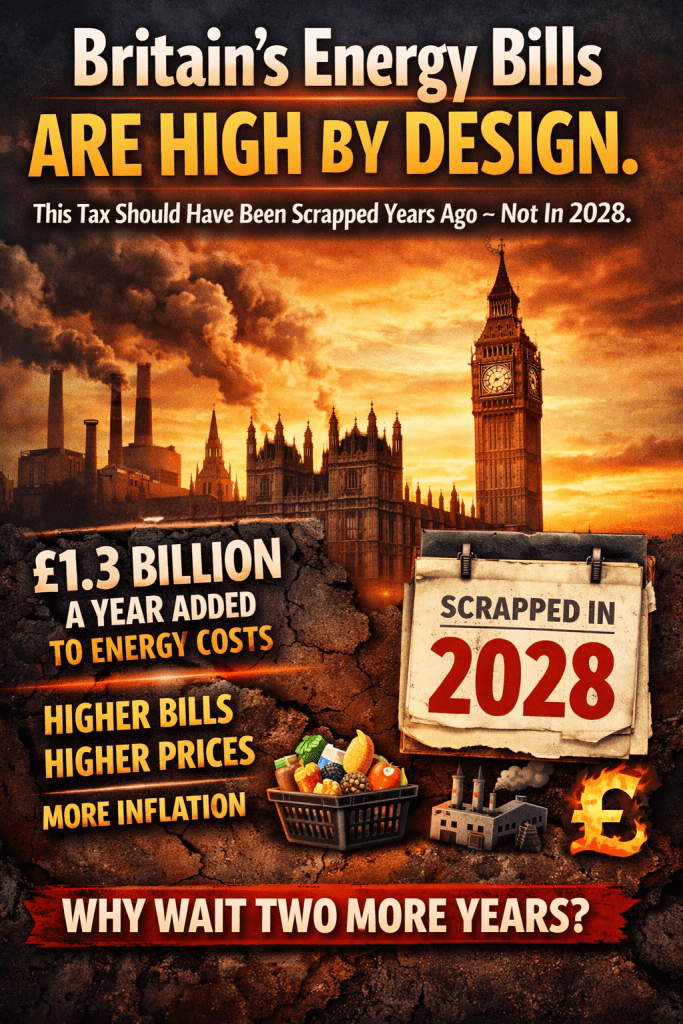
The levy was introduced from 1 April 2013 as part of the carbon price floor framework. Its purpose was to push coal off the grid by adding a top-up carbon cost to fossil-fuel electricity generation. In that narrow sense, it worked. Coal has now effectively disappeared from Britain’s power mix, while the levy itself was frozen at £18 per tonne of CO2 until 2028. But once coal had gone, the original political case for keeping this burden in place was plainly much weaker. �
That matters because this was never some abstract green signal floating harmlessly above the market. It was a real surcharge feeding into electricity costs. Reuters reported public estimates that the levy has been adding around £1.3 billion a year to bills, while analysts estimated that removing it would cut the average household electricity bill by about £21 a year. �
That £21 figure, however, understates the true political point. Looking only at today’s average bill effect misses the cumulative cost over time. If a policy adds roughly £1.3 billion a year across the system, and has been in place since 2013, then the total burden over more than a decade runs into many billions. On a household basis, the direct cost over the years is likely to have amounted not to a token sum, but to hundreds of pounds. And that is before the wider inflationary damage is considered. This last point is an inference from the annual system-wide burden and the duration of the policy, rather than a published official household total. �
Because expensive electricity does not stop at the meter. It runs through everything. Factories pay more. Cold storage costs more. Food processors pay more. Warehouses, retailers and manufacturers all face higher overheads. The Bank of England has repeatedly warned that higher energy prices feed through into inflation expectations and second-round price pressures, with energy and food prices especially salient. That is the missing part of this story. Net Zero-style energy taxes do not only hit people as billpayers. They hit them again as shoppers. �
This is why the endless ministerial line about “international markets” has always been so slippery. Yes, Britain was exposed to global gas shocks. The Bank of England has said the Middle East conflict has triggered volatile upward moves in global energy prices and increased inflation risks. But Britain was also carrying self-imposed costs of its own. Consumers were not simply paying world prices. They were paying world prices plus domestic policy penalties layered on top. �
That is why this issue reaches far beyond Reeves. The Conservatives own it. Labour owns it. The wider Net Zero machine owns it. This levy survived because successive governments accepted the same ideological premise: make conventional energy more expensive, and households and industry will be pushed into transition. Never mind the cost to steel, chemicals, manufacturing or family budgets. Never mind that gas still remains essential to balancing the grid when renewables fall short. The policy stayed because the political class convinced itself that engineered pain was evidence of seriousness. �
Now the same establishment wants applause for admitting, quietly and belatedly, that one of its own price-raising devices no longer makes sense. But even now Reeves will not end it immediately. She will leave it running for another two years. Another two years of avoidable cost. Another two years of pressure on businesses. Another two years of higher prices feeding through the economy. Another two years in which the public is told to look abroad for causes while government delays relief at home. �
The real lesson is not just that Carbon Price Support should have gone years ago. It is that Britain’s energy debate has been fundamentally dishonest. Ministers blamed gas and international markets because that was politically easier than admitting the obvious: energy policy itself has raised costs. Not every pound on the bill came from Westminster. But too many pounds did.
So no, Rachel Reeves does not deserve gratitude for this move. She deserves the question she has not answered: if this tax is wrong now, why is she making the country suffer it for two more years?
Shane Oxer — Campaigner for fairer and affordable energy
Footnotes
1. HMRC states the carbon price floor was introduced on 1 April 2013 and applies carbon price support rates to fossil fuels used in electricity generation. �
GOV.UK
2. Budget 2011 and subsequent government material show the policy was designed to support investment in low-carbon power by raising the carbon price faced by fossil-fuel generation. �
GOV.UK +1
3. Reuters reported on 16 April 2026 that the UK will scrap Carbon Price Support from April 2028, that the rate had been frozen at £18 per tonne of CO2 until 2028, and that analysts estimated a saving of about £21 a year on an average household electricity bill. �
Reuters
4. The same Reuters report said the levy had been adding around £1.3 billion a year to electricity bills. �
Reuters
5. The Bank of England’s March 2026 Monetary Policy Summary said higher energy prices raised the risk of second-round inflationary pressures and highlighted energy and food prices as especially important for inflation expectations. �
Bank of England
6. The Bank of England’s April 2026 Financial Policy Committee Record said the Middle East conflict had caused large and volatile upward moves in global energy prices and would increase inflationary pressure. �
Bank of England
7. The statement that households have likely paid “hundreds of pounds” over time is a reasonable inference from the reported annual system-wide burden and the policy’s duration since 2013, not a directly published official household total. It should be presented as an estimate, not a confirmed government figure. �
 SAY NO TO THE DESTRUCTION OF OUR LAND
Leave a comment