This Isn’t Just a Planning Decision , It’s a Warning
Something extraordinary has just happened in West Yorkshire.
A hyperscale data centre , backed by Microsoft , is being pushed toward approval at Skelton Grange in Leeds.
On the surface, it’s being sold as progress:
Jobs
Investment
Digital infrastructure
But buried inside the planning details is a reality that should concern every household in the country:
This development does not yet have the power to run.
And it does not yet have the water to operate.
The Scale They Don’t Want You to Think About
This is not a small project.
It is a 1.2 million square foot hyperscale data campus, the kind of infrastructure that underpins artificial intelligence, cloud computing, and government systems.
Facilities like this don’t switch off. Ever.
They require:
Continuous electricity (24/7, no interruption)
Industrial-scale cooling systems
Constant water supply
In real terms, this is the energy demand of a small town, concentrated into a single site.
The Power That Doesn’t Exist (Yet)
From the planning material itself:
“Full electrical capacity may not be available until 2030–2033.”
That is not speculation. That is their own admission.
So what is being approved today?
A development that:
Depends entirely on future grid upgrades
Has no confirmed full power supply
Will rely on infrastructure that may not exist for nearly a decade
Yes, there will be:
An on-site substation
Backup generators
But let’s be clear:
Substations don’t generate electricity.
Generators are emergency systems , not primary supply.
So again, the question stands:
👉 Where is the actual power coming from?
The Water Crisis Hidden in Plain Sight
If the power issue raises eyebrows, the water issue should stop this project in its tracks.
From the same planning material:
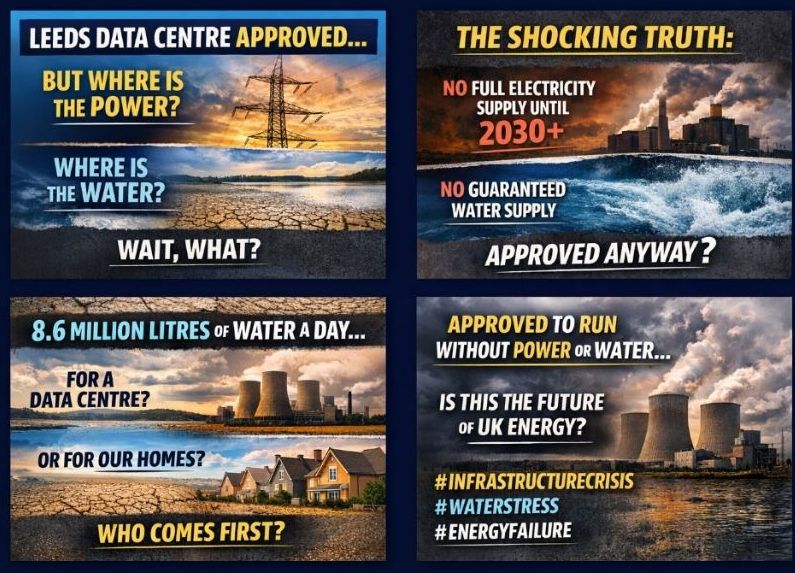
“The site would require up to 100 litres per second of water.”
That is:
8.6 million litres per day
Enough to supply tens of thousands of homes
And yet:
“Yorkshire Water has indicated that this level of supply is not currently available.”
Pause and think about that.
A region that has already faced water shortages…
is now being asked to approve a project that requires a continuous industrial water supply that does not exist.
The fallback?
Abstraction from the River Aire.
So now we are potentially moving from public water stress to direct environmental extraction.
The Question No One Is Asking
At what point do we ask:
Who comes first?
Residents already facing water pressure?
Or a corporate data facility requiring millions of litres every day?
A System That No Longer Makes Sense
This isn’t just about Leeds.
It exposes a national contradiction that is becoming impossible to ignore.
At the same time as this project is being approved, the UK is:
Covering farmland with solar panels
Building short-duration battery storage systems
Promoting an energy system based on intermittency
And yet…
We are approving infrastructure that requires:
Constant power
Guaranteed supply
Absolute reliability
These two realities cannot coexist.
Demand Is Being Approved Before Supply Exists
This is the core issue.
Not just in Leeds , but across the country.
We are now seeing a pattern where:
High-demand infrastructure is approved first
The supply to support it is promised later
That is not planning.
That is speculation.
The Silence Is the Story
Why did this only get a local headline?
Because once you connect the dots, it raises questions that go far beyond a single planning committee:
Is the UK grid actually capable of supporting future demand?
Are water resources being allocated transparently and fairly?
Are developments being approved based on reality , or assumption?
The Bigger Threat: This Is Just the Beginning
This won’t be the last data centre.
It’s the first wave.
AI, cloud computing, and digital infrastructure are driving a surge in demand that the current system is not prepared for.
And if this is how projects are being approved now,
without confirmed power, without confirmed water,
then we are heading toward a much larger problem.
Final Question
If a project of this scale cannot clearly demonstrate:
Where its electricity comes from
Where its water comes from
Then why is it being approved?
And more importantly:
What else is being approved under the same assumptions?
The Line That Changes Everything
This is no longer a local planning issue.
It is a national one.
The UK is now approving infrastructure that requires power and water it cannot currently supply.
That is not progress.
That is a system under strain.
Shane Oxer. Campaigner for fairer and affordable energy
 SAY NO TO THE DESTRUCTION OF OUR LAND
Leave a comment