For the best part of two decades, Britain has been governed by an energy doctrine that mistook targets for strategy and aspiration for engineering. The public was promised a smooth green transition, lower bills, cleaner growth and modernised infrastructure. Instead, we have rising costs, mounting delays, growing public resentment and a power system buckling under pressures it was never properly prepared to bear.
At the centre of this failure lies one extraordinary act of political negligence: they ignored the grid.
This was not a minor oversight. It was not a technical detail lost in the complexity of modern policymaking. It was the single most important fact in the entire energy debate. Electricity is only useful if it can be moved, balanced and delivered across a functioning network in real time. Without that network, generation is irrelevant. Wind turbines, solar farms and battery compounds may look impressive on planning documents and ministerial press releases, but if the system cannot absorb or transport their output, they are not assets. They are stranded ambitions.
That is the reality now confronting Britain.
The modern Net Zero state was built backwards. Instead of beginning with hard infrastructure, firm generation, system resilience and delivery timescales, Whitehall began with carbon targets. The Climate Change Committee, originally presented as an advisory body, became in practice the ideological metronome of British government. Its carbon budgets created a framework in which every department was expected to align itself with decarbonisation first and practical viability second.[1]
The Department for Energy Security and Net Zero, far from acting as a sober departmental check on feasibility, instead became the administrative engine of this orthodoxy , translating abstract carbon obligations into real-world deployment targets, subsidy schemes and planning pressure.[2]
In theory, the argument sounded plausible. Build more renewables, electrify more of the economy, expand storage, and the system will evolve around it. In practice, it meant pushing intermittent generation into a network that had not been rebuilt to carry it. It meant approving solar, wind and battery projects at a speed utterly disconnected from the much slower pace of transmission reinforcement, substation upgrades, Super Grid Transformer replacement, and local distribution expansion. It meant pretending that a national infrastructure programme requiring a decade or more could somehow be compressed into a ministerial timetable.
Now the consequences are becoming impossible to conceal.
Across the country, grid connection queues have become a public embarrassment. Projects face waits not of months, but of years , in some cases more than a decade. The backlog became so severe that the system operator was forced to pause fresh applications while it tried to clear speculative and undeliverable schemes from the queue.[3]
More than 200GW of projects were reportedly removed from the waiting list as part of this cleansing exercise, exposing the extent to which the system had become clogged with fantasy capacity.[4] This was not evidence of a healthy market. It was evidence of a policy regime detached from physical reality.
And yet the political response has been revealing.
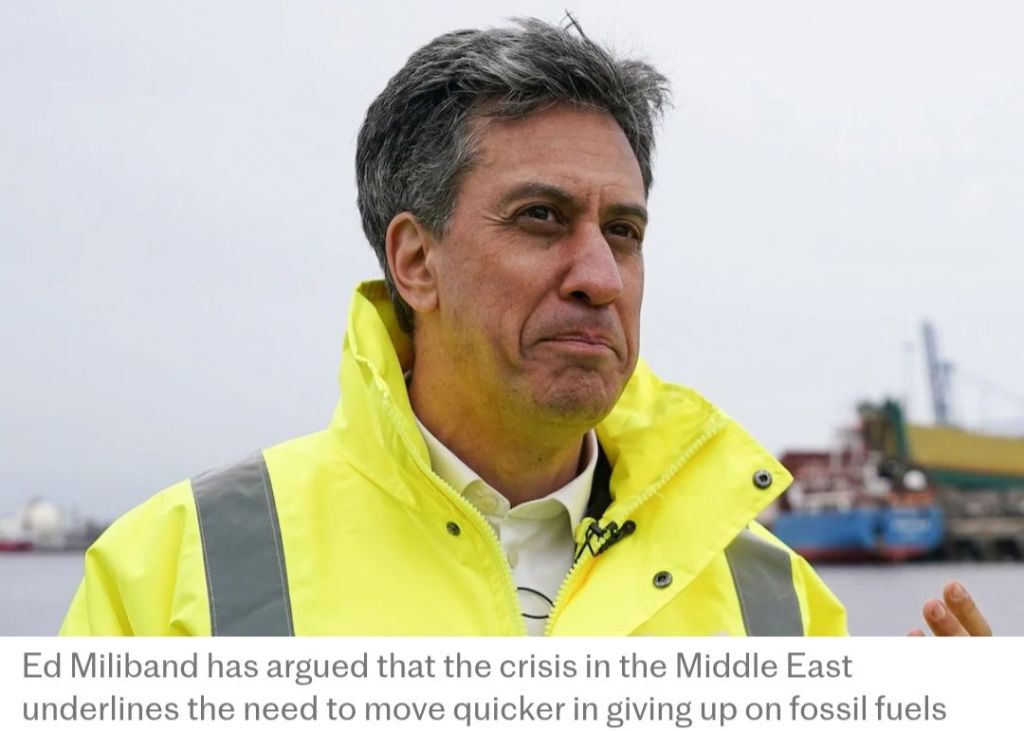
Rather than admit that the strategy itself was flawed, ministers have reacted with frustration that the machinery of the grid is not moving fast enough. Ed Miliband’s recent insistence that further slippage is “not acceptable” is, in one sense, politically understandable. But in another, it is astonishing.
One cannot simply scold a transformer into existing sooner. One cannot admonish a transmission corridor into bypassing years of planning, procurement, construction and land assembly.
To speak as though the system is merely dragging its feet is to betray either a profound misunderstanding of infrastructure, or an ideological refusal to accept its limits.
That is the central problem with Miliband’s approach. His politics assume that intent can overpower constraint. The harder the target, the more righteous the urgency, the more morally compelling the mission, the more the physical world is expected to yield. But grids do not respond to moral fervour. They respond to steel, copper, concrete, skilled labour, system stability requirements and time. If those things are absent, slogans make no difference.
The evidence of this mismatch is not confined to one place. It is national.
In Buckinghamshire and across parts of the South , transmission reinforcements central to accommodating future generation are projected into the early-to-mid 2030s.[5]
In South Yorkshire, around nodes such as Thorpe Marsh, West Melton and Brinsworth, constraint risks and reinforcement needs are already evident, even as additional renewable and storage schemes continue to crowd into the same corridor.[6]
Across North Yorkshire, Lincolnshire and Norfolk , all regions tied in different ways to ambitious renewable expansion, offshore integration or major transmission restructuring , the same pattern emerges. Generation ambition is immediate; network readiness is not. Policy says 2030. Infrastructure says 2034, 2035, sometimes later.
That gap matters more than any ministerial speech.
Because it means the British state has committed itself to outcomes the supporting system is not yet capable of delivering. It means projects are approved before they are connectable, costs are incurred before benefits are realisable, and communities are asked to accept industrialisation of land for infrastructure that may remain bottlenecked for years.
It means households are funding a transition in which inefficiency is not an accidental by-product but a structural feature.
This is where the public has been badly misled. Much of the cost of the Net Zero system was obscured for years behind technical language and dispersed charging mechanisms. Consumers were told renewables were cheap, but not told enough about curtailment costs, balancing costs, reinforcement charges, backup requirements and constraint payments. Yet these are the hidden economics of the new system. Britain now spends enormous sums managing the instability and locational mismatch created by policy-led deployment. Wind and solar are built where subsidy, land and planning opportunity permit; power demand is elsewhere; the network in between is constrained; and consumers end up paying to switch generation off, to reinforce circuits, and to procure backup for periods when the weather fails.[7]
The battery boom has not resolved this contradiction. On the contrary, it often deepens it. Batteries can provide useful short-duration flexibility, frequency services and local balancing support. But they are not a substitute for seasonal adequacy, nor do they magic away transmission shortages.
A two- or four-hour battery does not solve prolonged winter scarcity, and it still depends on the grid to charge and discharge at scale. Presenting battery deployment as a cure for systemic under-building of firm power and network capacity is not serious strategy. It is political theatre with steel cladding.
What has happened, in essence, is that engineering has been subordinated to ideology. The CCC institutionalised the ideology by embedding carbon reduction into a quasi-moral governing framework. DESNZ operationalised it by designing policy around compliance with decarbonisation milestones rather than around system-first realism.
Miliband has radicalised it further by treating delay not as evidence that the model is overstrained, but as proof that the bureaucracy must simply push harder.[8]
But the grid is not a Whitehall submission. It cannot be rewritten to suit the minister.
That is why the present moment matters. The ideology is beginning to collide visibly with the material world.
The connection queue is the collision.
The rising bill is the collision.
The spread of giant solar and battery proposals into already saturated regions is the collision.
The lengthening timeline for reinforcement is the collision.
For years, this tension could be hidden behind pledges and press releases.
It cannot be hidden now.
Britain is not merely late in upgrading its network. It is, in many regions, roughly a decade behind the policy imposed upon it.
That is an astonishing fact, and it should reshape the entire public debate. You cannot build a 2030 electricity system on a 2034 grid.
You cannot pretend otherwise unless ideology has so completely captured policy that facts themselves become an inconvenience.
This is not just Miliband’s failure, though he has become its clearest modern expression. It is the failure of Whitehall to challenge consensus, the failure of DESNZ to distinguish administration from advocacy, and the failure of the CCC to recognise the limits of its own model.
Britain did not need a sermon. It needed a plan grounded in infrastructure, resilience, affordability and engineering sequence. Instead it got carbon theatre backed by legal targets and bureaucratic momentum.
And now the bill is arriving.
Not merely in pounds, though certainly in pounds. But in lost time, wasted capital, damaged landscapes, industrial uncertainty, eroded public trust and a growing recognition that the people who set the targets never truly understood the system they were trying to transform.
That is the real scandal of Britain’s energy policy.
Not that it aimed high,
but that it aimed blindly.
Not that it sought reform,
but that it confused ideology with delivery.
And not that it moved too slowly, but that it moved in the wrong order.
The grid was always the foundation. They treated it as an afterthought.
The consequences are no longer theoretical. They are here. And they are only just beginning to bite.
Footnotes
[1] Climate Change Act 2008, especially the carbon budget framework and the statutory role of the Climate Change Committee in advising on emissions targets and reporting progress.
[2] Department for Energy Security and Net Zero, departmental remit and Clean Power 2030 programme materials, including the centrality of decarbonisation targets to electricity system planning.
[3] National Energy System Operator announcements and reform updates relating to grid connection queue management and pauses or restructuring of the applications process.
[4] Government and NESO statements on queue reform indicating the removal of approximately 200GW+ of stalled, speculative or non-viable projects from the connections pipeline.
[5] National Grid Electricity Transmission, Beyond 2030 regional transmission planning documents for the South East and adjacent reinforcement corridors, showing major completion milestones extending into the 2030s.
[6] National Grid ESO / NESO Appendix G and related regional grid data referenced in assessments of South Yorkshire substations and Grid Supply Points, including Thorpe Marsh, West Melton and Brinsworth.
[7] Ofgem, NESO and wider system balancing data on constraint payments, curtailment costs, balancing services and network reinforcement pressures associated with renewable integration.
[8] Public statements by Ed Miliband and DESNZ ministers in 2024–2026 pressing for acceleration of grid connections and renewable deployment in pursuit of Clean Power 2030.
Shane Oxer . Campaigner for fairer and affordable energy
 SAY NO TO THE DESTRUCTION OF OUR LAND
Leave a comment