There is a growing gap between what the public is being told about Net Zero, and what it is actually costing.
Carbon capture is now being presented as essential infrastructure , a necessary step if Britain is to decarbonise heavy industry and meet its legal climate targets. Projects such as Peak Cluster, stretching from Derbyshire to the Wirral, are framed as practical, responsible, and inevitable.
But once the numbers are examined properly, and the system is viewed in full, a different picture begins to emerge.
This is not simply an environmental policy.
It is a long-term financial commitment on a national scale , and one that the public is largely paying for without being fully shown the bill.
A System of National Scale
Peak Cluster is designed to capture carbon dioxide from cement and lime plants in the Midlands and transport it via a 200-kilometre pipeline to storage beneath the Irish Sea.
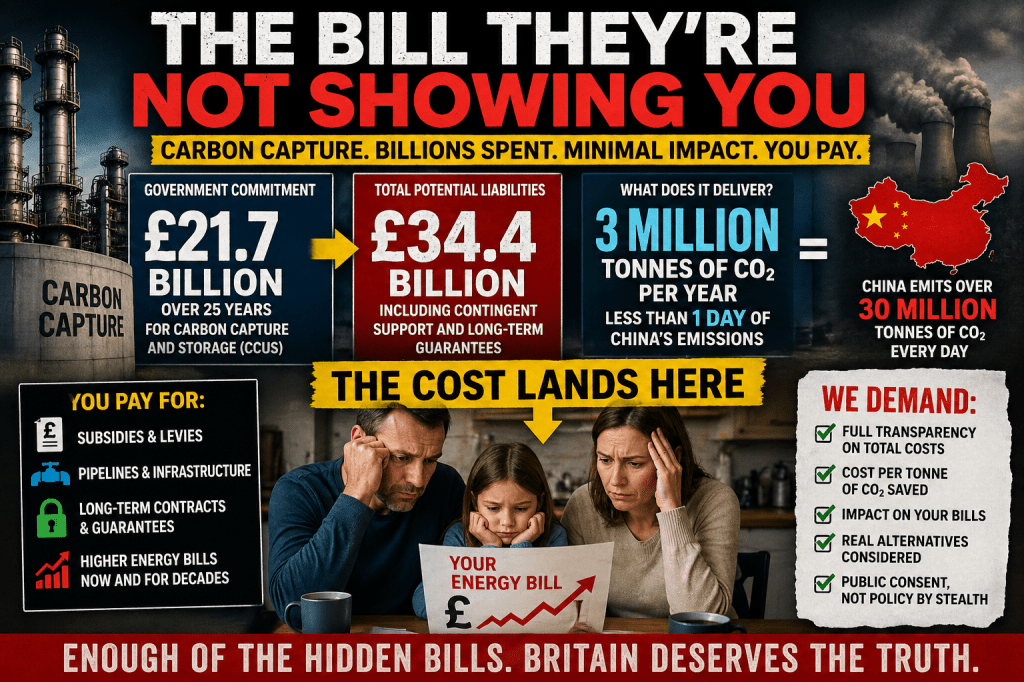
Its own figures suggest it will remove approximately 3 million tonnes of CO₂ per year.
That sounds substantial , until it is placed in context.
China emits over 11 billion tonnes annually, or roughly 30 million tonnes per day. In those terms, the entire Peak Cluster system offsets less than a single day of emissions from one country.
This is not an argument about responsibility. It is a question of proportionality.
Britain is being asked to commit significant resources, infrastructure and land use to achieve an outcome that is, in global terms, marginal.
The £21.7 Billion Programme , and What Sits Behind It
Peak Cluster is not a standalone project. It sits within a wider national carbon capture programme.
The Government has already committed £21.7 billion over 25 years to carbon capture and storage. More significantly, total potential liabilities once long-term guarantees and contingent support mechanisms are included , are estimated to rise as high as £34.4 billion.
This is not a fixed investment.
It is an evolving financial exposure, dependent on long-term contracts designed to guarantee returns for operators and reduce private sector risk.
And that raises the most important question of all:
Where do these costs actually go?
From Policy to Household Bills
Carbon capture is often described as industrial policy. In reality, it is deeply embedded in the energy system — and that means its costs do not stay within government departments or corporate balance sheets.
They flow outward.
Through:
Energy bills
Taxation
Higher costs across construction, manufacturing and infrastructure
The mechanism is familiar. It mirrors the way previous energy policies have been funded , through levies, subsidies and guaranteed pricing structures that are ultimately passed on to consumers.
The difference is scale.
These are long-term commitments, extending over decades, with costs layered on top of an already complex and expensive energy system.
A Cost of Living Pressure That Cannot Be Ignored
This is happening at a time when millions of households are already under sustained financial strain.
Energy bills remain elevated. Food prices have risen. Housing costs continue to climb. Disposable income is under pressure across much of the country.
In that context, introducing additional long-term cost burdens , particularly those that are not clearly explained , is not simply an economic issue.
It is a question of fairness.
People are being asked to absorb costs that are:
Long-term
Increasing
And not fully transparent
Without a clear understanding of what they are paying for, or whether it represents value for money.
The Infrastructure and Its Impact
Beyond cost, the physical reality of these projects should not be overlooked.
Peak Cluster alone involves:
A 200 km pipeline
Construction corridors across farmland and countryside
Permanent land-use restrictions above buried infrastructure
Industrial-scale compression facilities operating continuously
This is not invisible infrastructure. It is a significant and lasting change to the landscape, particularly in rural areas.
And once built, it cannot simply be reversed.
An Expensive System with Uncertain Delivery
Carbon capture remains a developing technology at scale.
While the principle is established, the integration of capture, transport and long-term storage across national infrastructure systems is still evolving. Projects internationally have faced cost overruns, delays and underperformance.
The UK programme is therefore not just expensive.
It carries delivery risk.
And yet, the financial structure ensures that much of that risk does not sit with operators , it is transferred, directly or indirectly, to the public.
Where Is the Consent? The Public Deserves the Truth on Net Zero Costs
This has to be brought out into the open.
The public cannot be expected to keep paying for policies they have never been properly shown, properly costed, or properly asked to approve.
Carbon capture is only one part of a much larger Net Zero spending machine. The Government has already committed £21.7 billion over 25 years, with total potential liabilities , including contingent support mechanisms , estimated to reach as high as £34.4 billion.
This is not a contained investment. It is a long-term financial commitment.
And those costs do not sit quietly in the background.
They are recovered through a combination of taxation, energy bills, and rising costs across the wider economy.
If Government were honest enough to explain the full cost of Net Zero , not just the headline spending, but the subsidies, contracts, levies, infrastructure costs, grid upgrades and long-term liabilities , there would be a very different national conversation.
People may still support environmental responsibility. But they would rightly demand to know:
why so much is being committed
who benefits
and why households are expected to carry the burden during a cost-of-living crisis
This is no longer just an energy debate.
It is a question of democratic consent.
Policies of this scale cannot be advanced through departments, quangos and private operators while the public is given only partial information. A programme that affects bills, land, farming, industry and national competitiveness requires full transparency.
At the very least, every major Net Zero infrastructure scheme should be required to publish:
Full lifetime cost
Cost to households and businesses
Cost per tonne of CO₂ saved
Public subsidy levels
Long-term contractual liabilities
Impact on energy bills
Viable alternatives considered
Without that, the public is not being informed.
It is being managed.
And that is the heart of the problem. These costs do not disappear into Whitehall accounting. They land on families, pensioners, small businesses, farmers and working people already under pressure.
If Net Zero is truly affordable, publish the figures.
If carbon capture is truly value for money, show the cost per tonne.
If these policies are truly in the national interest, prove it openly.
Because until the full costs are placed before the public, this is not consent.
It is policy by stealth.
And Britain cannot afford another hidden bill , and the public will not tolerate one once the full costs are understood.
Shane Oxer. Campaigner for fairer and affordable energy
 SAY NO TO THE DESTRUCTION OF OUR LAND
Leave a comment