The Peak Cluster carbon capture project is being presented as a necessary and pragmatic response to the United Kingdom’s legally binding Net Zero obligations. Its stated purpose is straightforward: to capture carbon dioxide emissions from cement and lime production in Derbyshire and Staffordshire, transport them via pipeline across northern England, and store them beneath the Irish Sea.
On paper, the argument appears compelling. Cement production is a carbon-intensive process, with a significant proportion of emissions arising not from fuel combustion but from chemical reactions inherent in the material itself.¹ As such, proponents argue that carbon capture and storage (CCS) is not optional, but essential.
However, once the scale of the project is examined in context , financially, environmentally, and globally , the justification becomes far less convincing.
Scale and Global Context
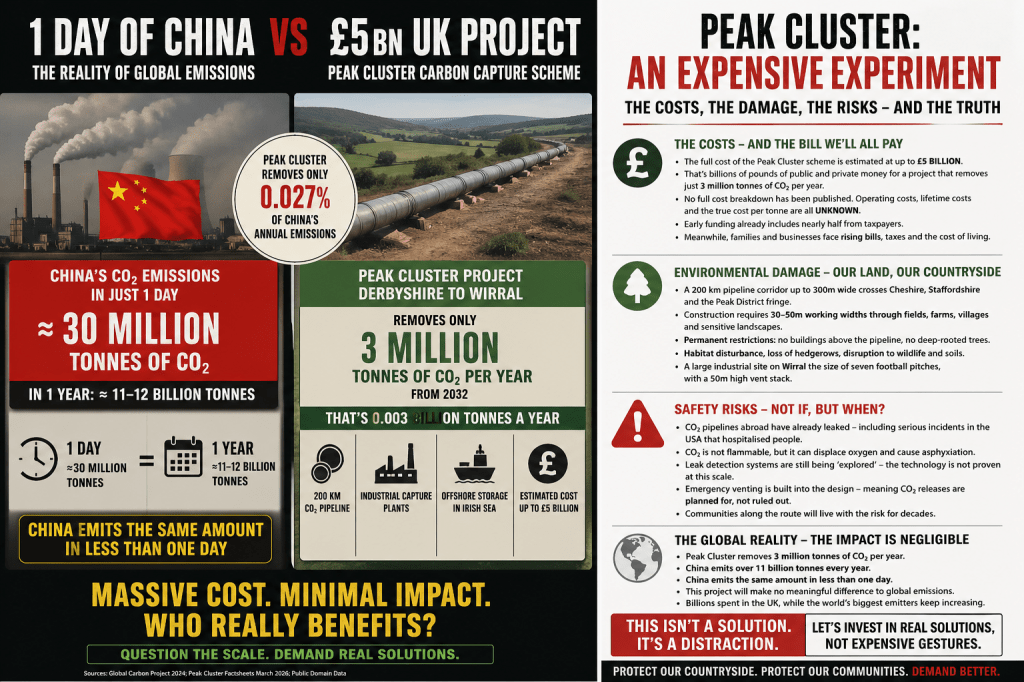
Peak Cluster’s own documentation confirms that the project is expected to capture approximately 3 million tonnes of CO₂ annually from 2032 onwards.² This figure is presented as a substantial contribution to emissions reduction.
Yet in global terms, it is negligible.
China alone emits in excess of 11 billion tonnes of CO₂ per year, equating to approximately 30 million tonnes per day.³ When compared directly, Peak Cluster’s entire annual output equates to less than one day of Chinese emissions.
This is not an argument about responsibility, but about proportionality. The UK is being asked to commit to a large-scale transformation of land and infrastructure in order to achieve a reduction that has no meaningful impact on global emissions trajectories.
Cost Uncertainty and Financial Exposure
Long-term financial liabilities are unclear
In effect, a project of national significance is advancing without a fully transparent cost structure. This creates a substantial risk that costs will escalate over time, particularly given the historical tendency of large infrastructure and CCS projects to exceed initial estimates.
Land Use and Environmental Impact
Despite being framed as an environmental solution, Peak Cluster involves a significant degree of physical intervention in the landscape.
The pipeline itself is expected to extend approximately 200 kilometres, with an initial corridor of up to 300 metres in width during route identification and planning.⁵ Construction would require working widths of 30–50 metres across rural land, including farmland and ecologically sensitive areas.
While restoration is promised following construction, the documentation makes clear that land use will not fully return to its original state. Permanent restrictions will apply, including limitations on building and the planting of deep-rooted vegetation above the pipeline.⁶
These constraints represent a long-term alteration of land use, rather than a temporary disruption. The cumulative effect across the route , particularly in agricultural regions , is likely to be significant.
In addition, the project includes above-ground infrastructure, including compression facilities on the Wirral, with industrial footprints and continuous operational requirements.⁷ These installations further reinforce the industrial character of what is otherwise rural or semi-rural land.
Safety and Technical Uncertainty
The project’s safety case is presented in terms of compliance with existing regulations and engineering standards. However, the documentation also acknowledges that certain technologies, including advanced leak detection systems, are still under consideration or development.⁸
This is a critical point. CCS at this scale is not yet widely deployed, and the long-term behaviour of high-pressure CO₂ transport systems remains an area of active development.
The inclusion of emergency venting systems , designed to release CO₂ under certain conditions , further highlights the operational realities of the system.⁹ While such measures are standard in pipeline design, they underscore the fact that the system is not risk-free.
International experience, particularly in the United States, has demonstrated that CO₂ pipeline failures, while relatively rare, can have serious consequences due to the gas’s ability to displace oxygen in confined environments.
The issue is not whether risks can be mitigated, but whether they are sufficiently understood and proven at the scale being proposed.
Technological Maturity and Delivery Risk
The project timeline indicates that Peak Cluster remains in the early stages of development, with ongoing consultation, environmental assessment, and engineering design. Construction is not expected to begin until the latter part of the decade, with operation projected from 2032.¹⁰
This extended timeline reflects both the complexity of the project and the fact that CCS infrastructure of this scale is still emerging.
Globally, CCS deployment has been characterised by delays, cost overruns, and underperformance relative to expectations. While the technology itself is not new, its application at scale particularly across integrated systems of capture, transport, and storage , remains limited.
This introduces a clear delivery risk. The UK is committing to infrastructure that is not only expensive, but also dependent on technologies and systems that have yet to demonstrate consistent success at scale.
Conclusion: A Question of Priorities
Peak Cluster is not a minor infrastructure upgrade. It is a multi-billion pound industrial system, extending across large areas of the country, with long-term implications for land use, public finance, and energy policy.
In return, it offers a reduction in emissions that is, in global terms, negligible.
This does not mean that emissions reduction is unimportant. It means that the method chosen must be proportionate, effective, and economically justified.
At present, Peak Cluster raises serious questions on all three counts.
The UK is being asked to commit to significant expenditure, accept substantial environmental disruption, and assume long-term operational risks , all in pursuit of a marginal impact on global emissions.
That is not a technical argument.
It is a question of judgment.
Footnotes
1. Peak Cluster Factsheet – Route Choice and Alternatives to CCS (March 2026) �
Peak Cluster_Factsheet_4 Alternates_March 2026.pdf
2. Peak Cluster Overview Factsheet (March 2026) �
About Peak Cluster – March 2026.pdf
3. Global emissions data (IEA / Global Carbon Project estimates, 2023–2024)
Peak Cluster Overview Factsheet (March 2026) �
4. About Peak Cluster – March 2026.pdf
Pipeline Construction Factsheet (March 2026) �
5. Peak Cluster Factsheet_2_About the pipeline_March 2026.pdf
Pipeline Construction Factsheet – Land Use Restrictions �
6. Peak Cluster Factsheet_2_About the pipeline_March 2026.pdf
Above Ground Infrastructure Factsheet (March 2026) �
7. Peak Cluster_Factsheet_3_Above ground infrastructure_March 2026.pdf
Environmental and Safety Factsheet (March 2026) �
8. Environment and safety – March 2026.pdf
Above Ground Infrastructure Factsheet – Venting Systems �
9. Peak Cluster_Factsheet_3_Above ground infrastructure_March 2026.pdf
Pipeline Construction Timeline (March 2026) �
20. Peak Cluster Factsheet_2_About the pipeline_March 2026.pdf
 SAY NO TO THE DESTRUCTION OF OUR LAND
Leave a comment