For years, the public has been told that Net Zero is both necessary and affordable.
What has not been clearly set out is the full cost of how it is being delivered.
Instead, what we are shown are individual policies: carbon capture, grid upgrades, renewable subsidies, infrastructure programmes. Each is presented in isolation. Each is justified on its own terms.
What is not presented is the combined financial effect.
That matters, because households do not pay for individual policies. They pay for the system.
A System of Costs , Not a Single Policy
The UK energy system is undergoing structural change. That change carries costs across multiple layers: generation, transmission, balancing, storage, and policy support.
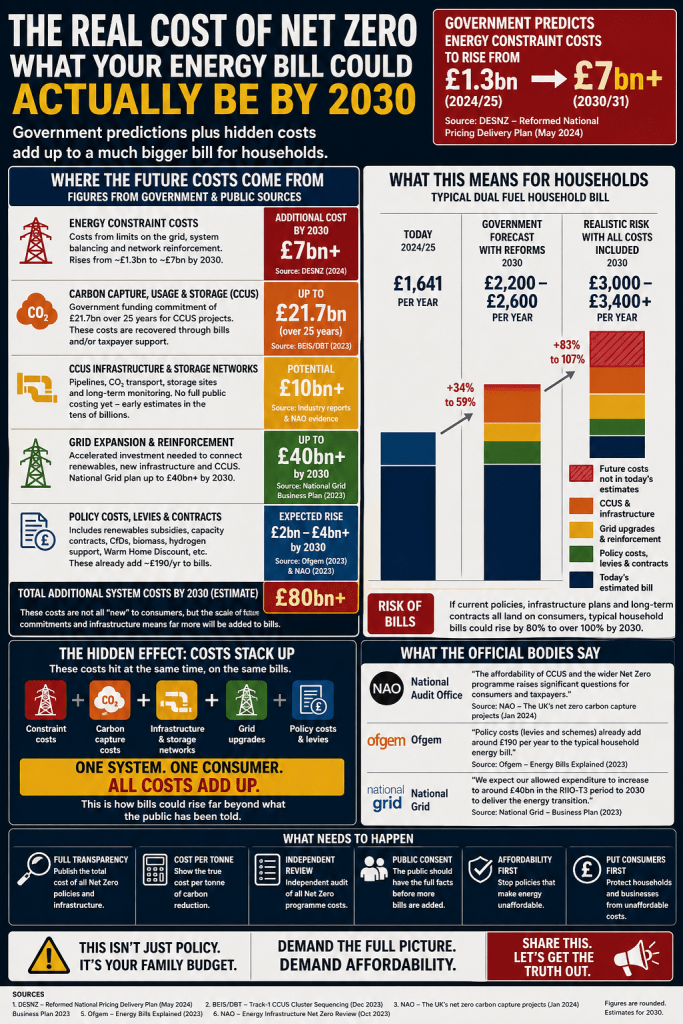
Recent Government material acknowledges that constraint costs , the cost of managing a grid that cannot efficiently move electricity , could rise from around £1.3 billion to approximately £7 billion per year by 2030.¹ These are not marginal adjustments; they reflect systemic pressure on the network.
At the same time, the Government has committed £21.7 billion over 25 years to carbon capture and storage, with total potential liabilities , including long-term guarantees , estimated to reach as high as £34.4 billion.²
These figures sit alongside wider infrastructure requirements. National Grid’s own business plans anticipate tens of billions of pounds in network investment to support the energy transition through to 2030 and beyond.³
Each of these costs has its own justification. Taken together, they represent something else entirely.
From Policy to Household Bills
Energy policy does not remain confined to Whitehall. It is embedded in the structure of the system itself.
According to the House of Commons Library, policy costs , including subsidies, schemes and levies , already account for a portion of household bills, alongside wholesale energy, network costs and supplier charges.⁴
These costs are recovered through pricing mechanisms that ultimately reach the consumer.
Ofgem data suggests that policy-related costs can add in the region of £150–£200 per year to a typical household bill, depending on market conditions and scheme design.⁵
The important point is not the exact figure. It is the mechanism.
New policies , whether carbon capture, infrastructure guarantees or system balancing , are funded through the same framework.
They do not disappear.
They accumulate.
The Risk of Cumulative Impact
The debate around Net Zero is often framed in terms of individual measures. This obscures the central issue.
No single policy is likely to double household energy bills on its own.
However, the cumulative effect of multiple cost layers , constraint costs, carbon capture support, grid expansion, storage infrastructure and policy levies , creates a clear risk of significant upward pressure.
Official projections suggest that a typical dual-fuel bill of approximately £1,600 today could rise to between £2,200 and £2,600 by 2030 under current assumptions.⁶
Those assumptions depend on delivery.
They assume that:
infrastructure is built efficiently
costs remain within forecast ranges
system pressures are successfully managed
If those conditions are not met, the outcome may differ.
Infrastructure That Cannot Be Reversed
Much of the current investment is not short-term.
Pipelines, substations, offshore storage facilities and transmission networks are long-life assets. They require maintenance, monitoring and, in some cases, guaranteed returns over decades.
Once committed, these costs are locked into the system.
They are not easily scaled back.
This creates a long-term financial structure in which consumers are exposed not only to current costs, but to future obligations tied to infrastructure that cannot be removed.
A Question of Transparency
This is where the debate becomes unavoidable.
The issue is not whether emissions should be reduced. Nor is it whether infrastructure investment is required.
The issue is whether the full cost of the chosen approach is being clearly presented.
At present, the public is given partial visibility. Individual schemes are announced, individual benefits highlighted, individual costs justified.
What is missing is a consolidated view:
the full lifetime cost of Net Zero infrastructure
the cumulative impact on household bills
the total exposure to taxpayers and consumers
the cost per tonne of emissions reduction
Without that, meaningful scrutiny is difficult.
The Reality
Households do not pay for policies in isolation.
They pay for the entire system.
Constraint costs.
Carbon capture.
Infrastructure.
Grid expansion.
Levies and contracts.
Each adds to the same bill.
Conclusion
If Net Zero is affordable, the full cost should be published.
If the current approach represents value for money, it should be demonstrated clearly, including the cost per tonne of emissions reduction and the long-term impact on consumers.
If households are expected to fund this transition, they are entitled to a complete and transparent account of what it will cost.
Until that is provided, the public is not being shown the full picture.
And without the full picture, there can be no informed consent.
Footnotes
1. DESNZ, Reformed National Pricing Delivery Plan (2024) – projections for constraint cost increases.
2. UK Parliament / House of Lords Built Environment Committee, Carbon Capture and Storage reports (2023–2024).
3. National Grid, Business Plan and RIIO-T2 / T3 investment projections (2023).
House of Commons Library, Energy Bills and Policy Costs (CBP-9491, 2024).
4. Ofgem, Energy Price Cap and Policy Cost Components (2023–2025).
5. Ofgem / Government projections based on current policy assumptions (2024–2025).
Shane Oxer. Campaigner for fairer and affordable energy
 SAY NO TO THE DESTRUCTION OF OUR LAND
Leave a comment