A stark warning has emerged from the United States: the electricity grid, designed for a different era, is no longer capable of accommodating the scale and nature of modern demand. Artificial intelligence and hyperscale data centres have not merely increased electricity consumption , they have fundamentally altered it.
In a single year, projected peak demand growth in the US surged from 38GW to 128GW, shattering decades of predictable forecasting.¹
This is not incremental change; it is systemic disruption.
Britain is now following the same path, but with a weaker grid, tighter constraints, and a policy framework built on assumptions that no longer hold.
For decades, electricity systems were engineered around stability. Demand rose gradually, seasonal patterns were well understood, and infrastructure could be planned accordingly. That era has ended. AI-driven data centres introduce a new form of demand: volatile, high-density, and immediate.
Large GPU clusters can trigger power fluctuations of hundreds of megawatts within seconds , behaviour for which no historical model exists.²
These are not passive consumers of electricity. They are dynamic, industrial-scale loads that require constant, uninterrupted supply.
The grid was never designed to accommodate this.
Britain is already showing signs of the same disconnect.
In Leeds and West Yorkshire, major data centre developments have been approved despite no confirmed grid capacity, no secured long-term water supply, and known regional network constraints. Northern Powergrid and National Energy System Operator (NESO) data already show constrained substations and limited headroom across key connection points.³
These are not minor oversights.
They are fundamental planning failures. A hyperscale data centre is not a conventional commercial project; it is an energy-intensive installation equivalent to a small town. Approving such infrastructure without firm power is not forward planning , it is speculation, with costs and consequences deferred to the public.
At the same time, the UK continues to expand offshore wind along the East Coast , from the Humber and Scunthorpe industrial corridor to Aberdeen and the wider North Sea.
Government policy through the Department for Energy Security and Net Zero (DESNZ) and the Contracts for Difference (CfD) scheme continues to prioritise rapid deployment of offshore capacity.⁴
Yet offshore wind carries a critical limitation that cannot be engineered away: it is intermittent. Output is governed by weather conditions, not system demand. National Grid ESO and ENTSO-E data confirm that prolonged low-wind events (“dunkelflaute”) can affect large regions simultaneously, reducing output across the system for extended periods.⁵
This is not a failure of technology; it is a physical constraint. Wind power cannot be dispatched on demand, and therefore cannot provide firm, guaranteed supply.
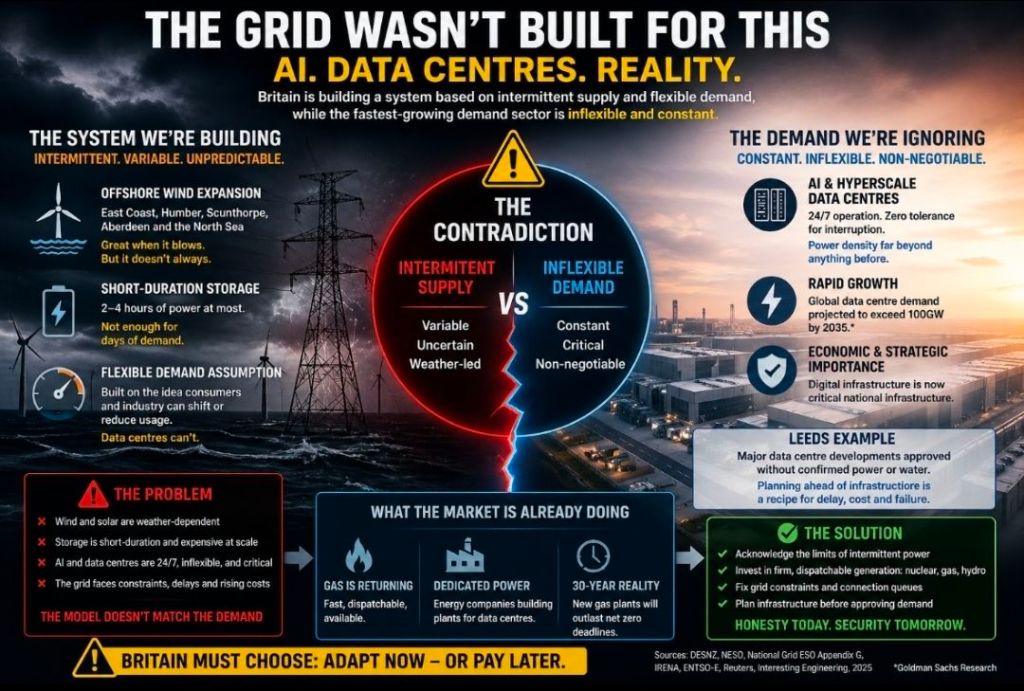
This creates a contradiction at the heart of UK energy policy. Britain is attempting to build an electricity system based on intermittent generation and flexible demand, while simultaneously enabling the growth of infrastructure that requires constant, inflexible power.
NESO’s Future Energy Scenarios (FES) explicitly assume increasing demand-side flexibility and system balancing through storage and interconnection.⁶
However, hyperscale data centres do not behave in this way. They cannot reduce consumption when the wind drops, nor can they shift load in response to pricing signals. Their demand is continuous, high-density, and increasingly central to the economy.
The system being built is not designed to support them.
The commonly cited solution , large-scale energy storage , does not resolve this contradiction. Battery Energy Storage Systems (BESS) deployed across the UK are predominantly short-duration, typically providing two to four hours of discharge.⁷
DESNZ statistics confirm that while installed capacity is growing, it remains insufficient to cover prolonged periods of low renewable output or to sustain gigawatt-scale continuous demand.⁸
Storage plays a role in frequency response and short-term balancing, but it does not provide the long-duration, dispatchable power required by modern infrastructure.
Evidence from the grid itself reinforces this point. National Grid ESO’s Appendix G datasets show significant queues of generation projects awaiting connection, many facing delays due to transmission constraints and reinforcement timelines extending into the 2030s.⁹
In regions such as South Yorkshire and the Humber, substations including Thorpe Marsh, West Melton, and surrounding nodes are already flagged with limited export capacity and constraint risks.¹⁰
At the same time, speculative “zombie projects” continue to occupy queue positions, distorting capacity forecasts and delaying viable developments.¹¹
The result is a system where planned generation cannot connect, while new demand continues to be approved.
The response in the United States is already instructive. Energy companies are no longer treating data centres as conventional customers but as anchor infrastructure requiring dedicated supply.
This has led to a rapid expansion of natural gas generation, with new plants being built specifically to serve hyperscale developments. These facilities can be deployed within three to five years and are capable of providing the constant, dispatchable power that data centres require.¹²
Crucially, they carry operational lifespans of around 30 years , meaning they will remain active well beyond existing net-zero targets. The market is not rejecting decarbonisation; it is responding to physical reality.
Britain cannot assume it will avoid the same outcome. The pressures are already present: electrification of transport and heating, constrained grid infrastructure, and increasing demand from digital systems. NESO’s own analysis highlights growing system stress, including rising constraint payments and the need for extensive transmission upgrades under the “Beyond 2030” network blueprint.¹³
These upgrades involve new substations, high-voltage lines, and system reinforcement at unprecedented scale , yet even these plans are struggling to keep pace with demand projections.
When the gap between supply capability and demand closes, it will not do so gradually. Infrastructure delays will increase, costs will escalate, and system reliability will come under pressure. In such conditions, prioritisation becomes unavoidable.
Strategic infrastructure , including data centres and major industrial users , will take precedence.
Domestic consumers and small businesses will bear the consequences through higher bills, increased standing charges, and reduced system resilience.
This is not a political argument;
it is the observed behaviour of constrained energy systems.
The central lesson is clear. The grid was built for a predictable, controllable world. That world no longer exists.
The rise of AI and hyperscale computing has introduced a form of demand that requires firm, continuous power , something intermittent generation alone cannot provide. Offshore wind will remain a valuable component of the energy mix, but it cannot substitute for dispatchable capacity. Gas, nuclear, and other forms of firm generation will continue to underpin system stability, regardless of policy preference.
Britain now faces a choice.
It can acknowledge this reality and adapt its energy strategy accordingly integrating firm power, aligning infrastructure planning with demand, and addressing grid constraints honestly , or it can continue to pursue a model that is increasingly detached from physical and operational realities. The longer that recognition is delayed, the more abrupt and costly the eventual correction will be.
References
World Resources Institute (WRI), US Data Center Electricity Demand Forecasts (2023–2024)
arXiv research on AI workload power fluctuations (GPU cluster demand behaviour)
Northern Powergrid & (NESO), regional capacity and constraint data
(DESNZ), Contracts for Difference (CfD) scheme documentation
National Grid ESO & ENTSO-E, wind generation variability and system adequacy reports
NESO, Future Energy Scenarios (FES) 2024
International Renewable Energy Agency (IRENA), Electricity Storage Report
DESNZ, UK Battery Storage Deployment Statistics
National Grid ESO, Appendix G Generation Queue Data (2025)
Northern Powergrid, regional GSP constraint data (Thorpe Marsh, West Melton, South Yorkshire nodes)
NESO / Ofgem discussions on “zombie projects” and queue reform (Connections Reform Programme)
Reuters, “Rush for US gas plants drives up costs and lead times,” 2025
National Grid ESO, “Beyond 2030” Transmission Network Blueprint
Shane Oxer. Campaigner for fairer and affordable energy
 SAY NO TO THE DESTRUCTION OF OUR LAND
Leave a comment