
By Shane Oxer
Something does not sit right.
Britain is being asked to trust that its energy transition is being built in the public interest through electrification, heat pumps, smart tariffs, renewable investment, and digital grid reform.
Yet when one company appears at almost every level of that transition, from supplying households to building infrastructure, installing technology, trading flexibility, developing software, and advising government itself, the public has every right to stop and ask a simple question:
Who exactly is scrutinising all of this?
No accusation is being made here. No wrongdoing is alleged. But in any functioning democracy, influence,particularly commercial influence,should always attract scrutiny, not silence.
Over the past decade, Octopus Energy has transformed itself from a challenger supplier into one of the most powerful forces in Britain’s energy market. Founded in 2015 by Greg Jackson and his partners, the company has grown to serve roughly eight million UK households, making it one of Britain’s largest domestic suppliers.[1]
That alone would make Octopus a major market participant. But it no longer operates simply as an energy retailer.
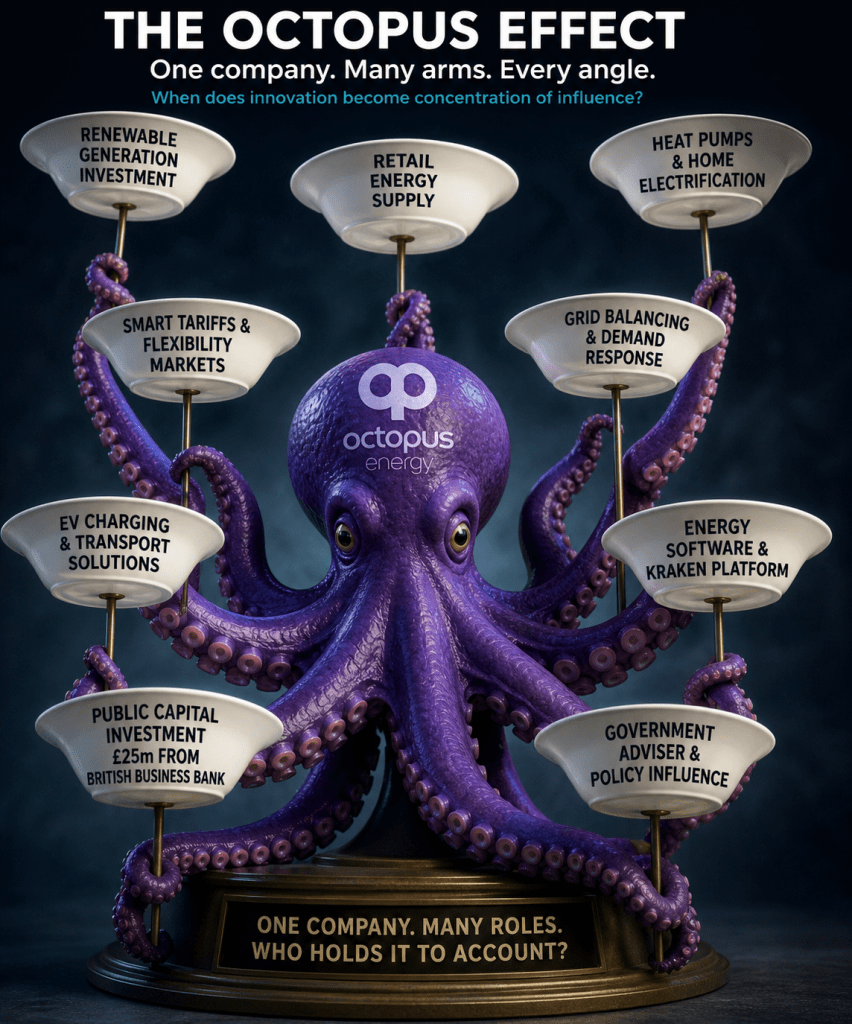
Today, the Octopus group sells electricity and gas, installs heat pumps, solar systems and batteries, operates electric vehicle charging platforms, participates in grid balancing services, runs smart demand-response tariffs, manages billions in renewable assets through its generation arm, and exports software infrastructure globally through Kraken Technologies.[2]
That matters because the same policy areas being aggressively promoted by the Department for Energy Security and Net Zero.
Heat electrification, smart energy systems, battery integration, flexible demand, and renewable deployment,are the same areas in which Octopus has strategically positioned itself for growth.
Again, that does not imply wrongdoing. It may simply reflect good business judgement.
But in a democracy, the question is not whether success is suspicious.
The question is whether success, influence, public policy, and government access are being independently examined when they begin to overlap.
This is where public interest becomes impossible to ignore.
Greg Jackson currently holds multiple unpaid advisory roles across government, including positions connected to the Cabinet Office, industrial strategy, and public service reform.[3]
At the same time, his company stands to benefit from many of the same government priorities:
Heat pump subsidies worth £2.7 billion through 2030.[4]
Expansion of smart-grid and flexibility markets.
Electrification of transport and domestic heating.
Continued public support for renewable deployment and battery integration.
Then, in 2026, the British Business Bank committed £25 million of taxpayer-backed capital into Kraken Technologies,Octopus’s software platform, describing it as its largest direct investment to date.[5]
Kraken was already valued in the billions.
So ordinary people are entitled to ask:
Why was taxpayer-backed capital flowing into an already highly valued company operating in markets already benefiting from government policy support?
And where exactly was the public debate before that decision was made?
Meanwhile, following the collapse of 27 suppliers during Britain’s energy crisis, Ofgem introduced tougher financial resilience requirements designed to protect consumers from future supplier failures.[6]
Public reporting later confirmed that some suppliers,including Octopus,did not initially meet those new capital targets but were allowed to continue operating under agreed recovery arrangements.[7]
That may be entirely within the rules.
But it raises another obvious public question:
If some of Britain’s biggest suppliers are operating under regulatory transition plans while simultaneously expanding, where is the visible public scrutiny?
Because here lies the real issue.
Ofgem regulates suppliers.
Department for Energy Security and Net Zero delivers Net Zero.
The British Business Bank supports scale-up investment.
Government appoints advisers.
Parliament debates policy.
But who, exactly, is looking at the whole picture?
Because when one company can simultaneously:
Supply millions of households,
Build renewable assets,
Trade grid flexibility,
Install consumer technology,
Operate critical energy software,
Receive public-backed investment,
And advise government…
…the public has every right to ask whether Britain’s institutions are still capable of independent scrutiny,or whether the energy transition is slowly becoming a system where policy, profit, and influence move in the same direction without anyone stepping back to ask who benefits most.
And that is not cynicism.
That is not conspiracy.
References
[1] Octopus Energy corporate reports and market statements, 2025–26
[2] Octopus Energy Group and Kraken Technologies public filings
[3] UK Government appointments records, Cabinet Office and Industrial Strategy Advisory Council
[4] Boiler Upgrade Scheme and DESNZ heat decarbonisation funding announcements
[5] British Business Bank investment announcement, January 2026
[6] Ofgem Financial Responsibility and Resilience Framework, 2025
[7] Ofgem Financial Resilience Transparency Report, 2025
Shane Oxer. Campaigner for fairer and affordable energy
 SAY NO TO THE DESTRUCTION OF OUR LAND
Leave a comment