Is Ed Miliband’s Net Zero push really the most affordable route to energy security , or are British households being asked to bankroll a system that still cannot stand on its own?
By Shane Oxer. Campaigner for fairer and affordable energy
Is this truly the most affordable route to energy security?
That is the question millions of British households should now be asking as energy bills rise again, grid costs continue climbing, and Britain’s electricity system remains heavily dependent on gas , even during some of the most favourable renewable conditions of the year.
For nearly two years, Ed Miliband has promised that Labour’s Clean Power Plan would deliver lower bills, greater energy independence, and long-term energy security. The message has been simple: build more offshore wind, cover more land with solar, install more battery storage, electrify transport and heating, and Britain will break free from volatile fossil fuel markets.
It is an attractive political narrative.
But engineering , and economics , are now beginning to tell a different story.
As of April 2026, the Ofgem energy price cap for a typical dual-fuel household stands at £1,641. Yet the latest forecast from Cornwall Insight projects that from July 2026, that cap could rise to approximately £1,929 , an increase of nearly £288, or around 18 per cent, in a single quarter. That is not a theoretical warning. It is the latest market projection based on wholesale costs, network charges, and system conditions.
So much for cheaper energy.
And perhaps most importantly, this increase is arriving before Britain has even entered the most expensive phase of the transition.
Before the largest transmission reinforcements are completed.
Before millions of additional electric vehicles place new demand on local networks.
Before widespread electrified heating begins to reshape winter demand.
Before the full infrastructure cost of the Government’s 2030 Clean Power target is passed through to households and businesses.
The public has been told that renewables are delivering energy independence. But the reality on Britain’s grid paints a far more complicated picture.
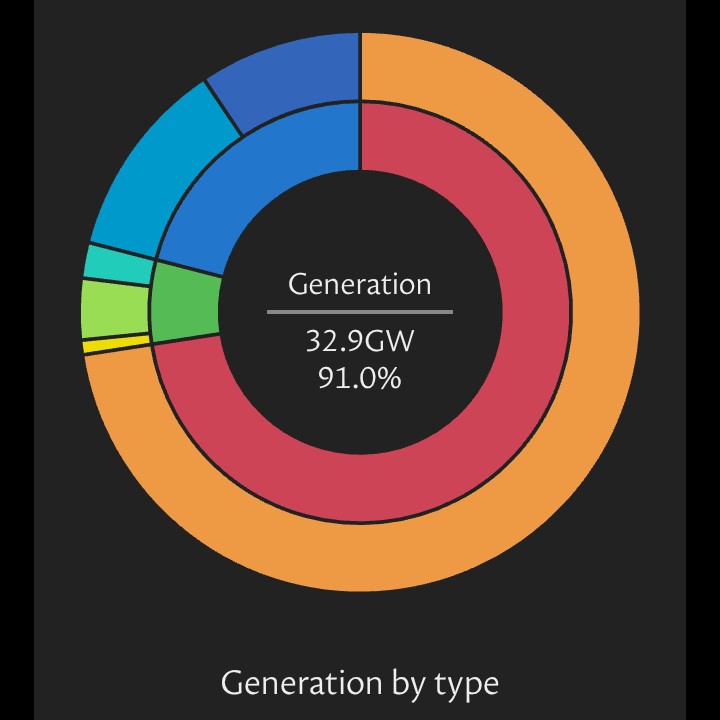
A live National Grid snapshot taken in May 2026 , one of the brightest months of the year, when solar generation is strong and daylight hours are long , still showed gas supplying a substantial share of Britain’s electricity at key points in the day. Solar performed strongly during daylight hours, as expected. But wind output remained highly variable, and dispatchable gas generation was still required to maintain system frequency, voltage stability, and supply security.
That is not climate politics.
That is power system engineering.
If gas is still essential in May, the obvious question is what happens in December, when solar output collapses after mid-afternoon, temperatures fall, electric heating demand rises, and high-pressure weather systems can leave wind generation depressed for days at a time.
This is where the public debate becomes far less comfortable.
Because the real cost of the transition is no longer just about building turbines or laying solar panels.
It is about managing an increasingly complex system that must constantly balance intermittent generation with real-time demand.
And that balancing is becoming extraordinarily expensive.
National Energy System Operator has warned that balancing and constraint costs , payments made to generators when the grid cannot physically move electricity to where it is needed , are already running at around £2 billion annually and could rise toward £8 billion a year by 2030 if grid reinforcement does not keep pace with renewable deployment.
That would represent a fourfold increase in system management costs within just a few years.
These are not costs for generating electricity.
These are the hidden costs of trying to manage an electricity system where power is often produced in the wrong place, at the wrong time, or faster than the network can transport it.
In plain English:
Consumers are increasingly paying generators to switch off.
They are paying other generators to switch on elsewhere.
They are paying for batteries to respond.
They are paying for backup gas capacity.
And they are paying for an ever-expanding network of substations, transformers, transmission lines, offshore landing points, and grid reinforcement to try and hold the system together.
That burden ultimately lands somewhere.
On family energy bills.
On industrial electricity prices.
On public borrowing.
Or through taxation.
Britain is now embarking on one of the largest electricity infrastructure programmes since the post-war rebuilding era.
Ofgem has already approved £28 billion of energy network investment, with total network reinforcement potentially rising much further by the early 2030s as new offshore wind, electrified transport, and distributed generation are connected to the grid. Ofgem’s own projections suggest network charges alone could add over £100 per household annually by the early 2030s.
That is before balancing costs.
Before backup capacity payments.
Before battery integration costs.
Before local distribution reinforcement.
Before additional policy levies.
So while ministers continue talking about cheap renewable energy, the underlying system costs continue moving in one direction.
Up.
Generation costs.
Network costs.
Balancing costs.
Constraint costs.
Storage costs.
Backup costs.
Every layer of the electricity system is becoming more complex, more capital-intensive, and ultimately more expensive.
And perhaps the most troubling part of all is transparency.
Questions continue to be raised about whether the Government is fully disclosing its internal modelling on electricity market reforms, grid congestion pricing, and the true consumer impact of its 2030 pathway.
If the economics support the policy ,
Why not publish the full modelling?
Why not show British households exactly what their bills are expected to look like in:
2027
2028
2030
Why not publish the full projected costs of:
Grid reinforcement
Curtailment payments
Backup generation
Battery deployment
System balancing
Industrial competitiveness impacts
Because the public is no longer debating climate ambition.
The public is now debating affordability.
Britain has made genuine progress in reducing power-sector emissions, and renewables do play an increasingly important role in the energy mix. But progress alone does not remove the obligation to tell the truth about costs, reliability, and engineering realities.
At present, Britain is not replacing fossil fuel dependence.
It is layering vast renewable infrastructure on top of a system that still depends on gas to keep the lights on.
And if gas is still essential , even in May ,
Then the British public has every right to ask:
Is this truly the most affordable route to energy security… or the most expensive political experiment in modern Britain?
References
[1] Ofgem – Domestic Energy Price Cap (April–June 2026).
[2] Cornwall Insight – July 2026 Price Cap Forecast.
[3] National Energy System Operator – Balancing and Constraint Cost Forecasts.
[4] Ofgem – Network Investment and RIIO-3 infrastructure approvals.

 SAY NO TO THE DESTRUCTION OF OUR LAND
Leave a comment