The Great Climate Assumption: Did Britain Base Net Zero on an Implausible Future?
For more than a decade, Britain’s climate debate has been conducted on a simple assumption: that the most alarming projections represented the most likely future.
The Climate Change Committee (CCC), the Met Office and the Department for Energy Security and Net Zero (DESNZ) have repeatedly justified sweeping economic and social changes by pointing to escalating climate risks.
Yet one of the key foundations underpinning that narrative , the high-emissions RCP8.5 scenario used prominently within UKCP18 climate projections , is now widely regarded by many researchers as an increasingly implausible pathway rather than a realistic business-as-usual forecast.
The question policymakers must now answer is simple:
To what extent was Britain’s Net Zero strategy built upon assumptions that no longer reflect the most likely future?
This is not a question of whether climate change exists. Nor is it an argument against environmental stewardship.
Britain should continue to reduce pollution, improve resilience and invest in cleaner technologies where they make economic and engineering sense.
The issue is whether the country has allowed worst-case modelling assumptions to evolve from a useful risk-management tool into the primary justification for policies that are reshaping the economy, the energy system and the countryside.
The distinction matters because public policy should be built upon probable outcomes, not merely possible ones.
Engineers design bridges to withstand extreme loads, but governments do not normally organise entire economies around the assumption that the worst conceivable event is the most likely.
Yet that is arguably what happened within climate policy. Over time, scenarios developed to explore high-end climate risks became embedded within regulatory impact assessments, adaptation plans, infrastructure design standards and Net Zero targets.
The result was that uncertainty gradually disappeared from public discussion, replaced by a narrative that presented increasingly severe outcomes as the expected destination unless extraordinary intervention occurred.
At the centre of this debate sits UKCP18, the Met Office’s flagship climate projection programme. Published in 2018, it became the principal source of long-term climate evidence for Whitehall, local authorities, regulators and the Climate Change Committee.
The projections were frequently cited to support claims of significantly hotter summers, more intense rainfall, increased flooding risk and growing heat-related impacts across the United Kingdom.
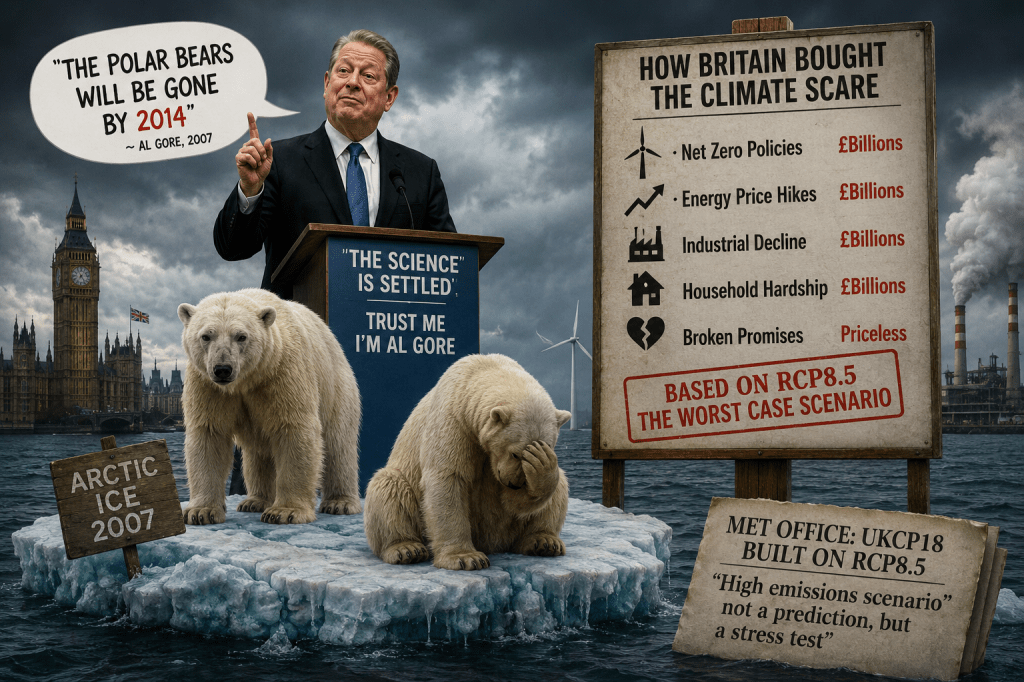
While UKCP18 contained a range of scenarios, its most prominent findings were derived from RCP8.5, a pathway assuming continuously rising emissions throughout the century and a substantial increase in global fossil fuel consumption.
At the time, the scenario was often presented as a plausible continuation of existing trends.
Today, however, even many climate researchers regard that interpretation as increasingly difficult to sustain. Studies published over the last five years have questioned whether the assumptions underpinning RCP8.5 , particularly regarding future coal consumption and population growth , remain realistic in light of technological developments, changing energy markets and observed emissions trajectories. The scenario still has value as a stress test, but a stress test is not the same thing as a forecast.
That distinction lies at the heart of the growing credibility problem facing Britain’s climate institutions.
If the scenario underpinning many of the most alarming projections is now considered low probability, then a legitimate public interest question arises. How much of Britain’s Net Zero programme, adaptation spending and regulatory framework was justified by reference to outcomes that were always intended to represent the upper edge of possible risk rather than the most likely future?
Shane Oxer. Campaigner for fairer and affordable energy
 SAY NO TO THE DESTRUCTION OF OUR LAND
Leave a comment