The situation unfolding at Port Talbot is a perfect example of how Britain’s energy and industrial policy has been driven by ideology first and engineering reality second.
For years, politicians, quangos, and climate bodies have pushed the rapid dismantling of traditional industry in pursuit of Net Zero targets, insisting that replacement infrastructure would follow. Yet once again, the country is discovering that the physical systems required to support this transition simply are not ready.
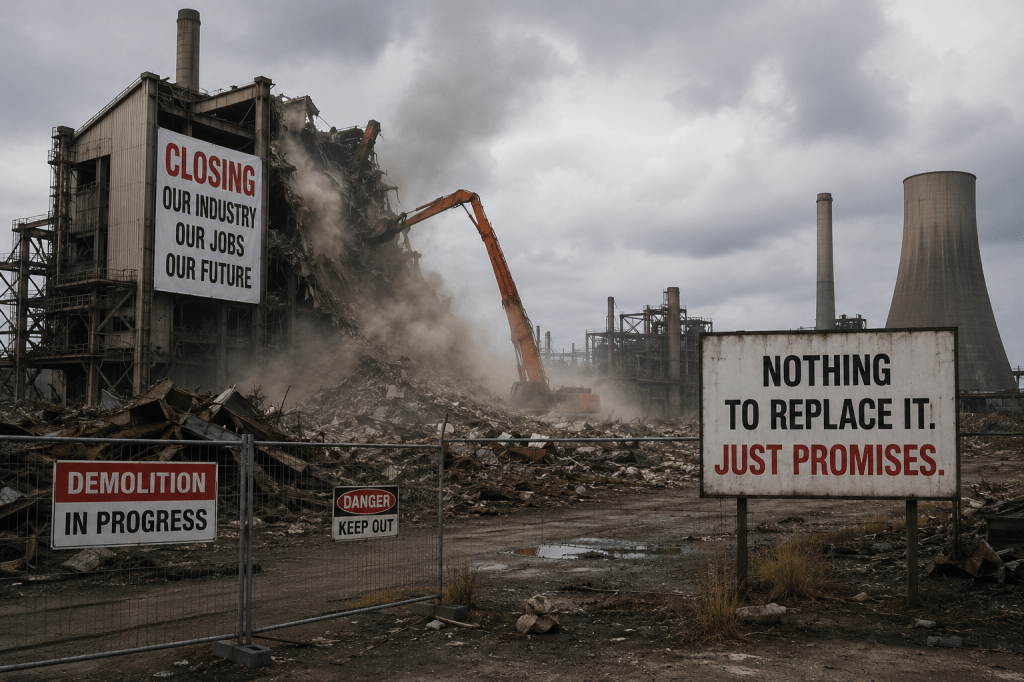
At Port Talbot, thousands of skilled steelworkers lost their livelihoods as the blast furnaces were shut down in favour of a £1.25 billion electric arc furnace transition.
Workers were told this was the future of “green steel” and modern industrial Britain. Now, Tata Steel itself is warning that the project could be delayed by up to eight months because the National Grid can not provide the electrical infrastructure required to power it.
This is not a minor technical issue. It goes to the heart of the entire Net Zero strategy.
Electric arc furnaces are hugely electricity-dependent. Unlike traditional blast furnaces, they can not operate without stable, high-capacity grid connections. Yet Britain is attempting to electrify heavy industry while simultaneously running one of the most constrained and overstretched electricity systems in Europe.
The result is a national policy being exposed in real time as fundamentally backwards.
We are dismantling proven industrial capacity before the replacement systems exist.
We shut down coal power stations before reliable replacement generation and storage were available. We discouraged domestic gas production while becoming more dependent on imports. We overloaded the grid with intermittent renewable generation before transmission infrastructure was upgraded. Now we are closing strategic steelmaking assets only to discover the electrical backbone required for their replacement is years behind schedule.
This is not “transition planning”. It is managed industrial decline disguised as climate policy.
The political class continues to speak in slogans about “green growth” and “clean energy jobs”, yet communities like Port Talbot are living through the opposite reality:
thousands of lost industrial jobs,
reduced domestic production capacity,
dependence on imported steel,
soaring electricity costs,
and now delays caused by a grid system that can not support the very transition government demanded.
The most alarming part is that this was entirely predictable.
Warnings about grid constraints, transformer shortages, substation delays, transmission bottlenecks, and lack of dispatchable generation have existed for years. National Grid, NESO, industrial groups, and energy analysts have repeatedly highlighted the growing mismatch between political ambition and engineering capability.
Yet ministers continued accelerating decarbonisation targets while ignoring the physical limitations of the system.
Britain is now facing the consequences of trying to run a modern industrial economy on political timelines rather than infrastructure reality.
Steel is not a luxury industry. It is a strategic national capability tied to defence, construction, transport, manufacturing, and energy infrastructure itself. Weakening domestic steelmaking while relying increasingly on imports from countries with higher emissions and lower labour standards makes little economic or environmental sense.
The deeper issue is that Net Zero policy has increasingly prioritised carbon accounting over national resilience.
Instead of asking: “How do we maintain industrial strength while reducing emissions?” the policy framework has too often become: “How fast can we eliminate legacy systems regardless of the consequences?”
That approach is now colliding with reality.
A serious industrial strategy would have rebuilt the grid first, secured abundant reliable electricity generation, modernised transmission infrastructure, expanded domestic gas resilience during transition years, and protected strategic industries until replacement systems were fully operational.
Instead, Britain repeatedly tears down existing infrastructure before replacement capacity is proven.
Port Talbot is not an isolated problem. It is a warning.
It exposes a growing national contradiction: the government wants an electrified industrial future, yet the country still lacks the grid capacity, generation stability, storage capability, and infrastructure resilience required to support it.
The danger is that Britain ends up trapped in the worst of both worlds: deindustrialised, energy insecure, dependent on imports, and paying some of the highest electricity prices in the developed world ,
Shane Oxer — Campaigner for fairer and affordable energy
 SAY NO TO THE DESTRUCTION OF OUR LAND
Leave a comment