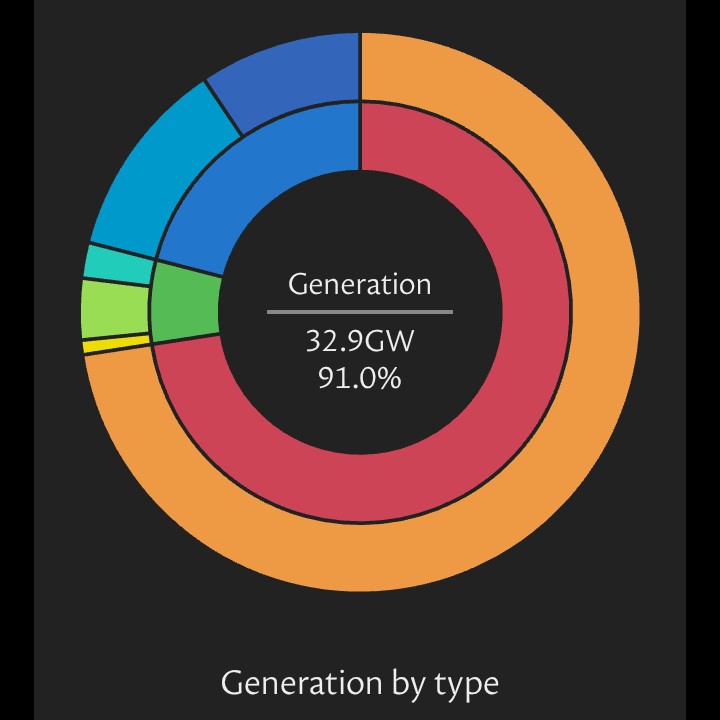
Today’s National Grid snapshot tells the story better than any ministerial speech.
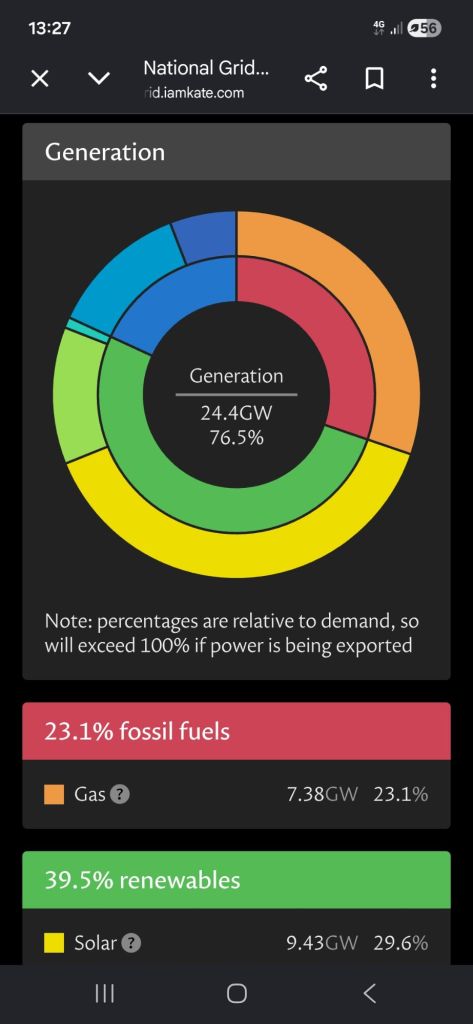
At the time of the screenshot, Britain was generating around 24.4GW of electricity. Gas was providing 7.38GW, or 23.1% of demand. Solar was producing around 9.4GW to 10GW, while wind was producing only around 3GW.
That is the Net Zero problem in one image.
Britain has spent years building a power system that looks impressive on paper but fails the basic test of reliability. We now have roughly 32GW of operational wind capacity across onshore and offshore wind, and more than 21GW of installed solar capacity. Yet at this moment, wind was producing only around 3GW.
That does not mean wind never performs well. It means something far more important: installed capacity is not the same as dependable power.
A wind farm may be listed as “capacity”. A solar farm may be listed as “capacity”. A battery storage scheme may be described as “flexibility”. But none of that means the system can reliably deliver electricity when households, hospitals, businesses, schools, factories, trains and data centres actually need it.
This is the truth DESNZ and NESO have failed to explain honestly to the British public.
Solar was performing strongly in today’s screenshot because it was daytime. But solar disappears every evening and falls dramatically in winter, precisely when national demand is highest. Wind can surge one day and collapse the next. Batteries may help for short periods, but they do not solve the deeper problem of seasonal intermittency or long-duration system stress.
So despite all the political promises, gas was still required.
That is not a minor technical point. It is the central failure of the current energy strategy.
For years, the public has been told that wind and solar would deliver cheap, clean, secure power. What they were not told clearly enough is that weather-dependent generation requires a vast supporting system: new transmission lines, pylons, substations, transformers, balancing services, backup generation, storage, curtailment management and emergency dispatchable power.
Those costs do not disappear. They land on bills.
The Times has now reported that cost-of-living campaigner Will Hodson, co-founder of Look After My Bills, has urged Ed Miliband to pause further offshore wind expansion because wind farms have been built faster than the grid infrastructure needed to carry their power. He described the situation as a scandal: wind farms are expanded, the grid cannot transmit all the electricity, and consumers end up paying constraint payments when generation has to be switched off.
That is exactly the failure many of us have been warning about for years.
The scandal is not simply that wind and solar are intermittent. That has always been known. The scandal is that DESNZ and NESO have pushed ahead with a generation-first policy while the grid, storage, transmission system and balancing arrangements are still years behind.
This is not an accident. It is a structural failure.
DESNZ has pursued the Clean Power 2030 agenda with targets for a massive expansion of offshore wind, onshore wind and solar. The Government’s own plan refers to 43–50GW of offshore wind, 27–29GW of onshore wind, and 45–47GW of solar power by 2030.
But where is the honest public explanation of the infrastructure needed to make those numbers usable?
Where is the fully costed plan for the pylons, substations, Super Grid Transformers, synchronous compensation, grid reinforcement works, control systems and backup generation needed to keep the lights on?
Where is the bill impact assessment for ordinary households?
Instead, the public is sold a slogan: cheap, clean, homegrown energy.
But the reality is proving far more expensive.
NESO itself has admitted the core problem in plain language. Balancing costs are rising because large volumes of wind generation, especially in the north, cannot always reach demand in the south. Put simply, as NESO has said, “the cables don’t exist yet.”
That one sentence destroys the entire Net Zero sales pitch.
If the cables do not exist yet, why are consumers being forced to subsidise more generation that the system cannot properly use?
If the grid is not ready, why are rural communities being asked to accept more solar farms, wind projects, battery storage compounds, pylons and substations?
If the infrastructure is years behind, why are DESNZ and NESO still treating every new renewable project as automatic progress?
This is the Great Net Zero Scandal: Britain is building energy infrastructure in the wrong order.
The correct order should be obvious:
Grid first. Reliable generation first. Storage and balancing proof first. Consumer protection first.
Instead, the system has been built backwards:
Targets first. Subsidies first. Developer profits first. Grid later. Consumer bills last.
That is why households are paying for wasted energy.
When the wind blows in the wrong place and the grid cannot carry the electricity, wind farms may be paid to reduce output. At the same time, other forms of generation, often gas, may have to be brought on elsewhere to meet demand. The consumer is then hit twice: once for the renewable build-out, and again for the balancing cost of making the system work despite its own design flaws.
This is not energy security.
It is managed dysfunction.
NESO and DESNZ cannot claim they were not warned. Grid constraints have been visible for years. Connection queues have been clogged. Transmission reinforcements have been delayed. Major substations and transformer upgrades are years away in many parts of the country. Yet projects continue to be pushed through the planning system as if generation capacity alone solves the problem.
It does not.
Today’s screenshot proves the point.
Wind: around 3GW.
Solar: around 10GW.
Gas: still required.
Total generation: around 24.4GW.
That is despite years of political claims that renewables would free Britain from fossil fuels and cut bills. In reality, the system still needs gas because wind and solar cannot be dispatched on demand. They generate according to the weather, not according to national need.
Solar may look strong at lunchtime in summer, but it is no answer to a still winter evening. Wind may surge during a storm and collapse during a calm spell. Batteries can smooth short-term fluctuations, but they cannot provide the firm, long-duration, national-scale security that a modern industrial economy requires.
And yet DESNZ keeps driving the country deeper into dependency on weather-dependent infrastructure.
This is where NESO must also be held to account.
NESO is not merely a passive observer. It is responsible for operating the electricity system and advising on the future shape of that system. If it knows that constraint costs are rising, if it knows the grid cannot carry all the power being generated, and if it knows the cable infrastructure does not yet exist, then it has a duty to be brutally honest with ministers and the public.
Instead, the public gets carefully managed language about “flexibility”, “clean power”, “network upgrades” and “transition”.
That is not good enough.
A serious national energy strategy would begin with the grid. It would ask what power can be moved, where, when and at what cost. It would prioritise firm, dispatchable generation. It would protect consumers from avoidable constraint costs. It would stop approving large-scale generation schemes in grid-constrained areas until the infrastructure exists to use them.
Above all, it would stop pretending that more weather-dependent capacity automatically means lower bills.
Consumers are not paying high energy bills because Britain lacks ambition. They are paying because the energy system has been redesigned around targets rather than engineering reality.
DESNZ set the direction. NESO manages the consequences. Developers profit from the rollout. Households pay for the waste.
That is the scandal.
Until ministers admit that the grid is not ready, that constraint costs are a public failure, and that installed renewable capacity is not the same as reliable power, the same mistakes will continue: more projects, more pylons, more balancing costs, more constraint payments, and higher bills for ordinary people.
The answer is not to accelerate the failure.
The answer is to stop, investigate and rebuild the policy around engineering reality.
Britain needs a grid-first energy strategy. It needs reliable domestic generation. It needs proper scrutiny of NESO and DESNZ. It needs an end to the fantasy that consumers can be endlessly charged for a system that does not work as promised.
The public should not be forced to pay for wasted energy.
The public should not be forced to fund a broken transition.
And the public should not be told that this failure is success.
This is the Great Net Zero Scandal — built before the grid, paid for by the people.
Shane Oxer — Campaigner for fairer and affordable energy
References
1. National Grid live generation screenshot supplied by the author, captured at approximately 13:27, showing total generation of around 24.4GW, gas generation of 7.38GW, solar generation of approximately 9.43GW, and wind generation noted at approximately 3GW.
2. Department for Energy Security and Net Zero, Clean Power 2030 Action Plan: A new era of clean electricity, GOV.UK. This document sets out the Government’s 2030 deployment ranges, including 43–50GW offshore wind, 27–29GW onshore wind and 45–47GW solar power.
3. National Energy System Operator, Energy Explained: The costs of balancing Britain’s electricity system to keep you powered. NESO states that balancing costs are increasing from around £2 billion a year to as much as £8 billion by 2030, with more than 60% linked to thermal constraints where wind generation cannot reach demand because the necessary cables do not yet exist.
4. National Energy System Operator, Thermal Constraint Costs Data Portal. NESO explains that thermal constraints occur when electricity flows would exceed the capacity of circuits connecting one region to another.
5. The Times, “End wind farm scandal to halt energy bills, Ed Miliband urged”. The article reports comments from Will Hodson, co-founder of Look After My Bills, urging a pause in further offshore wind expansion until the grid and constraint-payment problem is investigated.
6. RenewableUK, Offshore Wind. RenewableUK states that the UK has more than 16GW of operational offshore wind capacity.
7. RenewableUK EnergyPulse, UK Onshore Wind Pipeline Report 2025. RenewableUK reports operational UK onshore wind capacity at approximately 15.8GW.
8. Department for Energy Security and Net Zero, Solar photovoltaics deployment statistics, GOV.UK. DESNZ publishes monthly statistics on UK solar PV deployment and installed capacity.
9. International Energy Agency Photovoltaic Power Systems Programme, United Kingdom solar PV profile. The IEA PVPS reported that the UK had around 21.6GW of installed solar capacity by the end of December 2025.
10. Octopus Energy, Wasted Wind / constraint cost commentary. Octopus Energy has highlighted the cost of turning off wind generation when the grid cannot use it, describing this as a major cost to consumers from an outdated electricity system.
 SAY NO TO THE DESTRUCTION OF OUR LAND
Leave a comment