Here’s a ready-to-use WordPress Classic Editor blog draft using your screenshots.
The Subsidy Clock: Watch Britain’s Energy Subsidy Bill Rise in Real Time
I opened The Subsidy Clock today and took three screenshots within a short period.
What I saw should concern every household, every pensioner, every business, and every taxpayer in Britain.
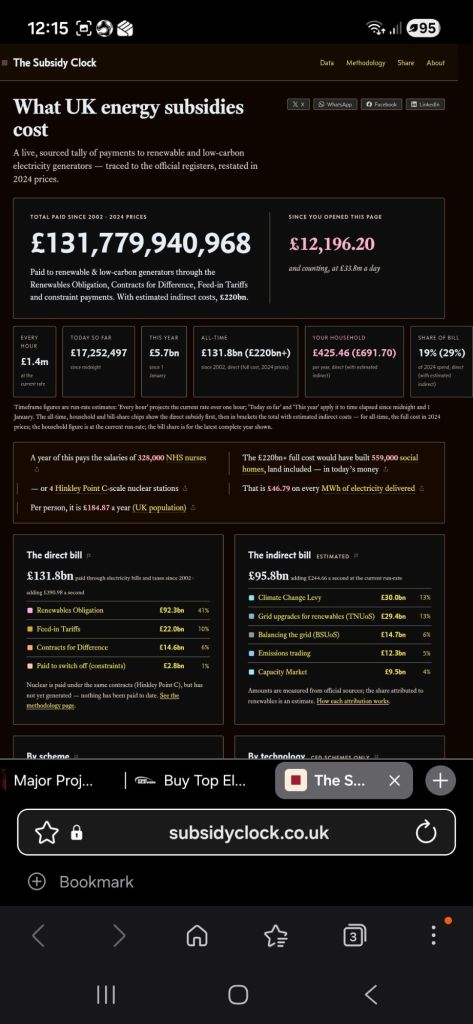
The counter moved from:
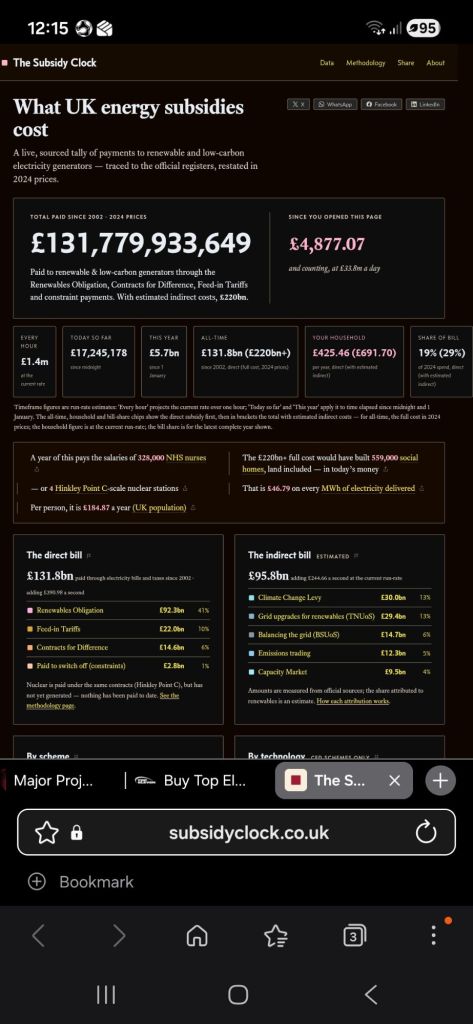
£131,779,933,649
to:
£131,779,940,968
That is an increase of:
£7,319.13
in the space of the screenshots.
This is not a theoretical debate. This is the visible cost of Britain’s energy policy ticking upwards before our eyes.
Caption: The Subsidy Clock showing £131.779bn already paid since 2002 in 2024 prices.
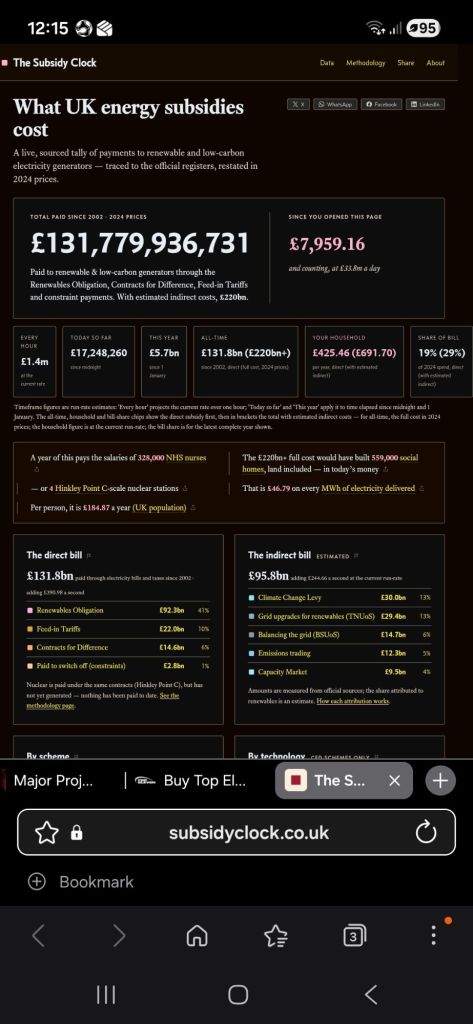
Caption: Seconds later, the counter has already risen by thousands of pounds.
Caption: By the final screenshot, the figure has risen by £7,319.13.
According to the site, The Subsidy Clock is a “live, sourced tally” of payments to renewable and low-carbon electricity generators, traced to official registers and restated in 2024 prices. It includes direct schemes such as the Renewables Obligation, Feed-in Tariffs, Contracts for Difference, and constraint payments. The site also shows estimated indirect costs separately.
https://subsidyclock.co.uk/
The figures on the page are staggering. At the time of the screenshots, the direct total stood at about £131.8 billion, with the site showing a wider estimated total of £220 billion-plus once indirect costs are included. The site’s own dashboard explains that its headline chips show direct subsidy first, with wider estimated indirect costs in brackets.
And the clock keeps moving.
The site explains that its live counter is based on recent run-rate estimates. In other words, this is not claiming that a physical payment is made every single second. It is showing the current subsidy burden translated into a real-time counter, using recent scheme data and replacing estimates with official figures as they are published.
But that makes it no less serious.
Because whether the payment is settled daily, monthly, annually, through bills, through levies, through grid charges, or through taxation, the reality is the same:
The public pays.
The Subsidy Clock also breaks the direct bill down by scheme. In the screenshots, the largest direct cost is the Renewables Obligation, followed by Feed-in Tariffs, Contracts for Difference, and payments made to switch off generation when the grid cannot take the power.
That last point matters.
Britain is not just paying to generate power. We are also paying, in some cases, for power not to be generated — because the grid is unable to carry it where and when it is needed. The methodology page states that constraint payments relate to wind farms instructed to reduce output when the grid cannot carry their electricity.
This is the central failure of the current energy strategy.
For years, politicians told the public that renewables would bring cheap energy. But households now face a system layered with subsidies, balancing costs, grid upgrades, constraint payments, capacity payments and carbon-related costs. The public sees only the final bill. The machinery behind it is hidden in acronyms.
RO. FIT. CfD. TNUoS. BSUoS. ETS. Capacity Market.
Most people do not know what these mean. But they are paying for them.
The Subsidy Clock makes the invisible visible.
It turns a complex, buried, bureaucratic cost structure into something people can immediately understand: a bill that keeps rising.
This is why Britain needs an honest national debate about energy.
We cannot keep pretending that the present system is cheap. We cannot keep approving vast solar schemes on farmland, more wind farms, more battery storage sites, and more grid expansion without asking who pays, how much it costs, and whether it actually delivers reliable power when Britain needs it.
A serious energy policy would start with reliability, affordability and sovereignty.
That means rebuilding the grid around firm generation. It means supporting domestic nuclear, including Small Modular Reactors. It means using our own gas resources responsibly while the transition is made. It means putting rooftop and industrial-site solar ahead of farmland sprawl. And it means ending the fantasy that covering countryside with panels and pylons will somehow produce cheap, secure electricity.
The screenshots tell a simple story.
While politicians talk, the bill rises.
While officials publish strategies, the bill rises.
While countryside is targeted for more infrastructure, the bill rises.
And while ordinary households are told to accept higher standing charges, higher electricity bills, and more “green” costs, the bill rises still further.
The public deserves to know the truth.
This is not cheap energy.
This is a subsidy machine.
And it is running every hour of every day.
Source note: The Subsidy Clock states that every figure on the counter traces to official sources and that the data files behind the dashboard are published as CSV files regenerated from the same daily build as the dashboard.
Shane Oxer. Campaigner for fairer and affordable energy
 SAY NO TO THE DESTRUCTION OF OUR LAND
Leave a comment