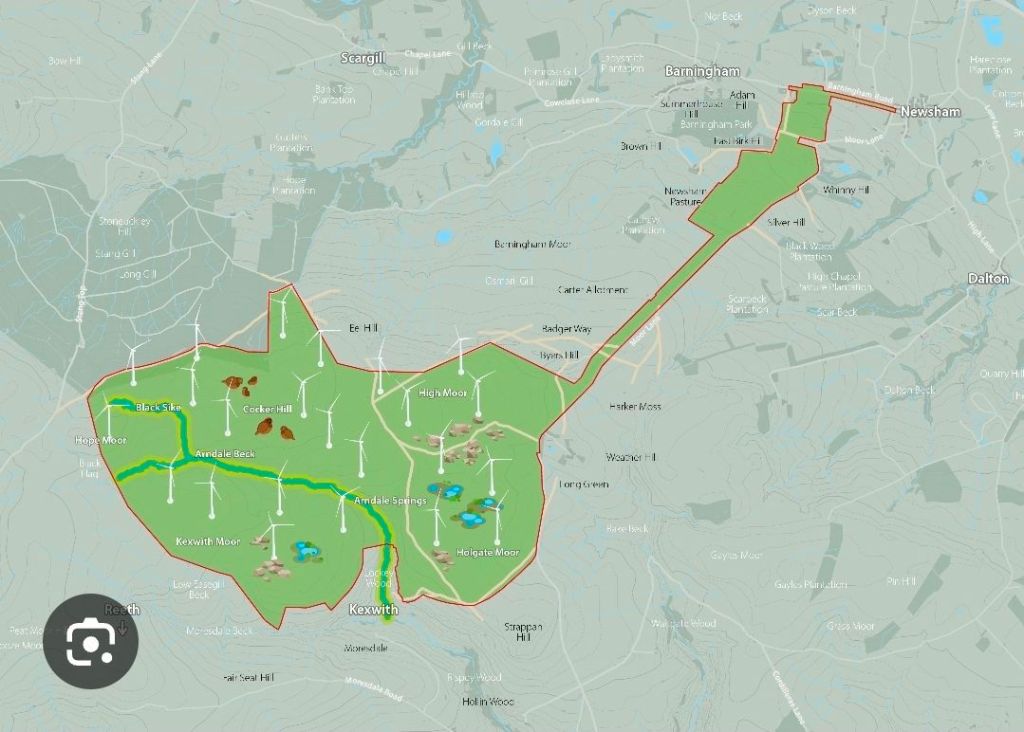
Look at the proposed Hope Moor Wind Farm map and ask one simple question:
Is this really the best Britain can do?
More than a thousand hectares of upland countryside, peat, watercourses, habitat and landscape would be brought into the orbit of an industrial energy scheme, not for firm power, not for 24-hour baseload, not for electricity that can be relied upon every hour of every day, but for an intermittent energy source that depends entirely on the weather.
The developer’s own Environmental Impact Assessment Scoping Report says the Hope Moor site extends to approximately 1,111 hectares. It proposes up to 23 wind turbines, each with a maximum tip height of 200 metres, and an installed capacity currently anticipated at up to 165.6 MW. The report estimates annual output of approximately 454,055 MWh per year, equivalent to an average delivered output of only around 51.8 MW across the year. In other words, the scheme’s own figures imply an average output of roughly 31% of installed capacity.
That is the first truth the public must understand.
A 165.6 MW wind farm is not the same thing as 165.6 MW of reliable power.
Wind is not available on demand. It is not 24/7. It is not 365 days a year. It rises and falls with weather conditions, and when the wind drops, the system still needs backup, balancing, reserve power, grid management and additional infrastructure.
An SMR, by contrast, is designed for firm baseload generation. It is not literally never offline , all serious power stations require planned maintenance , but in system terms nuclear is a 24/7, 365-days-a-year technology. The global nuclear fleet achieved an average capacity factor of 83% in 2024, with North American reactors averaging 90%. That is the difference between weather-dependent generation and dependable generation.
Now compare Hope Moor with one Rolls-Royce Small Modular Reactor.
A single Rolls-Royce SMR is designed to generate 470 MW and provide consistent baseload generation for at least 60 years. Rolls-Royce says one SMR power station would occupy the footprint of around two football pitches and could power approximately one million homes.
Using the global nuclear average capacity factor of 83%, one 470 MW SMR would produce around 3.42 TWh per year. At a 90% capacity factor, it would produce around 3.71 TWh per year.
Hope Moor’s own forecast is 0.454 TWh per year.
So one SMR would produce roughly 7.5 to 8.2 times more electricity every year than Hope Moor, depending on whether the comparison uses the global nuclear average or the higher-performing North American nuclear average.
Put another way: to match the annual output of one SMR, Britain would need the equivalent of around eight Hope Moor wind farms.
That means roughly:
184 giant turbines.
More than 8,800 hectares of affected land.
Multiple upland landscapes industrialised.
Eight sets of access tracks, crane pads, substations, cabling, haul roads and watercourse crossings.
And even that still would not provide the same product, because wind would remain intermittent.
The lifetime comparison is even starker. Hope Moor is proposed for an operational life of up to 30 years. A Rolls-Royce SMR is designed for at least 60 years. Hope Moor’s own lifetime output over 30 years would be around 13.6 TWh. One SMR operating for 60 years at an 83% capacity factor would produce around 205 TWh. At 90%, it would produce around 222 TWh.
That means one SMR could produce around 15 to 16 times more lifetime electricity than one Hope Moor wind farm.
So why are we being asked to sacrifice vast areas of countryside for low-density intermittent generation when compact, reliable, British-built nuclear technology could deliver far more power from a tiny fraction of the land?
This is not just about energy. It is about land. It is about hydrology. It is about peat. It is about watercourses, wildlife, landscape character, rural communities and the direction of national policy.
The Hope Moor scoping report confirms that this is not simply a matter of placing turbines in fields. The project would involve turbine foundations, external transformers, underground electrical cabling, hardstanding areas, access tracks, site accesses, watercourse crossings, haul roads for construction vehicles, onsite substations, compounds, construction compounds, batching plant, borrow pits, drainage, CCTV, fencing, lighting, highway modifications and other associated works.
For each turbine, the report assumes foundations of up to 25 metres diameter and hardstanding areas including crane pads of up to 4,150 square metres, plus blade laydown areas of up to 2,050 square metres. The crane pad area would remain in place for servicing, maintenance, component replacement and decommissioning.
That matters because Hope Moor is not empty land. It is an upland hydrological system.
The scoping report identifies extensive deep peat greater than 200 cm across central and western areas, shallower peat along the eastern access track, and widespread peatland erosion and drainage features. It also records localised deep peat reaching a maximum depth of 4.91 metres.
It also accepts that, because of the number of watercourses on the site, the project could not be developed without some watercourse crossings. The report scopes in hydrology and hydrogeology impacts including increased runoff rates, flood risk from impermeable hardstanding, restriction of flow at permanent watercourse crossings, changes in natural surface water drainage patterns, and changes to groundwater levels and groundwater movement.
That is not environmental protection. That is environmental risk management after the decision to industrialise the landscape has already been made.
The developer may say these risks can be mitigated. But the proper question is more fundamental:
Why take this risk at all for intermittent generation when one compact SMR could produce many times the electricity from a tiny physical footprint?
Then there is the grid question.
Hope Moor’s own website says recent changes to grid connection processes mean the grid connection point will not be confirmed until later in the development timeline. It also states that the grid connection route and method do not form part of this application and would instead be progressed through a separate application.
That is highly significant. The public is being asked to assess a major upland wind proposal before the full grid picture is known.
This matters because similar large wind proposals are already exposing the same national problem. You have identified Calderdale as a comparable case, with grid-related material pointing towards a 2035 timeframe. That point should be used carefully: it is not proof that Hope Moor would have the same date, but it is powerful evidence of the wider issue. Large renewable projects are being promoted as urgent, yet their grid reality may sit years into the future.
And that changes the argument completely.
If the practical grid horizon for schemes of this kind is drifting towards the mid-2030s, then the question is not “wind now or nuclear later”. The fairer question is:
If both technologies are realistically fighting for the same mid-2030s grid window, why choose the one that consumes vast land, disrupts peat and hydrology, and produces intermittent power?
The government selected Rolls-Royce SMR as preferred bidder in June 2025, and Great British Energy , Nuclear said it would aim to connect projects to the grid in the mid-2030s. Rolls-Royce also says it is working with government and regulators to deliver power to the grid by the mid-2030s.
So the timing argument can no longer be dismissed.
If a wind project is not yet fully grid-defined, and if comparable grid infrastructure is pointing into the 2030s, then Britain has a strategic choice to make. Do we spend the next decade consenting more industrial sprawl across sensitive landscapes, or do we build firm, compact, sovereign generation that actually strengthens the grid?
The cost comparison also needs honesty.
Supporters of onshore wind often quote low headline generation costs. DESNZ’s 2025 electricity generation cost report gives onshore wind projects commissioning in 2035 a capex-sensitivity range of £33/MWh to £55/MWh, with a medium case of £41/MWh. But the same report warns that technologies play different roles in the power system and that it is not appropriate simply to compare LCOEs when technologies perform different functions.
That warning is crucial.
A wind MWh is not the same product as a nuclear MWh.
Wind is weather-dependent. Nuclear is firm. Wind needs balancing. Nuclear provides stable baseload. Wind output may arrive when it is not needed and disappear when demand is high. Nuclear can operate day and night, winter and summer.
The Office for Budget Responsibility has made the same broader point: a full assessment of energy costs must reflect more than generator construction and operating costs. It must take account of dispatchability, weather-dependence, location, grid connection and balancing. The OBR notes that many renewables, particularly solar and onshore wind, require more smaller-scale generators to be connected and balanced on the grid, increasing overall system costs.
Using the DESNZ medium onshore wind figure of £41/MWh, Hope Moor’s forecast 30-year output of around 13.6 TWh would imply a narrow generator-cost benchmark of roughly £558 million over its life. But that figure does not buy firm power. It buys intermittent generation when the wind is available.
To produce the same lifetime electricity as one SMR operating for 60 years at an 83% capacity factor — around 205 TWh — Hope Moor-style wind generation would require approximately 15 Hope Moor 30-year equivalents. At the same DESNZ £41/MWh benchmark, that would imply around £8.4 billion of generator-only wind cost, before properly accounting for the additional system costs of intermittency, balancing, curtailment and grid reinforcement.
Rolls-Royce SMR cost estimates should also be treated honestly. Early SMR cost projections are not the same as a final delivered UK fleet cost. But the published design target reported by Ingenia was around £1.8 billion for a 470 MWe power station, with a target LCOE of £35–£50/MWh, including waste management and decommissioning. The government has pledged more than £2.5 billion for the overall SMR programme in the Spending Review period.
So the serious comparison is not “cheap wind versus expensive nuclear”.
The serious comparison is this:
Intermittent energy sprawl across sensitive land
versus
compact, firm, British-built baseload generation.
Hope Moor would place 23 turbines up to 200 metres high across an upland landscape with peat, watercourses, hydrological sensitivity and long-term ecological risk.
One Rolls-Royce SMR would generate many times more electricity from a compact site, operate for twice as long, support British engineering, provide firm power, and strengthen national energy sovereignty.
Wind turbines also do not last forever. WindEurope states that the operational lifetime of an onshore wind turbine is typically 20–25 years, after which operators face lifetime extension, repowering or decommissioning. It also notes that turbine blades are more complex to recycle than most other turbine materials.
Hope Moor’s own report anticipates a 30-year operational life, with routine maintenance, inspection and the possibility of component replacement.
So the countryside is asked to carry the disruption twice: first during construction, then again decades later when the project must be repowered, replaced or decommissioned.
By contrast, SMRs are designed around long-life, high-density generation. Fewer sites. Less land. More power. Greater reliability. Better strategic resilience.
That is the choice Britain should be debating.
Not slogans.
Not ideology.
Not “renewables good, nuclear bad.”
Not glossy artist impressions of turbines on empty-looking hills.
The real question is this:
How much land are we prepared to sacrifice for energy that is not there when the wind stops blowing?
Hope Moor exposes the madness of the current policy direction. We are being asked to industrialise vast areas of upland countryside for an energy source that averages around 52 MW from a 165.6 MW scheme, while a single compact SMR could deliver around 390–423 MW average output depending on the capacity factor used.
That is the difference between energy density and energy sprawl.
Britain does not need to cover its countryside in turbines and panels to keep the lights on. It needs reliable generation, proper grid planning, nuclear baseload, gas resilience, domestic engineering, and local technologies such as rooftop solar where they make sense without consuming farmland and moorland.
Hope Moor is not the future.
It is a warning.
A warning that we are confusing installed capacity with usable power.
A warning that we are sacrificing landscapes before grid reality is even settled.
A warning that peat, hydrology and rural communities are being treated as collateral damage.
A warning that Britain’s energy policy has lost sight of energy density, reliability and common sense.
The better path is clear.
Stop sacrificing vast landscapes for intermittent energy sprawl. Build compact, reliable, sovereign power instead.
Shane Oxer. Campaigner for fairer and affordable energy
 SAY NO TO THE DESTRUCTION OF OUR LAND
Leave a comment