What looks like one electricity substation is really the gateway to a much larger transformation of Rotherham’s countryside
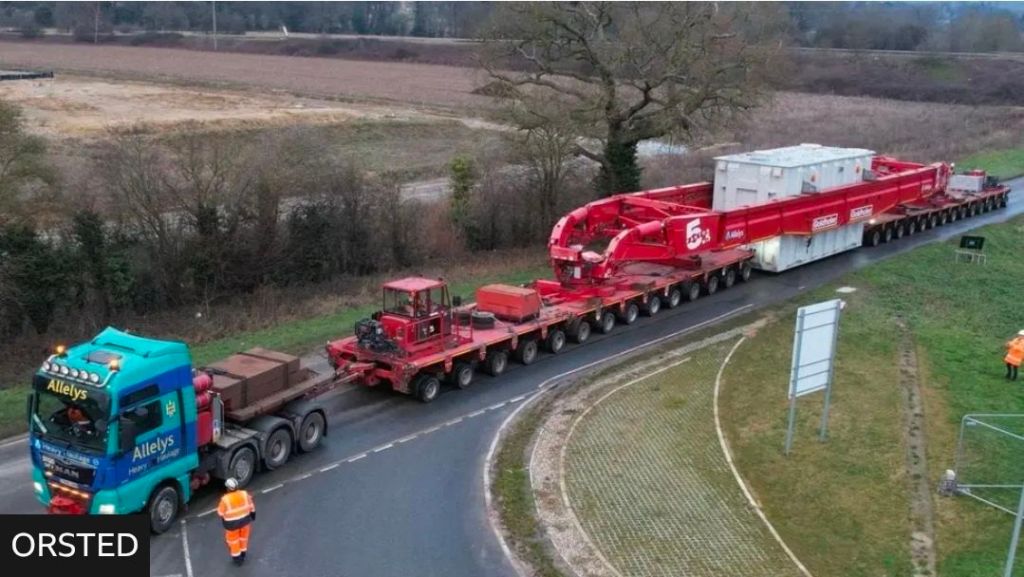
A supergrid transformer changes the voltage of electricity. It does not generate electricity. The proposed Long Lane substation is designed to contain two of these enormous machines.
Look carefully at the photograph of the Supergrid Transformer.
This is the physical reality hidden behind phrases such as “clean-energy transition”, “network reinforcement” and “The Great Grid Upgrade”.
A Supergrid Transformer, commonly shortened to SGT, is an enormous piece of electrical equipment. National Grid explains that its purpose is to change electricity from one voltage to another so that power can move between the high-voltage transmission network and lower-voltage systems. These machines commonly weigh well over 150 tonnes and require specialist vehicles, police escorts and carefully planned delivery routes.
National Grid
But an SGT is not a generator.
It does not produce electricity.
It cannot replace a gas-fired power station, a nuclear reactor or any other source of dependable generation. It can only transform and transmit electricity that has already been produced somewhere else.
Now look at the photograph of the shunt reactor.

A shunt reactor manages reactive power and helps control voltage. It does not generate the dependable electricity required during a cold, windless winter period.
A shunt reactor is another vast piece of grid machinery. National Grid describes it as equipment used to absorb or manage reactive power and keep voltage levels stable across an alternating-current transmission system. Recent National Grid installations have weighed around 130 tonnes.
National Grid
Again, it produces no electricity.
The proposed Long Lane development is expected to contain two Supergrid Transformers, one shunt reactor and power-quality equipment, including an indicative static compensator. These were identified in the applicant’s own noise assessment as the principal operational noise sources of the scheme.
These photographs therefore tell us something important.
Brinsworth is not merely getting a small local electricity installation. Rotherham is being asked to surrender countryside for a major 400kV transmission hub containing some of the largest and heaviest machines used anywhere on the electricity network.
This is not an extension hidden inside the existing substation
National Grid says there is insufficient room at the existing Brinsworth substation off West Bawtry Road. It therefore proposes an entirely new facility on land east of Long Lane, between Brinsworth, Whiston and the M1.
The site extends to approximately 18 hectares and is predominantly agricultural land. The principal compound would measure approximately 252 metres by 196 metres, surrounded by security fencing, with a substation building reaching approximately 14.5 metres in height. Gantries, electrical plant, internal roads, drainage infrastructure, lighting, CCTV, an emergency diesel generator and associated earthworks would surround it.
National Grid
The council’s planning report confirms that the development would include:
Two Supergrid Transformers.
One shunt reactor.
A power-quality filter.
Circuit breakers and disconnectors.
A relay room.
A Gas Insulated Switchgear control building.
Access roads, fencing, drainage and security infrastructure.
This is industrial infrastructure on a scale that will permanently change the character of the land.
It is not a few electrical cabinets placed behind a hedge.
The land itself must be reconstructed
The site slopes substantially, so National Grid cannot simply place the equipment on the existing ground.
The applicant’s documents describe excavating approximately 166,000 cubic metres of material and using a similar quantity as engineered fill. Cuttings could reach approximately 8.4 metres, while areas of fill could be around 7 metres deep.
That means digging into one side of the landscape, processing or moving the material, and using it to create an enormous artificial platform on the other.
This is not minor levelling.
It is the industrial re-engineering of a hillside.
Once completed, the original landform will have gone. In its place will be a vast engineered platform, electrical compounds, buildings, roads, fencing, drainage ponds, earth bunds, gantries and overhead-line connections.

Landscaping may eventually obscure parts of it from certain viewpoints. It cannot return the land to what it was.
Green Belt did not stop being green, it was reclassified in planning language
The land is within Rotherham’s Green Belt.
It is not previously developed industrial land. The council’s own report accepts that it is not previously developed land but nevertheless concludes that it can be treated as “grey belt” because officers considered that it did not strongly perform certain Green Belt functions.
That distinction matters.
The countryside has not physically become grey. It has become administratively convenient to describe it that way.
The officer report acknowledges that the proposal will result in the permanent loss of agricultural land and hedgerow and will introduce engineered landforms into a predominantly rural landscape. Nevertheless, it concludes that the effects are localised and can be mitigated.
There were 345 letters of objection, only one letter of support, and a petition bearing 61 signatures. Several parish councils also objected.
Despite that level of opposition, officers recommended that the council enter into a Section 106 agreement securing £24,954 for Biodiversity Net Gain monitoring and then grant permission subject to conditions.
The item went before Rotherham Planning Board on 16 July 2026. At the time this article was prepared, the public planning portal had not yet been updated with a formal decision notice.
The ground investigation did not close the question
One of the most concerning parts of this application is the way the ground investigation has been presented.
The Jacobs report describes the 2024 investigation as preliminary and says that further intrusive investigations were anticipated to support detailed design.
At the time of writing, Jacobs had not been given detailed information about the sizes and weights of the proposed plant, buildings and equipment. Its foundation commentary was therefore based on likely ground conditions rather than the final loading of the actual equipment.
The report specifically states that foundation bearing capacity should be confirmed once foundation sizes and loads are known. It also says the investigation was inconclusive over whether an overhead-line foundation could fall within opencast backfill and that more investigation was required.
In the south-western section, the possible presence of opencast backfill was considered a high risk. Jacobs recommended further ground investigation at the actual location of the proposed overhead-line works once safe access became available.
The report’s conclusion could hardly be clearer:
The understanding was based on limited data from one phase of investigation.
Important risks were still not fully understood.
The location, extent and nature of opencast backfill remained uncertain.
Further intrusive investigation was recommended.
Further groundwater monitoring was necessary.
Geotechnical parameters should be reconsidered during detailed design.
Planning permission can legally be accompanied by conditions and later design approvals. But local people are entitled to ask a very simple question:
Should the principle of placing two enormous transformers, a shunt reactor, buildings and 400kV infrastructure on a heavily re-engineered former mining landscape be accepted before the foundation loads and ground model have been fully reconciled?
What are they really building?
Brinsworth is best understood as a traffic junction for electricity.
It will not be a power station. It will not contain a primary source of energy. It will transform voltage, regulate the system and allow greater quantities of electricity to pass through the network.
National Grid says the Long Lane substation is needed to uprate the existing Brinsworth-to-Chesterfield transmission line from 275kV to 400kV. A new substation is also proposed near Chesterfield, while the linked Chesterfield-to-High Marnham project would continue the 400kV reinforcement into Nottinghamshire.
National Grid presents these schemes separately. Together they create a reinforced high-voltage corridor running through Brinsworth, Chesterfield and High Marnham.
The juggernaut does not stop at the substation fence.
A separate application was submitted in June 2026 for permanent and temporary diversion works to the National Grid 400kV overhead transmission line around Long
Rotherham Planning
National Grid says the existing line can be uprated without a conventional planning application because it was originally authorised to operate at 400kV, although new works connecting the line into the substations require separate Electricity Act consent.
National Grid
This is therefore a sequence:
The new Long Lane substation.
The overhead-line alterations.
The uprating from 275kV to 400kV.
The new Chesterfield substation.
The reinforcement onward to High Marnham.
The connection corridors.
And, eventually, the generation and storage developments seeking access to the reinforced network.
Rotherham Council’s own March 2026 minutes recorded that the proposed Whitestone Solar Farm boundary included possible cable routes to both the existing Brinsworth substation and the proposed Long Lane site because the new facility had not yet been approved or constructed. That did not confirm a final connection, but it demonstrated how the proposed substation was already influencing the design of other major energy schemes.
This is why Long Lane must not be viewed in isolation.
It is enabling infrastructure.
The winter question nobody should avoid
A strong electricity grid is necessary.
Britain has allowed parts of its transmission system to age while connection queues, congestion and network costs have grown. Reinforcement is therefore needed.
But reinforcing a grid is not the same as securing the energy that flows through it.
National Grid’s own explanation of the equipment proves this distinction. The SGT changes voltage. The shunt reactor controls reactive power and voltage stability. Neither creates electricity.
The proposed Brinsworth substation will produce nothing itself , not for several days in winter, not for one hour in summer.
It can only carry what is available.
That becomes critical during a cold, still and overcast period when wind and solar generation can fall simultaneously. NESO uses the term Dunkelflaute for these events and acknowledges that they raise significant concerns, particularly when they coincide with peak electricity demand.
National Energy System Operator (NESO)
During such a period, a larger grid does not make the wind blow.
A 400kV line does not create sunshine.
A shunt reactor cannot replace a generating station.
A Supergrid Transformer cannot manufacture the power it transforms.
Electricity must then come from dependable generation, storage capable of lasting through the whole event, imports , assuming neighbouring countries have spare power , or demand reduction.
That is the flaw at the heart of the present strategy.
The country is committing vast areas of land and billions of pounds to the machinery required to connect, balance and transmit an increasingly weather-dependent system, while the fundamental question of reliable generation is repeatedly pushed into the future.
This is not an argument against the electricity grid
It is important to be clear.
The argument is not that transformers, substations or transmission lines are unnecessary.
They are essential parts of any modern electricity system.
The argument is about what kind of electricity system Britain is building.
Had the country committed to a grid-first strategy alongside dependable nuclear generation, domestic gas capacity, efficient combined-cycle power stations and genuinely useful local generation, the case for reinforcement would be rooted in energy security.
Instead, the public is told that almost every piece of land, every new pylon, every industrial compound and every rise in network expenditure is justified because it contributes to Net Zero.
That turns an engineering question into an article of faith.
A grid designed principally around intermittent production needs more transmission, more balancing equipment, more reactive-power control, more storage, more reserve generation and more emergency intervention.
The SGT and shunt-reactor photographs are not separate from the renewable rollout.
They are part of the hidden infrastructure required behind it.
The coming culmination
Brinsworth is not the culmination.
It is an opening move.
Once the substation and reinforced corridor exist, they will be cited as justification for further connections. Every new development will be presented as making use of infrastructure already constructed. Each project will be examined through its own planning boundary even though the cumulative transformation will be far larger.
One solar development.
One battery installation.
One cable route.
One pylon diversion.
One widened access.
One substation.
Taken separately, each may be described as manageable.
Taken together, they become the industrialisation of the Rother Valley and the countryside surrounding Rotherham.
That is the coming juggernaut of Net Zero.
Not one dramatic decision, but hundreds of interconnected decisions, each surrendering another piece of land and each justified by the infrastructure approved before it.
Rotherham deserved a more honest debate
Residents should have been told plainly that this is not simply a local substation improvement.
It is a new 400kV strategic hub.
It contains two enormous Supergrid Transformers and a shunt reactor.
It requires the reconstruction of an agricultural hillside.
It forms part of a much wider transmission corridor.
It will facilitate further energy connections.
It generates no electricity.
And it cannot solve the fundamental problem of prolonged low wind and solar output during winter.
The real question was never whether Britain requires an effective electricity network.
Of course it does.
The question was whether Rotherham should permanently surrender Green Belt countryside to enable an energy strategy that continues expanding weather-dependent generation without first securing enough dependable, controllable power.
The photographs show the scale of the machinery.
The planning documents show the scale of the earthworks.
The grid plans show the scale of what is coming next.
Rotherham is not merely being asked to host a substation.
It is being placed in the path of the Net Zero juggernaut.
Shane Oxer. Campaigner for fairer and affordable energy
 SAY NO TO THE DESTRUCTION OF OUR LAND
Leave a comment