They came back to the Moor
There are landscapes in England that seem to exist outside of time. Places where the walls still follow the contours of the hills exactly as they did centuries ago, where the wind carries the sound of curlew across the heather, and where a walker reaching the high ground can still experience something increasingly rare in modern Britain: silence. Not the silence of emptiness, but the silence of a landscape that has been shaped by generations of human stewardship rather than industrial ambition.
Hope Moor, on the edge of the northern Pennines, is one of those places.
To those passing through, it may appear to be little more than open upland , remote, exposed, perhaps even harsh. But to those who know it, who have walked it, farmed it, studied it, or simply stood upon it as the evening light falls across the peat and heather, it is something far more valuable.
It is part of a living landscape whose value cannot be measured in megawatts, balance sheets, or carbon accounting models. It is part of the cultural and ecological inheritance of northern England.
And it is now under threat once again.
What makes this story so powerful is that this is not the first time such a battle has been fought here.
More than two decades ago, communities around Barningham Moor found themselves confronting plans to industrialise these same uplands.
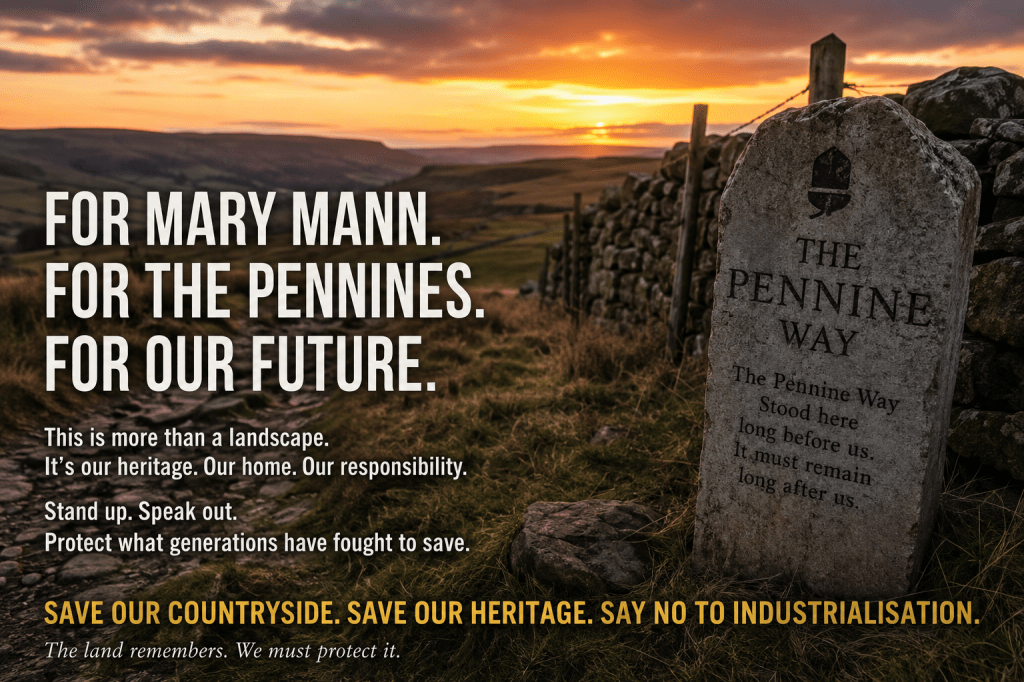
At the centre of that resistance was Mary Elizabeth Mann, a determined local voice who understood what many planners and developers still fail to grasp:
once the character of a landscape is fundamentally altered, it is almost never restored.
Mary Mann was not a politician. She was not an environmental celebrity or a career activist. She was something far more powerful , an ordinary citizen who understood that some places matter beyond economics. She understood that moorland is not “vacant land.” It is not “underutilised space.” It is habitat, heritage, memory, and identity. Alongside others, she helped galvanise opposition to proposals that many local people believed would permanently scar one of the North’s most precious landscapes.
That earlier battle became part of local memory. Many believed it had settled the question once and for all. They believed that the moors had been defended, that the arguments had been heard, and that future generations would not have to fight the same battle all over again.
Yet today, under the banners of climate policy, energy security, and Net Zero, the same moorland finds itself facing a new and far larger proposal. Developers have returned, armed with more polished marketing, stronger political backing, and turbines that are vastly taller than those proposed a generation ago.
The language has changed, but the landscape facing industrialisation is the same.
This time, the public is being told that such developments are necessary, inevitable, even virtuous. They are shown computer-generated images of elegant turbines against golden skies, accompanied by promises of clean electricity and reduced emissions. What they are not shown quite so clearly are the roads cut across peatland, the concrete foundations buried beneath the heather, the heavy machinery crossing fragile ground, or the decades of industrial access required to maintain such infrastructure once it is built.
Standing on Hope Moor today, it is impossible not to feel that history is repeating itself. The same arguments about progress. The same assurances about minimal impact. The same suggestion that those who object are somehow standing in the way of the future.
But perhaps the deeper question is this:
if these landscapes have survived for centuries, and if one generation fought so hard to protect them, what right does ours have to surrender them so easily?
That is why Hope Moor matters. Not simply because it is beautiful, although it is. Not simply because it stores carbon, although it does. Not simply because it supports wildlife, although it unquestionably does. It matters because it represents something increasingly rare in modern Britain , the idea that not every landscape exists to be exploited.
And for those who remember Mary Mann or who understand what she stood for, this is not merely another planning consultation.
It is an unfinished business.
Tomorrow: Part II — The Great Carbon Contradiction
How can Britain claim to save the climate by disturbing one of its greatest natural carbon stores?
Shane Oxer. Campaigner for fairer and affordable energy
 SAY NO TO THE DESTRUCTION OF OUR LAND
Leave a comment