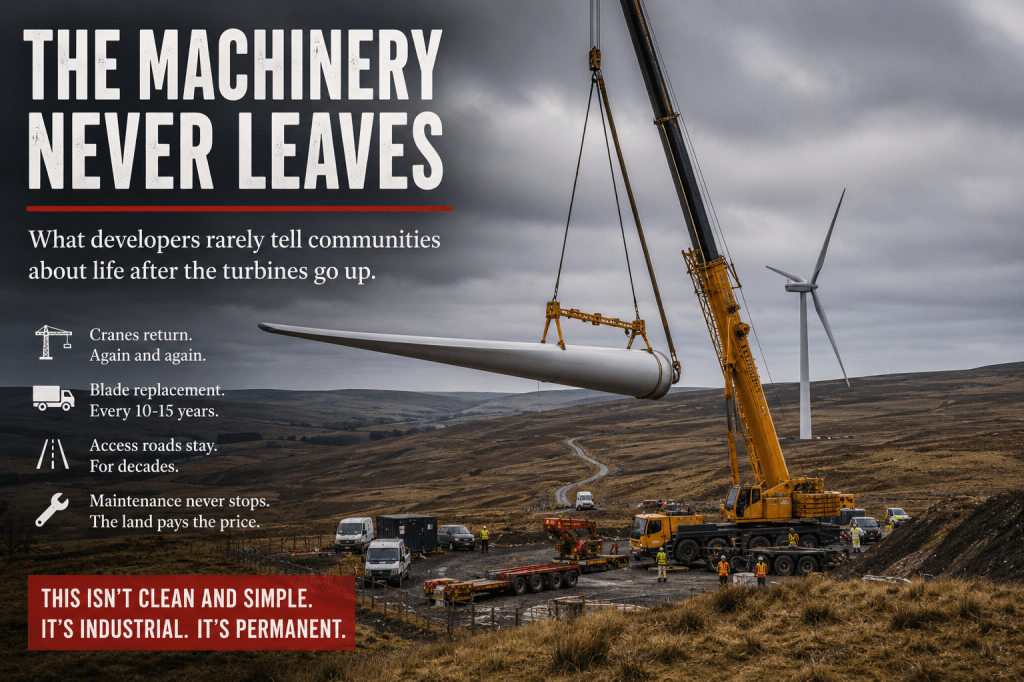
The Machinery Never Leaves.
What developers rarely tell communities about life after the turbines go up
There is a carefully cultivated image that surrounds modern wind energy.
It is the image found in consultation brochures, government policy papers, and glossy promotional videos: turbines turning gracefully against a blue sky, birds circling overhead, clean electricity flowing silently into Britain’s homes.
The impression is deliberate.
Build the turbines. Generate the power. Leave nature to carry on as before.
But on moorland like Hope Moor, that image tells only half the story.
Because what developers rarely explain—at least not in the headlines—is that a wind farm is not a one-off construction project.
It is the beginning of a permanent industrial relationship with the land.
And once the machinery arrives, it never truly leaves.
To install turbines on upland peatland requires far more than simply erecting steel towers. It means excavated foundations, thousands of tonnes of concrete, reinforced crane pads, cable trenches, drainage interventions, construction compounds, access roads capable of carrying abnormal loads, and the continuous movement of heavy engineering equipment across some of Britain’s most sensitive landscapes.
And that is just the beginning.
Because turbines do not simply stand untouched for twenty-five years.
They require constant inspection. Mechanical servicing. Electronic upgrades. Gearbox repairs. Transformer replacement. Hydraulic systems. Blade inspections. Emergency interventions after storms. Lightning strike repairs. Structural monitoring.
And sometimes, something much larger.
Blade replacement.
Few members of the public realise that modern turbine blades—despite their size and engineering sophistication—do not always last the full operational life of a wind farm. Exposure to wind shear, rain erosion, temperature changes, lightning strikes and material fatigue means major refurbishment or replacement can be needed during a project’s lifetime.
Which means the cranes return.
The escort vehicles return.
The abnormal-load convoys return.
The maintenance compounds remain.
And the roads cut across the moor continue serving industrial traffic long after the ribbon-cutting ceremony has been forgotten.
At Hope Moor, that matters enormously.
Because this is not brownfield land.
This is peatland.
Every return journey, every crane mobilisation, every heavy axle crossing, every engineering intervention carries a cumulative environmental cost. Soil compaction. Surface disturbance. Hydrological changes. Pressure on drainage systems. Habitat fragmentation. Noise. Light. Vehicle emissions.
In other words, the environmental footprint of a wind farm does not end when construction finishes.
It becomes embedded into the landscape for decades.
This is one of the great omissions in the modern energy debate.
Communities are shown artist impressions of turbines on a skyline.
They are rarely shown the cranes coming back fifteen years later.
They are told about annual carbon savings.
They are rarely shown the diesel engines, the escort convoys, the specialist transport fleets, or the replacement parts travelling hundreds of miles to reach remote upland sites.
And yet all of it forms part of the true environmental cost.
For landscapes like Hope Moor, the question is no longer whether turbines can generate electricity.
Of course they can.
The real question is whether Britain fully understands what it is agreeing to when industrial infrastructure is embedded into living landscapes for a generation or more.
Because once the roads are cut…
Once the compounds are built…
Once the access routes are hardened across peat…
The machinery does not leave.
And neither do the consequences.
Tomorrow: Part VI — The Grid Nobody Sees
Why turbines are only the beginning — substations, batteries, cable corridors, and the industrial footprint hidden beyond the skyline.
Shane Oxer — Campaigner for fairer and affordable energy
 SAY NO TO THE DESTRUCTION OF OUR LAND
Leave a comment