The Grid Nobody Sees.
Because the turbines are only the beginning.
There is a carefully constructed illusion at the heart of Britain’s modern energy debate.
Communities are shown elegant artist impressions of wind turbines turning quietly against open skies. Clean. Silent. Harmless. Symbols of progress.
It is a powerful image.
And it is only half the truth.
Because a wind farm is never just a wind farm.
Behind every turbine lies an industrial system most communities never see until it is too late—substations, transformer compounds, cable trenches, access roads, crane pads, drainage works, construction compounds, security fencing, service vehicles, lighting infrastructure, maintenance routes, and in many cases the possibility of further associated development as grid demands grow.
This is the infrastructure nobody talks about.
And this is where the real footprint begins.
At Hope Moor, the turbines may dominate the public conversation, but the turbines are only the visible part of a much larger industrial network now being prepared for one of northern England’s most treasured upland landscapes.
Because generating electricity is only the first step.
Exporting it is another.
Every megawatt produced on this moor must travel somewhere. That means underground cable corridors cut through open ground. It means switching stations. Transformer compounds. Excavated trenches. Service routes. Engineering compounds. Permanent access roads capable of carrying abnormal loads. And decades of industrial maintenance to keep it all operational.
This is not simply renewable energy.
This is permanent industrial infrastructure embedded into a living landscape.
And once you understand that, the consultation brochures begin to look very different.
Because what is being proposed at Hope Moor is not merely a collection of turbines on a skyline.
It is the gradual transformation of open moorland into part of Britain’s expanding energy network.
And once roads are cut through peatland…
Once cable corridors cross blanket bog…
Once substations rise where skylarks once nested…
You do not simply “restore” what was there before.
You change the land for generations.
That is why Hope Moor matters.
Not because people oppose energy.
Not because people reject technology.
But because there is a growing sense across rural Britain that environmental policy has begun to forget the environment itself.
We are told this is about saving the climate.
Yet the land beneath these turbines may already be one of Britain’s most important natural carbon stores.
We are told this is about protecting the future.
Yet some of the country’s most peaceful and ecologically sensitive landscapes are increasingly being treated as industrial corridors.
And perhaps nowhere is that contradiction more painful than here.
Because for many local people, this fight did not begin with planning applications, government policy, or investor presentations.
It began with one woman.
Mary Elizabeth Mann understood these moors long before developers ever saw them as development opportunities. She understood their archaeology, their silence, their wildlife, and their history. She understood that these landscapes were not empty spaces waiting to be used—but living places carrying centuries of human and natural memory.
More than twenty years ago, she stood at the centre of the battle to defend Barningham Moor, helping resist industrial development on these same uplands when many believed the landscape could be lost forever.
She believed some places should not be industrialised simply because technology made it possible.
Mary passed away in 2017.
But the land she fought for remains.
And now, the same moors face the same battle again, only larger, wealthier, politically stronger, and wrapped in the language of climate virtue.
So perhaps the real question is no longer what Mary Mann would do.
The real question is:
Will we do what she once did?
Will walkers speak?
Will conservationists speak?
Will the people who have crossed the Pennine Way, watched curlew rise from the heather, or stood on these hills and felt the silence of England’s uplands
speak while there is still something left to protect?
Because once you industrialise a living landscape.
you do not get it back.
And if Hope Moor falls, it will not simply be a planning decision.
It will be a statement about what modern Britain now values
and what it is prepared to lose.
Call to Action
If you care about Britain’s peatlands…
If you care about the Pennines…
If you care about the landscapes that shaped generations…
Then now is the time to stand up.
For Hope Moor.
For Mary Mann’s legacy.
And for the countryside that still belongs to all of us.
Shane Oxer. Campaigner for fairer and affordable energy

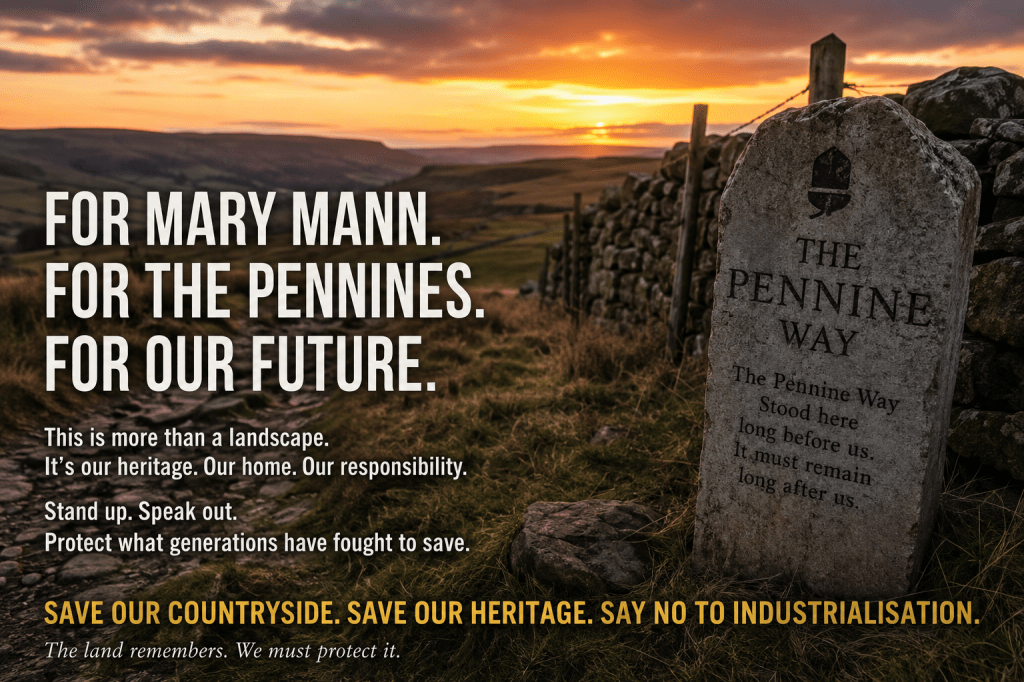
 SAY NO TO THE DESTRUCTION OF OUR LAND
Leave a comment