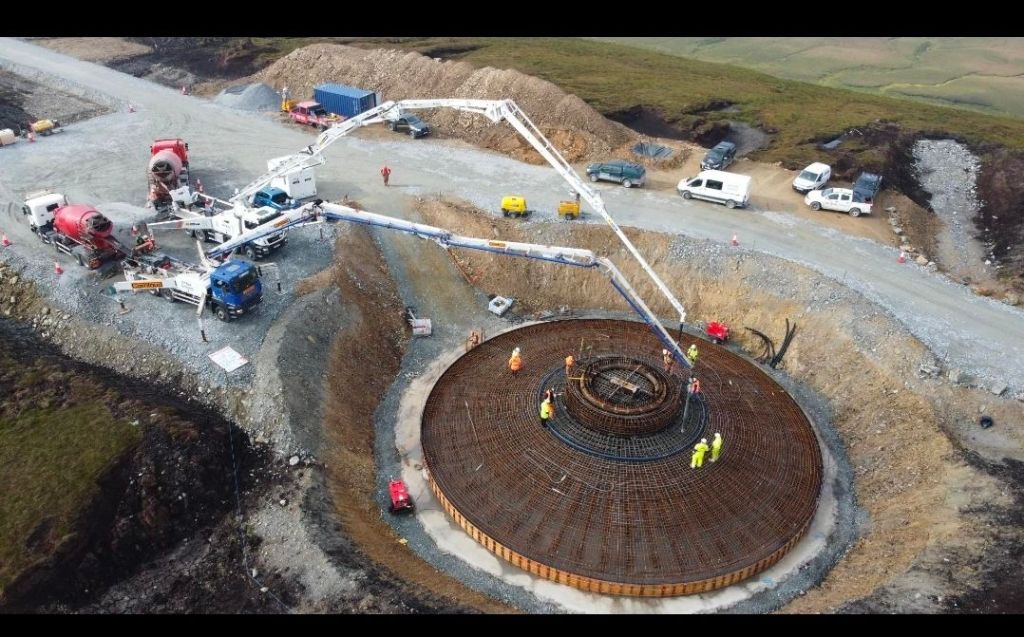
Look closely at this image.
What you are seeing is not a footpath improvement. Not habitat restoration. Not landscape recovery.
This is a massive reinforced concrete turbine foundation, being poured into upland terrain—an industrial platform designed to anchor turbines approaching 200 metres in height.
For many, this is presented as “green progress.”
But for those following what is now happening at Hope Moor and in the proposed Calderdale Energy Park, it raises a serious question:
Are we reducing environmental damage , or simply relocating it?
The Forgotten Value of Peat
Britain’s upland peatlands are not wasteland.
They are some of the country’s most important natural carbon stores, holding centuries , sometimes millennia , of captured carbon. They regulate water flow, support rare wildlife, and help reduce downstream flooding.
Yet increasingly, these same landscapes are being targeted for large-scale energy infrastructure:
Turbine bases
Crane pads
Access roads
Cable trenches
Borrow pits
Construction compounds
Each intervention may appear manageable on paper.
But when repeated dozens of times across sensitive moorland, the cumulative effect becomes industrialisation of fragile ecosystems.
What the Planning Evidence Shows
The documents submitted for Calderdale raise serious concerns.
Your formal planning objection identifies:
Gaps in peat probing data
Reliance on interpolated peat modelling
Hydrological uncertainty around upland catchments
Potential impacts on blanket bog and drainage systems
Questions over whether peat avoidance was genuinely prioritised �
Calderdale planning Objection.docx
This matters because under UK energy infrastructure policy, developers are expected to avoid sensitive peatland first , not damage it and promise mitigation later.
That is a critical distinction.
Concrete in Carbon Sinks
The image above shows what “green infrastructure” can actually mean on the ground:
A massive excavation. Steel reinforcement. Hundreds of tonnes of concrete.
For larger turbines, these foundations can contain hundreds of tonnes of material, sometimes more depending on terrain and load requirements.
When placed on upland peat systems, questions must be asked:
What carbon is released during excavation?
What happens to natural water movement?
Can blanket bog really be restored once drainage patterns are altered?
Who pays for long-term decommissioning?
These are not fringe questions.
They are core environmental questions.
Hope Moor and Calderdale: A Test Case
Hope Moor and Calderdale are becoming symbols of a wider national conflict.
Not a conflict between “climate deniers” and “environmentalists.”
But between two competing visions of environmental stewardship:
One says build at speed.
The other asks whether destroying natural carbon sinks in the name of carbon reduction makes ecological sense at all.
Britain cannot claim to protect biodiversity, restore peatlands, and reduce flood risk , while simultaneously permitting industrial-scale excavation into the same landscapes.
That contradiction is becoming harder to ignore.
Shane Oxer. Campaigner for fairer and affordable energy
 SAY NO TO THE DESTRUCTION OF OUR LAND
Leave a comment