For months, campaigners, engineers and local communities have been warning that Britain’s energy debate is focused on the wrong question.
The issue is no longer whether more wind farms, solar farms and battery schemes can be approved. The issue is whether the electricity grid can actually connect them.
This week, one of the biggest names in the industry effectively confirmed those concerns.
SSE, the UK’s largest renewable energy generator, has announced that it is unlikely to meet its own 2030 renewable generation target.
The reasons given were telling:
grid connection delays, infrastructure constraints, policy uncertainty and planning delays affecting key projects.
This is significant because SSE is not an opponent of renewable energy. It is one of the companies expected to deliver the Government’s Clean Power 2030 ambitions. If a company of this scale is warning that its targets are now unlikely to be met, serious questions must be asked about the credibility of the wider national strategy.
For years, politicians have spoken as though approving more renewable projects automatically delivers more electricity. The reality is very different.
Electricity generation is only one part of the system.
Every wind farm, solar farm and battery installation requires substations, transformers, transmission lines, control systems and network reinforcement before power can reach homes and businesses. Across the country, those upgrades are running years behind the ambitions being placed upon them.
This is not speculation. It is visible throughout the UK’s connection queues and infrastructure programmes.
Projects are being approved faster than the grid can absorb them.
The result is a growing disconnect between political announcements and engineering reality.
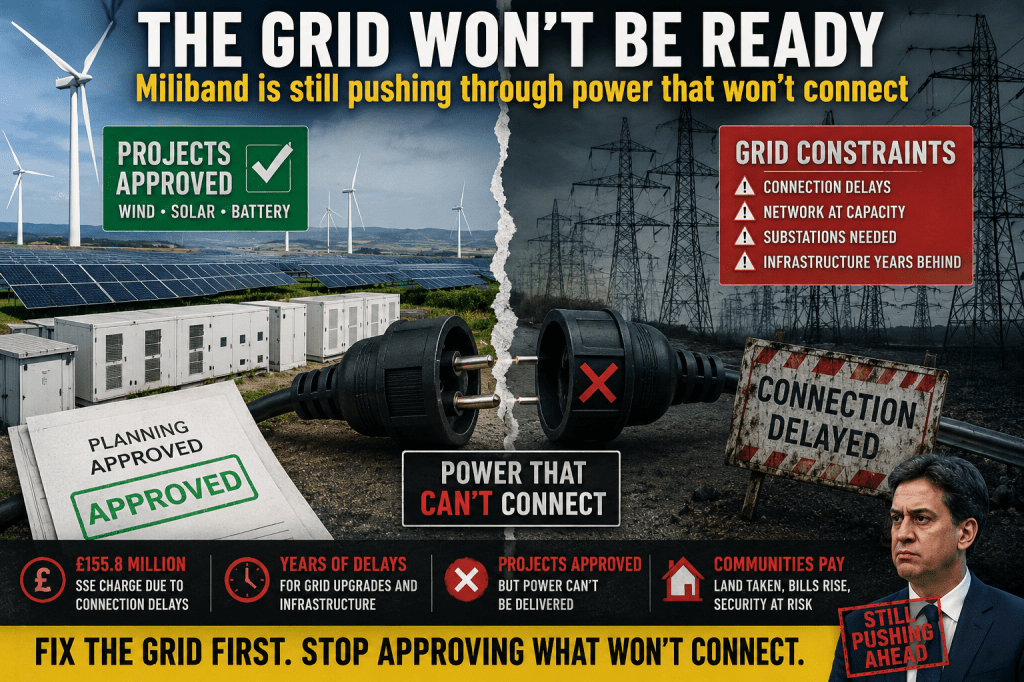
SSE’s announcement includes a £155.8 million charge relating to delays connecting Scottish wind projects to the electricity network. That is not a theoretical concern. It is a direct financial consequence of infrastructure failing to keep pace with generation development.
The company also highlighted delays to onshore wind projects and planning difficulties surrounding critical grid infrastructure, including a substation project in Scotland that must now be reconsidered following legal challenge.
Again, this confirms what many local communities have been saying.
The energy transition is no longer constrained by the willingness to build generation. It is constrained by the ability to build the infrastructure needed to support it.
Despite this, Energy Secretary Ed Miliband continues pushing ahead with a planning system that prioritises approval of new generation schemes.
Across The United Kingdom, all regions, large-scale solar farms, battery storage facilities and renewable developments continue to be promoted, even where significant grid constraints already exist.
The fundamental question remains unanswered:
What is the point of approving projects that cannot connect, cannot export power when required, or depend upon infrastructure that may not be completed for many years?
This matters because every project comes with costs.
Agricultural land is taken out of production.
Rural landscapes are industrialised.
Communities face years of disruption.
Developers secure planning permissions and grid positions.
Yet the infrastructure required to make those projects useful often remains unfinished.
The danger is that Britain creates a growing inventory of consented energy projects while the network needed to support them falls further behind.
That is not energy security.
It is energy planning by political target rather than engineering reality.
The Government’s Clean Power 2030 programme assumes that generation, transmission, substations and network reinforcement can all be delivered within extremely ambitious timescales.
The evidence increasingly suggests otherwise.
SSE’s warning should serve as a wake-up call.
When the UK’s largest renewable energy generator publicly admits that it is unlikely to achieve its own 2030 ambitions because of grid constraints, policymakers should stop and reassess their assumptions.
Instead of approving ever more generation capacity regardless of network readiness, The priority should be fixing the grid first.
Britain needs an energy strategy built around engineering realities rather than political slogans.
Because generating electricity is only half the challenge.
Getting it to where it is needed is the part we are failing.
And until that problem is solved, approving more projects will not deliver the secure, affordable and reliable energy system the country needs.
Shane Oxer. Campaigner for fairer and affordable energy
 SAY NO TO THE DESTRUCTION OF OUR LAND
Leave a comment