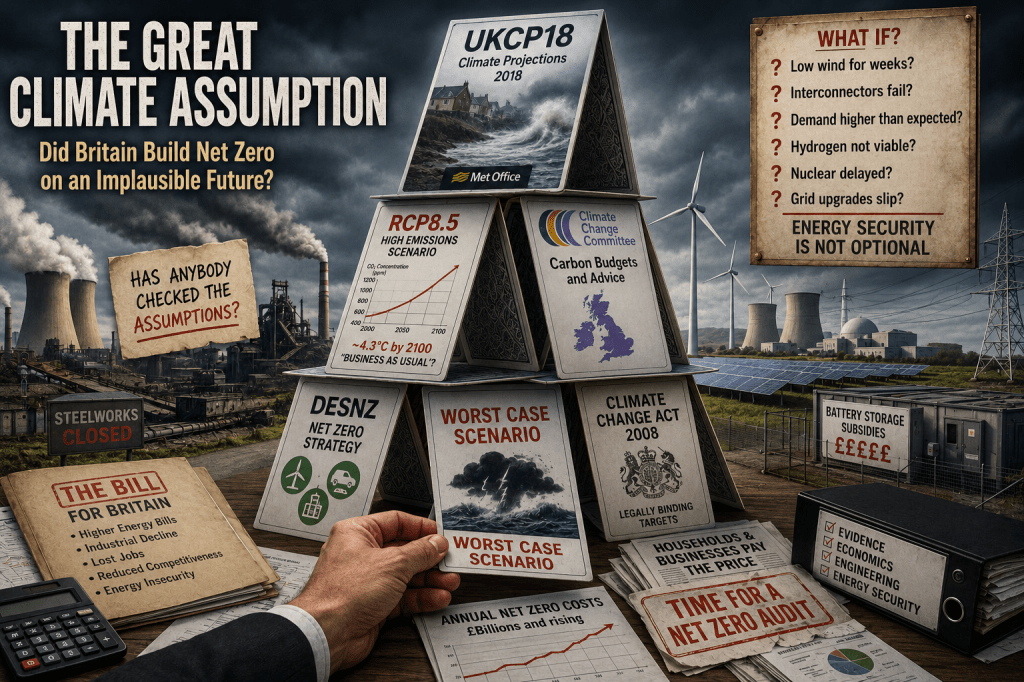
For much of the last decade, questioning Net Zero assumptions has been portrayed as synonymous with questioning climate science itself. This has been one of the most damaging developments in the entire debate. In any other area of public policy, assumptions are tested continuously against reality. Forecasts are revised. Costs are reassessed. Outcomes are measured against promises. Yet in climate policy, particularly in Britain, a curious inversion has occurred. The more ambitious and expensive the policy becomes, the less willing institutions appear to be to revisit the assumptions upon which it was built.
That cannot continue.
Britain has now reached the point where the costs, consequences and trade-offs are too significant to ignore. The issue is no longer whether carbon emissions should be reduced. It is whether the pathway chosen remains economically rational, technically achievable and proportionate to the risks being addressed.
The first requirement must be a comprehensive audit of the assumptions underpinning current policy.
Such an audit should begin with UKCP18. When it was published in 2018, it became the foundation document for climate adaptation planning across much of government. Local authorities, regulators, infrastructure operators and the Climate Change Committee all drew heavily upon its findings. Yet the scientific debate surrounding high-end scenarios such as RCP8.5 has evolved considerably since then. If one of the principal pathways underpinning the most dramatic projections is now regarded by many researchers as increasingly implausible, then policymakers have a duty to examine what effect that has on current regulations, adaptation plans and investment strategies.
The question is straightforward. Which existing policies would still be justified if they were assessed using more moderate and probable climate scenarios rather than the highest-emissions pathway?
Until that question is answered, taxpayers cannot know whether billions of pounds are being spent to address realistic risks or highly speculative ones.
The second element of a Net Zero audit should focus on economics.
For years, the public has been presented with the benefits of decarbonisation while the costs have often been fragmented across numerous departments, regulators, levies and infrastructure programmes. There is no single balance sheet showing the total cost of the transition. Grid reinforcement costs sit in one location. Renewable support mechanisms in another. Constraint payments elsewhere. Capacity market payments elsewhere again. Network charges, balancing costs, standing charges, subsidy commitments and adaptation spending are rarely considered together.
Yet the public ultimately pays for all of them.
A serious audit would therefore calculate the full economic impact of Net Zero policies since the Climate Change Act 2008. It would examine the effects on electricity prices, industrial competitiveness, manufacturing output, household energy costs, investment flows and energy security. Most importantly, it would compare those costs with the actual emissions reductions achieved and the estimated influence on global temperatures.
This is not an argument against environmental action. It is an argument for transparency.
No private company would embark upon a multi-trillion-pound investment programme without conducting rigorous cost-benefit analysis. Governments should be held to at least the same standard.
The third and perhaps most important component of reassessment concerns energy security.
The events of recent years should have shattered any lingering complacency about the importance of reliable domestic energy supplies. The energy crisis following Russia’s invasion of Ukraine exposed the vulnerability of countries that had become overly dependent on international markets and imported fuels. Across Europe, governments suddenly rediscovered concepts that had been largely absent from climate discussions: resilience, redundancy, strategic reserves and national security.
Britain should learn the same lesson.
An energy policy designed primarily around emissions reduction is not necessarily the same thing as an energy policy designed around security. The two objectives can overlap, but they are not identical.
A secure energy system must be capable of withstanding geopolitical shocks, severe weather events, infrastructure failures and unexpected surges in demand. It must be affordable enough to support industrial competitiveness. It must be robust enough to operate under adverse conditions. Above all, it must recognise that electricity systems are governed by engineering realities rather than political aspirations.
This is where the debate over firm generation becomes unavoidable.
Despite years of discussion about batteries, hydrogen and smart grids, Britain remains heavily dependent on gas-fired generation to provide dispatchable power when renewable output falls. National Grid and NESO planning documents continue to recognise the need for significant firm capacity throughout the coming decades. Nuclear power remains essential for long-term decarbonisation, yet progress has been painfully slow. Meanwhile, electricity demand is expected to increase substantially as transport, heating and industry are electrified.
The resulting challenge is obvious. Britain is attempting simultaneously to increase demand, reduce dispatchable generation and transform the entire grid infrastructure upon which modern society depends.
That may ultimately be possible.
But it is not risk-free.
Nor is it guaranteed.
A rational government would therefore conduct a formal stress test of its Net Zero assumptions. Not a climate stress test, but an energy security stress test.
What happens during a prolonged winter period of low wind output?
What happens if interconnector imports are unavailable?
What happens if electricity demand rises faster than expected?
What happens if hydrogen fails to achieve commercial viability at scale?
What happens if nuclear projects are delayed?
What happens if grid reinforcement programmes slip by five or ten years?
These are precisely the questions that should dominate public debate. Yet too often they remain secondary to discussions about long-term emissions targets.
The truth is that Britain’s energy transition has become increasingly dependent upon assumptions.
Assumptions about technology. Assumptions about cost reductions. Assumptions about consumer behaviour. Assumptions about international supply chains.
Assumptions about future weather patterns.
Assumptions about future emissions trajectories.
Some of those assumptions may prove correct.
Others may not.
The responsible course is not to abandon climate policy but to recognise that policies built upon assumptions must be periodically reassessed as evidence evolves.
That is how good governance works.
Seventeen years after the Climate Change Act was passed, Britain has every reason to pause and take stock. Emissions have fallen dramatically.
The world has changed. Energy markets have changed. Geopolitical realities have changed. Scientific understanding has evolved. Yet many of the core assumptions driving policy remain remarkably untouched.
A mature democracy should not fear such scrutiny.
Indeed, it should welcome it.
The purpose of a Net Zero audit would not be to weaken environmental protections or abandon emissions reduction. Its purpose would be to ensure that policy remains rooted in evidence, economics and engineering rather than institutional inertia.
Because ultimately the question facing Britain is not whether climate risks exist.
It is whether the response remains proportionate to those risks.
If the answer is yes, then a comprehensive audit will strengthen public confidence and reinforce the legitimacy of future action.
If the answer is no, then it is far better to discover that now than after another decade of rising costs, declining competitiveness and increasing dependence upon technologies and infrastructure that may never perform as promised.
The Climate Change Committee, the Met Office and DESNZ have spent years asking the country to trust their assumptions.
Perhaps it is now time to examine them.
Conclusion
The debate Britain needs is not between believers and sceptics, nor between Net Zero supporters and Net Zero opponents. It is between those willing to test assumptions against evidence and those who treat assumptions as settled truth.
The central question is simple.
If RCP8.5 is no longer considered a plausible business-as-usual future, if the economic costs of decarbonisation continue to mount, and if the electricity system still depends upon firm generation that Net Zero plans often struggle to accommodate, then should Britain not reassess the foundations upon which its entire climate strategy has been built?
That is not climate denial.
It is due diligence.
And after seventeen years of the Climate Change Act, it may be the most important question the country has yet to ask.
Shane Oxer. Campaigner for fairer and affordable energy
 SAY NO TO THE DESTRUCTION OF OUR LAND
Leave a comment