For years, the British public were told that Net Zero was simply about “saving the planet.” We were assured it would mean cleaner energy, lower bills, green jobs, and a brighter future. Few people realised that behind the slogans sat something far more dangerous: a political and i
deological movement increasingly willing to interfere in every aspect of daily life.
Now it is no longer just about power stations, wind turbines, or electric cars.
The climate agenda has entered the supermarket aisle.
The latest example may seem trivial on the surface , supermarkets replacing brown eggs with white eggs in pursuit of lower carbon emissions , but symbolically it represents something much larger.
It exposes the creeping mentality now infecting British institutions: that consumer choice, tradition, and even personal preference must increasingly bow to carbon accounting and Net Zero ideology.
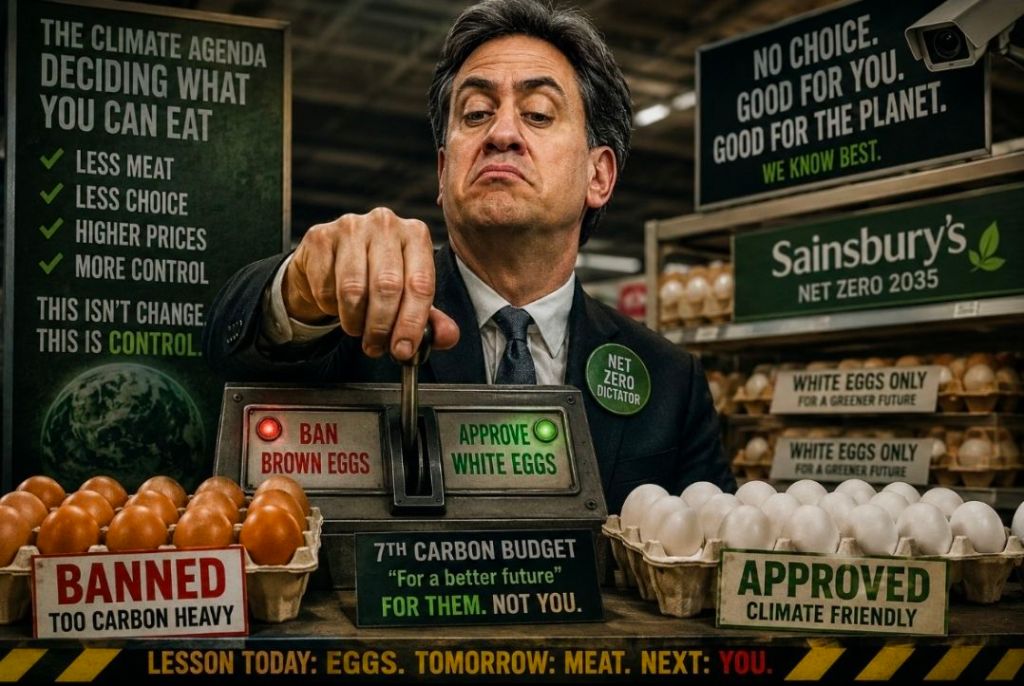
Sainsbury’s has announced it will phase out brown eggs in favour of white eggs because they are supposedly more “efficient” and produce lower emissions. Meanwhile, Waitrose and Morrisons have publicly pledged to continue offering both, defending the principle of customer choice.
That distinction matters.
Because this is no longer simply about eggs.
It is about control.
For decades, British consumers decided what they wanted to buy based on preference, quality, price, and tradition. Today, corporations increasingly make those decisions through the lens of ESG targets, carbon budgets, and Net Zero compliance frameworks. Products are not judged primarily on whether consumers want them, but whether they satisfy environmental metrics imposed by government policy, investors, activist groups, and quangos.
The British public never voted for this transformation.
Nobody voted to reduce meat consumption. Nobody voted to phase out petrol cars. Nobody voted for soaring standing charges. Nobody voted for vast solar developments across productive farmland. Nobody voted for heat pump mandates. Nobody voted to industrialise the countryside with pylons, substations, and battery compounds. Nobody voted for supermarkets to become climate enforcement agencies.
Yet all of these things are happening simultaneously under the banner of Net Zero.
At the centre of this machinery sits the Climate Change Committee , an unelected body whose carbon budgets increasingly dictate national policy across transport, housing, agriculture, energy, industry, and consumer behaviour. What began as advisory guidance has evolved into a quasi-legislative system that now shapes virtually every major department in government.
The 7th Carbon Budget signed off under Ed Miliband’s watch pushes even further into agricultural reform, land-use change, and emissions reduction from food production. While politicians rarely say the words openly, the implications are obvious: less meat, fewer livestock farms, more dietary intervention, and increasing pressure on retailers to “nudge” consumer behaviour.
This is the modern method of political control.
Not outright bans , at least not initially. Instead:
restrictions,
incentives,
taxes,
carbon labelling,
manipulated pricing,
ESG compliance,
supply-chain pressure,
and gradual removal of alternatives.
The public are not forced overnight. They are managed.
One choice disappears. Then another becomes expensive. Then another is labelled environmentally harmful. Eventually, the “choice” exists only in theory.
We are witnessing the rise of a soft authoritarianism wrapped in environmental language.
The defenders of this system claim these are merely sensible adjustments for sustainability. But sustainability for whom? At what cost? And decided by whom?
Britain already faces:
some of the highest industrial energy prices in the developed world,
worsening grid instability,
rising food costs,
collapsing heavy industry,
declining energy security,
and increasing dependence on imported technologies.
At the same time, ordinary families are lectured about their diets, vehicles, heating systems, and lifestyles by political elites who continue flying globally to climate conferences while imposing restrictions at home.
The hypocrisy is staggering.
Brown eggs are not destroying the planet. British farmers are not the enemy. Consumers choosing what they wish to eat is not a climate emergency.
Yet Net Zero ideology increasingly treats normal human behaviour as a problem to be corrected.
And this is precisely why public anger is growing.
People can tolerate environmental policy when it is balanced, practical, and democratic. What they reject is ideological extremism masquerading as moral superiority. They reject being told that every aspect of their lives must now be measured against carbon spreadsheets produced by unelected committees.
The issue is no longer environmental stewardship. It is freedom.
Can people still choose what they drive? What they eat? How they heat their homes? What products they buy? What landscapes they preserve? What industries their nation retains?
Or will every decision increasingly be filtered through the doctrine of carbon reduction regardless of economic damage, public consent, or common sense?
This is why seemingly small stories matter.
Today it is brown eggs. Tomorrow it is meat quotas. Then vehicle restrictions. Then mandatory heating systems. Then limits on flights. Then carbon-linked financial controls.
Each policy is presented individually. Each sounds manageable in isolation. But together they form an increasingly intrusive system of behavioural governance.
And ordinary people are beginning to notice.
The greatest irony of all is that Britain’s sacrifices will barely alter global emissions. The UK contributes roughly 1% of worldwide carbon output, while China continues building coal-fired power stations at scale and much of the developing world prioritises economic growth over climate ideology.
Yet British consumers are expected to accept:
higher bills,
reduced choice,
shrinking freedoms,
industrial decline,
and transformed landscapes,
all to satisfy legally binding targets that many voters neither understand nor support.
The public were promised prosperity through Net Zero. Instead they are increasingly being offered rationed choice wrapped in moral pressure.
This is no longer environmentalism in the traditional sense. It has become a political doctrine.
And like all doctrines, it eventually demands obedience.
The British people must now decide whether they still believe in democratic accountability, consumer freedom, affordable energy, food security, and national sovereignty , or whether these too must be sacrificed to the ever-expanding climate agenda.
Because once governments, corporations, and quangos begin deciding what citizens should eat “for the greater good,” the line between environmental policy and social control becomes dangerously thin.
And Britain is moving closer to that line every single day.
Shane Oxer. Campaigner for fairer and affordable energy
 SAY NO TO THE DESTRUCTION OF OUR LAND
Leave a comment