How Hornsea Three Exposes the True Scale of Britain’s Electrification Strategy
Most people see offshore wind farms as elegant symbols of a cleaner future. White towers turning slowly beyond the horizon have become the visual shorthand for Net Zero Britain. Politicians speak of “cheap renewable energy”, television adverts show sweeping coastlines and spinning blades, and the public is told that electrification is simply a matter of replacing fossil fuels with greener alternatives.
But that image bears little resemblance to the engineering reality now unfolding across Britain.
Behind every offshore wind farm lies an immense industrial system of substations, converter halls, transformer compounds, battery installations, and transmission reinforcements.
What is happening in East Anglia today is not merely the construction of renewable energy projects. It is the creation of an entirely new electricity architecture , a second grid layered on top of the old one.
And nowhere is this transformation more visible than in the Hornsea Three project.
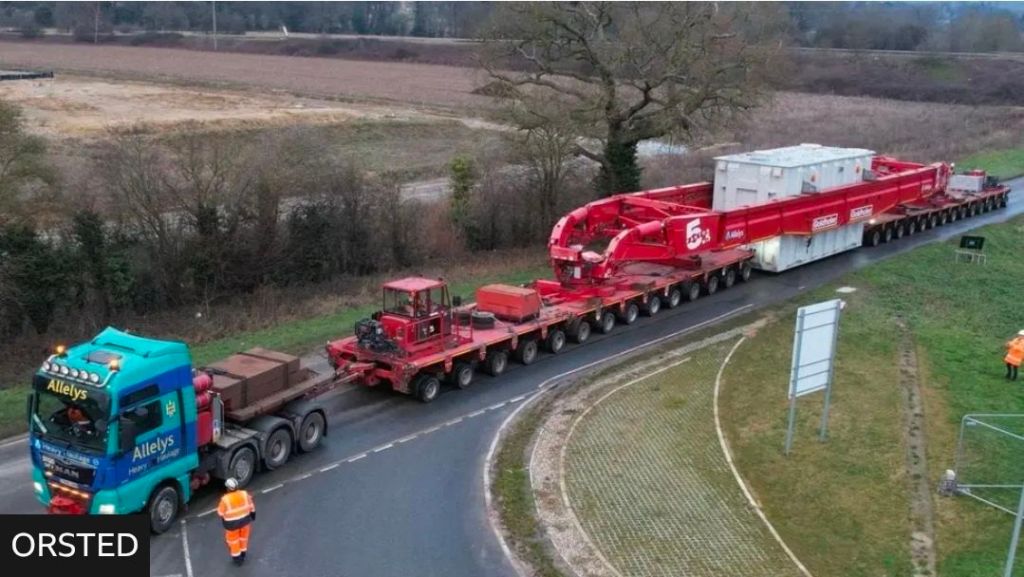
Recent images of abnormal-load convoys travelling slowly through Norfolk offer the public a rare glimpse into the hidden machinery of electrification. The transformers being transported from the Port of King’s Lynn to the Swardeston converter station weigh up to 272 tonnes each. Police escorts accompany them along closed roads while traffic lights, street furniture and road infrastructure are temporarily dismantled to allow passage. The convoy moves at little more than walking speed.
To most observers this may appear to be little more than a logistical curiosity. In reality, it is evidence of one of the largest transmission transformations Britain has ever attempted.
These are not ordinary transformers destined for a local substation.
They are transmission-scale assets forming part of an enormous HVDC conversion system designed to transport offshore wind energy into the national grid. Nine such transformers are required for the Hornsea Three connection architecture alone.
The scale of this matters because Hornsea Three is not simply a wind farm. It is effectively a new offshore power province connected to Britain through a super-grid highway stretching across East Anglia and deep into the national transmission network.
The public conversation still treats offshore wind as though turbines themselves are the project. In truth, the turbines are now only one component of a much larger and more complicated machine.
The real engineering challenge begins once electricity leaves the turbines.
Because Hornsea Three sits around 120 kilometres offshore, conventional AC transmission becomes increasingly inefficient. Instead, the project relies on High Voltage Direct Current technology , HVDC , to move vast quantities of power beneath the sea. This requires giant offshore converter platforms to gather electricity from the turbines, convert it from AC to DC, and transmit it to shore through dedicated export cables.
Once the power reaches Norfolk, the process begins again in reverse.
At Swardeston, enormous converter halls and transformer compounds convert the electricity back into AC before synchronising it with the national transmission system. Only then can the electricity travel onwards through Britain’s 400kV super-grid.
This is why the substations matter more than the turbines.
The future grid is increasingly converter-led rather than generation-led. Britain’s traditional electricity system was designed around large synchronous power stations , coal, gas and nuclear plants generating stable AC electricity close to centres of demand. The new system depends instead upon offshore HVDC corridors, inverter-based generation, reactive compensation systems, synchronous balancing equipment, and increasingly complex transmission management technologies.
The substations are no longer passive junctions in the system. They are becoming active industrial machines in their own right.
The scale of this emerging super-grid becomes obvious when the Energy Act register data and TEC register are examined together.
The Norwich Main 400kV substation has become one of the clearest examples of this transition. According to the combined infrastructure dependency mapping,
Norwich Main now carries approximately 5,335MW of TEC-associated capacity linked to projects, including Hornsea Power Station 3, Norwich, and Norwich 2. The effective connection window for these projects stretches from December 2025 through to June 2033.
Crucially, the register classifies Norwich Main as: “Phased: partly pre-2030 but extends post-2030” with a risk designation of: “High risk , phased / post-2030 dependency.”
That language matters enormously. It means the system itself acknowledges that the transmission infrastructure required to support offshore electrification will not be fully mature until well into the next decade.
The same pattern repeats across East Anglia.
At Walpole 400kV substation, the combined EA and TEC data reveals over 6,342MW of associated infrastructure dependency, with approximately 6,070MW scheduled after 2030. The node itself carries a “high risk” phased dependency classification extending through to 2033.
This is not a short-term reinforcement programme. It is a decade-long transformation of the transmission network.
The technology mix associated with Walpole reveals how complex the modern grid has become.
The register references battery storage, reactive compensation systems, low-carbon dispatchable power, solar infrastructure, and transmission-connected demand management.
In simple terms, Walpole is evolving into a giant balancing hub designed to stabilise an increasingly volatile electricity system.
At Necton, another critical East Anglian node, the data shows more than 3,241MW of associated infrastructure extending through to 2034. Projects linked to the site include Vanguard, Norfolk Boreas, the Necton Greener Grid Park, and major battery storage systems.
Friston tells a similar story. The register identifies over 4,087MW of associated infrastructure dependency tied to offshore wind projects, interconnectors, and East Anglia transmission expansion, again extending to 2034.
What emerges from the data is a picture very different from the one commonly presented to the public.
Britain is not simply building wind farms.
It is constructing an entirely new super-grid system requiring:
converter stations,
HVDC corridors,
synchronous balancing technologies,
giant substations,
battery clusters,
and reinforcement works extending well into the 2030s.
The timing problem embedded within this strategy is perhaps the most important issue of all.
Hornsea Three itself is expected to begin energisation around 2027. Yet large portions of the supporting transmission architecture remain incomplete for years afterwards. Walpole extends into 2033. Norwich Main into 2034. Friston into 2034. Several North Anglia connection nodes are explicitly classified as “Post-2030 only”.
This creates a potentially dangerous mismatch between generation deployment and transmission readiness.
The turbines may arrive first, but the inland highway needed to transport and stabilise that electricity is still under construction.
That gap matters because intermittent generation behaves fundamentally differently from traditional power stations. Wind output fluctuates constantly. Offshore systems require balancing support. HVDC systems introduce new stability challenges. Large inverter-based networks require reactive compensation and synthetic inertia to maintain frequency stability.
The more renewable penetration increases, the more dependent the system becomes on complex balancing infrastructure.
This explains why Britain is simultaneously witnessing an explosion in:
battery energy storage systems,
synchronous compensators,
converter compounds,
reactive compensation facilities,
and enormous new transmission corridors.
These are not optional extras. They are the hidden machinery required to hold the modern electrified grid together.
The public is repeatedly told renewable energy is now “cheap”, yet those headline costs rarely include the wider system architecture now required to make intermittent generation usable at national scale.
The turbines themselves are only the visible tip of the iceberg.
Beneath them lies an expanding super-grid highway whose true scale is only beginning to emerge.
The abnormal-load convoys moving slowly through Norfolk are therefore far more significant than they first appear. They are physical evidence of Britain’s transition into a converter-led electricity system , a transformation that will reshape landscapes, substations, transmission corridors, and national infrastructure for decades to come.
The EA and TEC registers show this process with remarkable clarity.
And they also reveal something else.
The super-grid highway Britain is building is still far from complete.
 SAY NO TO THE DESTRUCTION OF OUR LAND
Leave a comment