The proposed South Brooks Solar Farm on the Dungeness Peninsula may become one of the clearest examples yet of how Britain’s energy policy has drifted away from engineering reality, environmental common sense, and rational planning.
On paper, the scheme is marketed as another “green energy” project designed to help Britain reach Net Zero targets. In reality, the documents tell a very different story — one of strategic grid desperation, environmental contradiction, and increasingly irrational infrastructure planning.
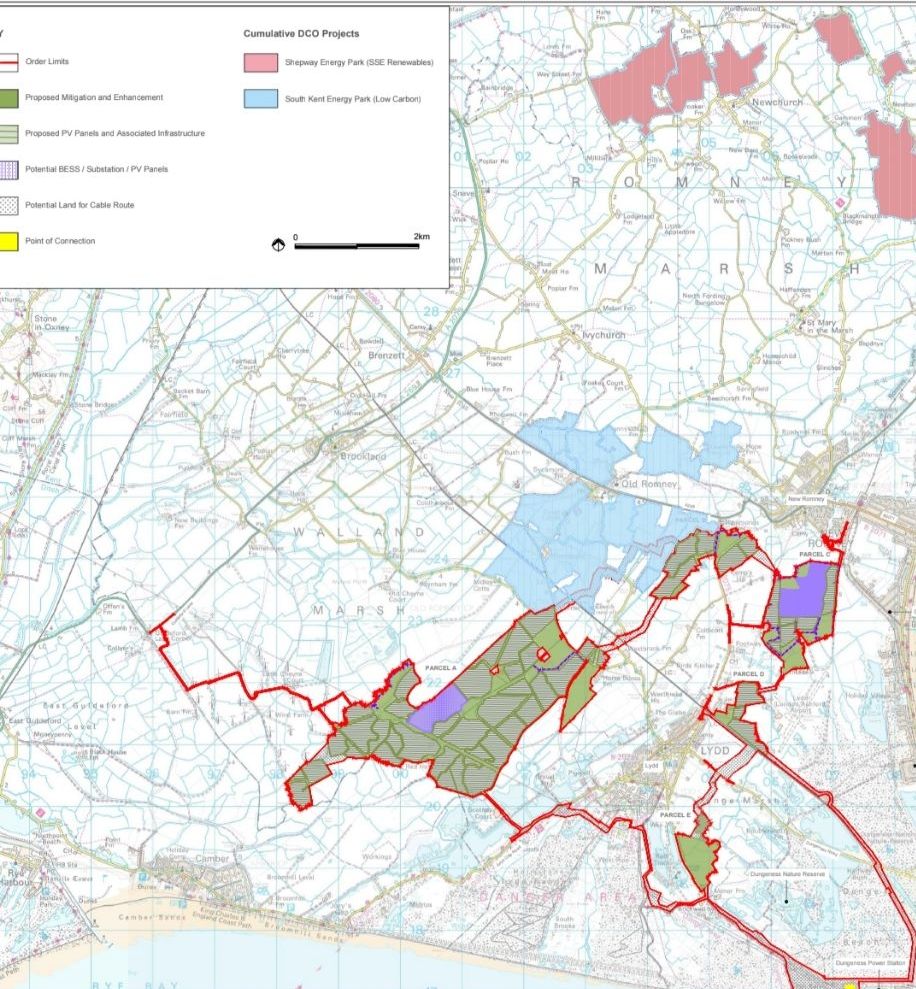
The proposal, designated under Planning Inspectorate reference EN0110027, would cover approximately 1,094 hectares of land across Romney Marsh and the Dungeness area. The development includes large-scale solar generation, battery storage infrastructure, substations, cable corridors, and a direct connection into the National Grid transmission system adjacent to the former Dungeness nuclear complex.
At first glance, this may appear to be a straightforward renewable energy project. But once the technical documents are examined, the scale of the madness becomes apparent.
A Solar Farm Built in Flood Zones
Perhaps the most astonishing admission within the Environmental Impact Assessment scoping material is this:
“approximately 72.6% of the Site boundary is within Flood Zones 2 and 3”
Let that sink in.
Nearly three-quarters of the proposed site lies within medium or high flood-risk zones.
Even more remarkably, the developer openly acknowledges that the flooding risk is predominantly tidal in origin. This is not simply occasional field waterlogging or poor drainage after heavy rain. This is a coastal flood-risk landscape connected to tidal influences surrounding Romney Marsh and Dungeness.
At the same time Britain is being told that catastrophic climate risks justify the wholesale transformation of the national energy system, we are now witnessing proposals to place nationally significant energy infrastructure directly inside vulnerable coastal flood-risk areas.
The contradiction is extraordinary.
Solar farms are not simple collections of panels. They require extensive supporting electrical infrastructure including:
inverter stations;
transformers;
substations;
buried cable networks;
access roads;
switchgear;
control buildings;
and potentially large-scale battery storage systems.
Saltwater intrusion and floodwater exposure are highly destructive to electrical systems. Transformers, inverters, cable joints, switchgear and batteries are particularly vulnerable to corrosion and water damage.
Yet this proposal proceeds regardless.
Dungeness — From Nuclear Stability to Renewable Instability
The reason this project exists in this location becomes obvious when examining the National Grid response.
South Brooks is not connecting into a normal local electricity network. The proposal is attempting to plug directly into the historic Dungeness transmission complex — infrastructure originally built to support nuclear generation.
For decades, Dungeness provided stable synchronous baseload electricity into the South East grid. The transmission system surrounding it was engineered around predictable, continuous nuclear output.
But Dungeness B ceased generation in 2021 and is now being decommissioned.
What we are now witnessing is the attempted repurposing of that nuclear-era transmission corridor into a renewable energy aggregation hub.
This is where the deeper engineering problems begin.
Nuclear generation provided:
stable AC generation;
rotational inertia;
voltage support;
predictable export capability;
and continuous output.
The proposed replacement system would instead rely upon:
intermittent solar generation;
inverter-driven power;
highly variable export profiles;
daytime-only peak production;
and potentially extensive curtailment.
These are fundamentally different systems.
The public is rarely told that replacing stable synchronous generation with inverter-heavy intermittent generation often requires vast additional infrastructure merely to keep the grid stable.
This includes:
reactive compensation systems;
synchronous compensators;
harmonic filtering;
dynamic voltage support;
upgraded protection systems;
balancing infrastructure;
and wider transmission reinforcements.
In short, Britain is increasingly rebuilding the grid not because electricity demand requires it, but because intermittent generation destabilises the network architecture that already existed.
NESO’s Strategic Contradiction
The National Energy System Operator (NESO) and National Grid increasingly present these schemes as part of a modernised “Great Grid Upgrade”.
But the South Brooks documents reveal the deeper truth: much of the UK’s current grid expansion is being driven not by practical engineering optimisation, but by the desperate attempt to force intermittent renewable generation into a network originally designed for reliable power stations.
The National Grid response references wider strategic reinforcements including the Richborough to Aldington corridor and offshore transmission expansion.
This means South Brooks is not a standalone project. It is part of a much larger restructuring of the South East transmission system involving offshore wind integration, long-distance power transfers, and post-nuclear grid redesign.
The problem is that the network itself does not appear ready.
The project documentation confirms that the applicant has secured a National Grid connection agreement. Yet evidence from transmission queue data suggests energisation may not occur until as late as 2037.
If true, Britain is effectively approving enormous industrial infrastructure projects today for connections potentially more than a decade away.
That raises serious questions:
Is the infrastructure actually deliverable?
How much curtailment will occur?
How many further reinforcements will be required?
And what will the true cost to consumers ultimately be?
Environmental Contradictions Everywhere
The environmental sensitivity of the site is staggering.
The documents identify proximity to or interaction with:
the Dungeness, Romney Marsh and Rye Bay SSSI;
Ramsar-designated wetlands;
Special Protection Areas (SPA);
Special Areas of Conservation (SAC);
National Nature Reserves;
RSPB reserves;
protected shingle habitats;
internationally important bird populations;
and extensive ditch and drainage ecosystems.
Some of these designations are literally metres from the site boundary.
The proposal area itself sits within one of the most ecologically sensitive coastal landscapes in Britain.
Yet once again, grid access appears to have trumped environmental suitability.
This is becoming a recurring pattern across the country.
The real driver behind many solar NSIPs is not necessarily where solar energy performs best environmentally or geographically — but where strategic transmission infrastructure already exists.
In other words, Britain’s countryside is increasingly being industrialised around the logic of grid opportunism.
The Hidden Madness of Renewable Planning
What makes South Brooks particularly revealing is that it exposes the growing disconnect between political Net Zero narratives and physical infrastructure reality.
The UK is now simultaneously:
closing stable nuclear and fossil-fuel generation;
rebuilding transmission networks at enormous cost;
industrialising protected landscapes;
constructing renewable infrastructure in flood-risk areas;
and relying upon future reinforcements that do not yet exist.
All while energy bills continue rising.
The public is repeatedly told this represents “modernisation”.
But South Brooks instead resembles a symptom of strategic confusion.
The irony is difficult to ignore:
Britain once used Dungeness to generate stable, reliable electricity from a compact nuclear site.
Now the country proposes covering more than a thousand hectares of environmentally sensitive flood-prone land with intermittent solar infrastructure — while simultaneously requiring vast new grid upgrades simply to accommodate it.
That is not energy efficiency.
It is strategic regression masquerading as progress.
Conclusion
South Brooks Solar Farm is not merely a local planning issue. It is a window into the wider dysfunction of Britain’s energy strategy.
The project demonstrates how:
grid constraints are driving irrational siting decisions;
environmentally sensitive landscapes are being sacrificed;
massive transmission upgrades are becoming permanent requirements;
and the country is increasingly dependent upon speculative future infrastructure to sustain present-day policy ambitions.
Perhaps most concerning of all, it exposes how organisations like NESO now appear trapped in a cycle of endless reinforcement planning — constantly rebuilding the grid to compensate for the instability created by the very generation model being promoted.
The result is a system that becomes:
more expensive,
more complex,
more environmentally intrusive,
and arguably less resilient.
South Brooks may one day become remembered not as a triumph of green energy policy — but as a warning sign of how far Britain’s energy planning has drifted from engineering reality.
Shane Oxer — Campaigner for fairer and affordable energy
 SAY NO TO THE DESTRUCTION OF OUR LAND
Leave a comment