By Shane Oxer — Campaigner for fairer and affordable energy
The British public is repeatedly told that the solution to the country’s future energy needs is simple: build more solar farms, install more wind turbines, and trust the “clean power” transition being pushed by Ed Miliband, DESNZ, NESO, and the Climate Change Committee.
But behind the headlines and political slogans lies a growing engineering reality that few politicians are willing to admit.
Britain is building an energy system based on theoretical capacity rather than dependable power.
The difference is enormous , and dangerous.
The Reality Behind the Solar Numbers
We are constantly told the UK has around 22 GW of solar installed on the system today, with ambitions to push this toward 50 GW by 2030.
To the average person, that sounds reassuring.
Fifty gigawatts sounds like vast amounts of electricity.
But installed capacity means nothing if the system cannot deliver power when Britain actually needs it.
Yesterday evening provided a perfect real-world example.
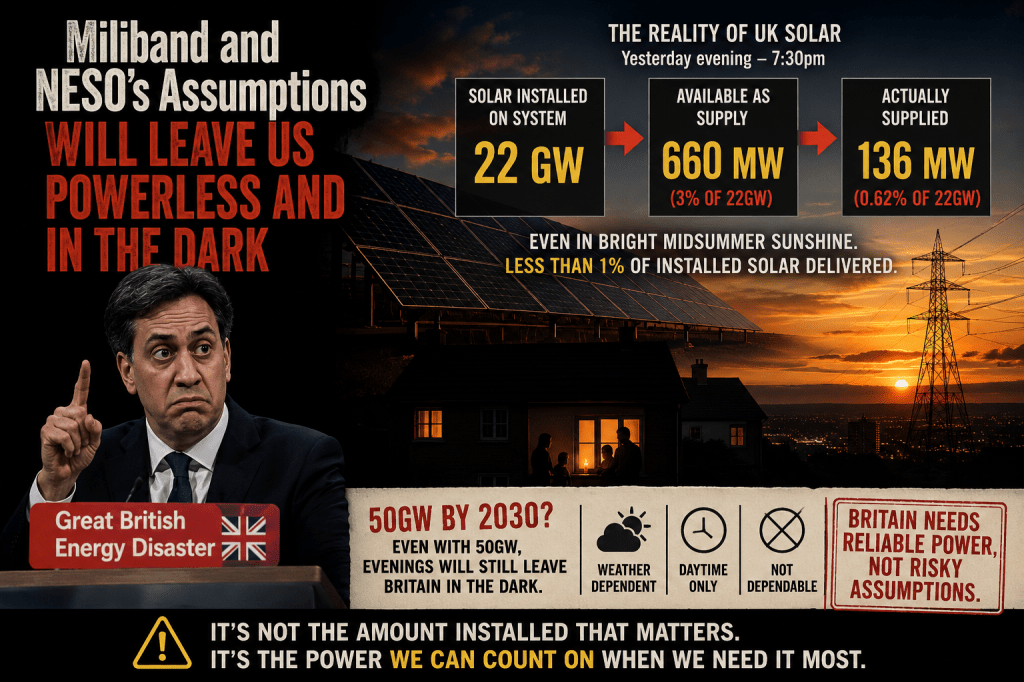
At approximately 7:30 pm in bright midsummer sunshine in Gosport:
– The UK reportedly had 22 GW of solar connected to the grid.
– Yet only 660 MW was available as supply.
– Of that, only 136 MW was actually being supplied.
That means the real delivered output from the entire national solar fleet was approximately:
0.62% of headline installed capacity.
Not 62%.
Not 6%.
Less than one percent.
This is the reality hidden behind renewable headline statistics.
The Capacity Illusion
The public is repeatedly shown “installed capacity” figures because they sound impressive politically.
But power systems do not operate on political slogans.
They operate on real-time physics.
A 50 GW solar fleet does not provide 50 GW of dependable electricity.
It only provides power when conditions allow.
The UK faces a fundamental geographical problem:
– Britain is a northern latitude country.
– Demand peaks occur during winter.
– Peak demand occurs in the evening after sunset.
– Solar output collapses precisely when demand begins rising.
Yesterday evening’s figures demonstrate this perfectly.
If 22 GW of installed solar can effectively deliver almost nothing during a bright midsummer evening, what happens in December?
The answer is simple:
Very little.
The Winter Problem Nobody Wants to Discuss
The greatest danger to the UK grid is not summer.
It is the cold winter evening.
That is when Britain experiences:
– peak domestic demand,
– heating load,
– lighting demand,
– industrial demand,
– electric vehicle charging,
– and increasing electrification pressure from Net Zero policies.
Yet solar performs worst exactly during these conditions.
During winter anticyclonic weather systems — cold, still, high-pressure conditions — Britain can experience:
– extremely low wind generation,
– near-zero solar generation,
– high national demand,
– and dependence on imports or gas backup.
This is the system stress scenario energy planners should be designing around.
Instead, the UK is being pushed toward a grid dominated by intermittent generation while dependable baseload generation is systematically removed.
Scaling Failure Is Still Failure
Supporters of current policy argue that the answer is simply “more solar”.
But scaling an unreliable system does not make it reliable.
Using yesterday evening’s figures:
If 22 GW effectively delivered 136 MW under those conditions, then even 50 GW would only deliver proportionally small amounts during similar periods.
The problem is structural.
The issue is not merely how much solar Britain installs.
The issue is that solar output is fundamentally mismatched to UK demand patterns.
This forces the grid to rely on:
– gas backup,
– interconnectors,
– expensive balancing mechanisms,
– battery systems with limited duration,
– and emergency imports from neighbouring countries.
The result is not energy independence.
It is growing instability and dependency.
The Hidden Cost to Consumers
This reality also explains why energy bills continue rising despite record renewable deployment.
Consumers are effectively paying for:
– the renewable system itself,
– duplicate backup systems,
– balancing costs,
– curtailment payments,
– massive transmission expansion,
– and increasing grid reinforcement requirements.
Britain is not replacing one system with another.
It is attempting to run two systems simultaneously:
1. An intermittent renewable grid.
2. A hidden backup grid required whenever renewables fail.
That duplication is extraordinarily expensive.
And the public is paying for it through bills, taxes, subsidies, standing charges, and infrastructure costs.
NESO’s Dangerous Assumptions
NESO’s future assumptions rely heavily on enormous renewable expansion combined with storage and flexibility measures.
But many of these assumptions remain largely theoretical at national scale.
Battery systems may help with short-term balancing, but they do not solve multi-day winter supply shortages.
Hydrogen remains inefficient and commercially uncertain.
Interconnectors cannot guarantee imports during Europe-wide weather events.
And none of these systems change the basic reality that solar power disappears every evening.
Britain is therefore building a grid increasingly dependent on assumptions rather than engineering certainty.
That is not resilience.
It is risk.
The Country Needs Honest Energy Planning
None of this means solar has no role.
Rooftop solar can contribute useful daytime generation.
Localised systems can reduce some peak summer demand.
But solar should supplement a stable grid — not replace dependable generation.
Britain requires:
– reliable baseload generation,
– modern gas backup,
– serious nuclear expansion,
– domestic energy production,
– synchronous AC generation,
– and realistic engineering-led planning.
Instead, ideology is replacing practicality.
The danger is that Britain will eventually discover the difference between installed capacity and dependable power the hard way:
during a future supply crisis.
When that moment comes, the public will not care how many gigawatts were “installed”.
They will only care whether the lights stay on.
And yesterday evening’s figures should concern every person in Britain.
 SAY NO TO THE DESTRUCTION OF OUR LAND
Leave a comment