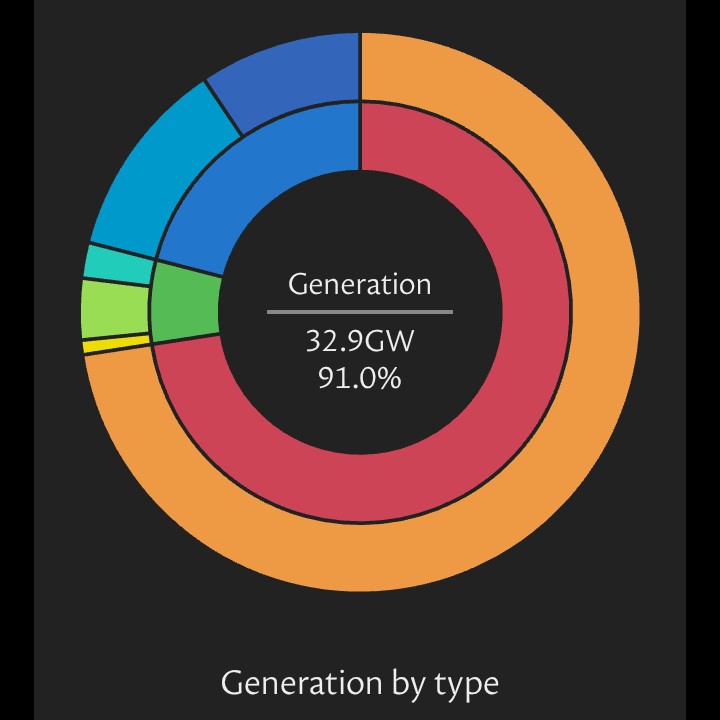
For years, campaigners, engineers, and local communities have warned that Britain’s energy strategy was becoming detached from economic and engineering reality.
Now, one of the country’s most senior energy executives has effectively admitted it.
Simone Rossi, the chief executive of EDF Energy UK, has publicly called for a pause on new wind farm approvals, warning that Britain already has more electricity generation capacity than it needs.
His remarks should send shockwaves through Westminster.
Speaking to The Telegraph, Rossi stated:
“As a country, we don’t need more electricity generation capacity. We need to use the generation capacity we have already got.”
That single sentence undermines years of political messaging, which claimed Britain faced a shortage of renewable generation.
The issue is not simply generation anymore.
The issue is whether the system can economically absorb, transport, stabilise, and use what is already being built.
The Truth Finally Emerges
For years, ordinary households have been told that:
more wind farms would reduce bills,
more solar farms would improve energy security,
and more renewable infrastructure was urgently required to avoid shortages.
Yet, at the same time, curtailment payments have exploded.
Britain is now paying hundreds of millions of pounds every year to switch wind farms OFF because the grid can not handle the electricity being generated.
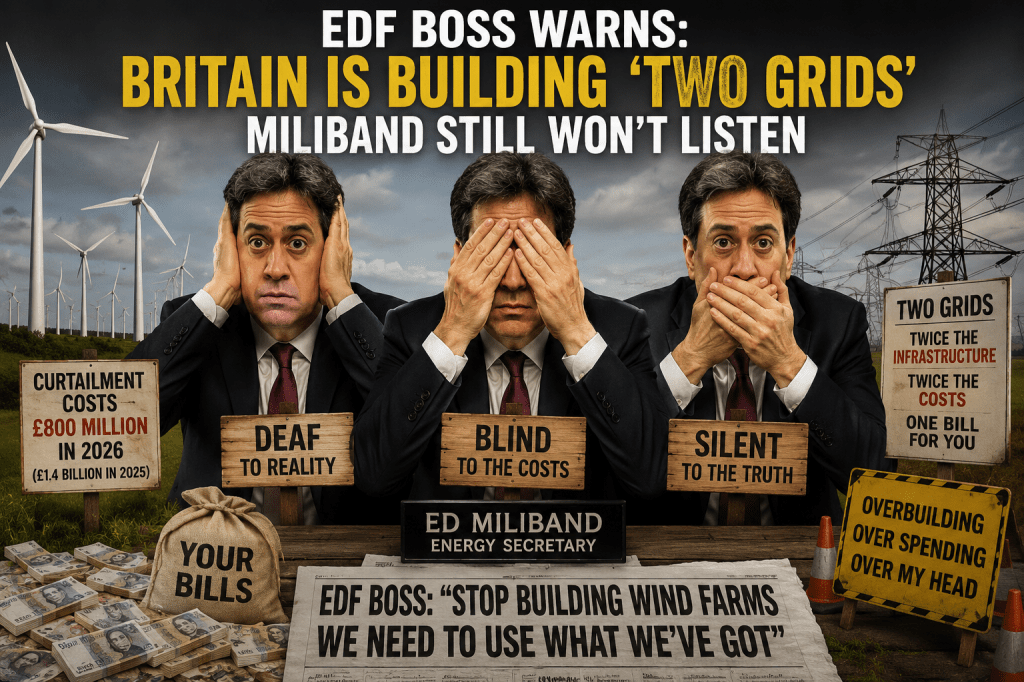
According to the figures cited, curtailment payments are already approaching £800 million in 2026 after reaching £1.4 billion in 2025.
Consumers are effectively paying twice:
first to subsidise generation,
then again to pay generators not to generate.
This is not an efficient system.
It is evidence of structural failure.
“We Need to Build Twice the Grid”
Perhaps the most important admission from Rossi was this:
“We have this large generating infrastructure twice as much as we need, which means we also need to build twice the grid.”
This is precisely what many of us have been warning about.
Britain is no longer simply upgrading its electricity network.
It is effectively constructing a second parallel infrastructure system to accommodate intermittent renewable generation.
The public is now being asked to fund:
new pylons,
HVDC corridors,
synchronous compensators,
super grid transformers,
battery installations,
substations,
reinforcement schemes,
balancing systems,
and massive transmission expansion projects.
Meanwhile, the original grid still has to remain in place because Britain still requires stable dispatchable power from gas and nuclear generation when the wind is not blowing.
In simple terms: we are paying for the old system while simultaneously building a second one.
The Demand Problem Nobody Wants to Discuss
Rossi also highlighted another uncomfortable truth: electricity demand in Britain has actually fallen over the past two decades.
Why?
Because Britain has undergone deindustrialisation, sluggish economic growth, and the replacement of heavy industry with a service-based economy.
This matters enormously.
The entire economics of the current Net Zero strategy depends upon a massive future increase in electricity demand through:
electric vehicles,
heat pumps,
data centres,
AI infrastructure,
and industrial electrification.
Without that demand surge, the infrastructure being built becomes increasingly oversized and economically irrational.
In effect, the government is building for a theoretical future that may not arrive on the timescale politicians expect.
Grid Constraints Are No Longer a Fringe Concern
For years, critics of the current energy strategy were dismissed as anti-renewable or ideological.
But now, senior industry figures themselves are openly acknowledging:
transmission bottlenecks,
grid saturation,
balancing instability,
and overcapacity risks.
This is especially important in regions such as Yorkshire and the Humber, where communities are already seeing:
huge solar developments,
battery storage systems,
new substations,
reinforcement corridors,
and major transmission expansion projects.
Local people have repeatedly questioned why more generation is being approved when grid infrastructure is already struggling to cope.
Now, the head of one of Britain’s largest energy companies appears to be asking the same question.
The Debate Is Changing
This is not a minor comment from a backbench critic.
This is the chief executive of EDF Energy UK.
A company deeply involved in:
nuclear power,
wind generation,
grid-connected infrastructure,
and Britain’s long-term energy future.
When even major operators begin questioning the pace and sequencing of renewable expansion, it becomes impossible to dismiss concerns about:
cost,
practicality,
affordability,
and engineering feasibility.
The debate is now shifting from: “Can we build more generation?”
to: “Can the country actually afford, balance, and use what is already being built?”
That is the debate Britain should have been having from the beginning.
Instead of blindly expanding infrastructure without regard for economic reality, policymakers should now pause, reassess grid capability, prioritise reliable generation, and focus on building an energy system that works for consumers rather than political targets.
The warning signs are no longer coming from campaigners alone.
They are now coming from inside the industry itself.
Shane Oxer. Campaigner for fairer and affordable energy :::
 SAY NO TO THE DESTRUCTION OF OUR LAND
Leave a comment