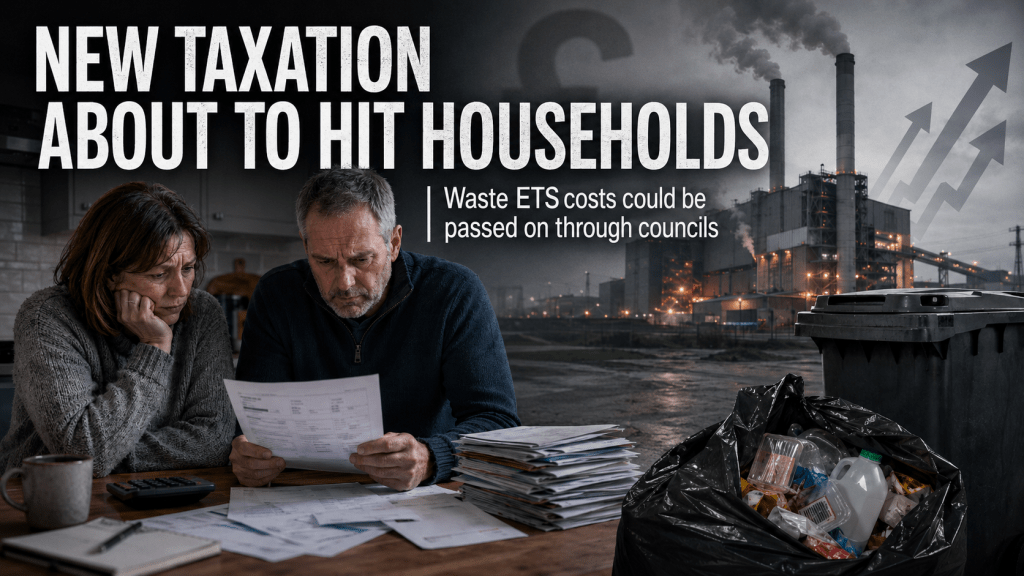
There is another cost coming down the line for ordinary households and most people have probably never heard of it.
It is called the UK Emissions Trading Scheme, or UK ETS. On paper, it sounds technical, distant, and harmless. In practice, it could become yet another hidden Net Zero charge pushed through councils, waste contracts, gate fees, service cuts, and eventually household bills.
This time, the target is waste incineration and energy-from-waste facilities.
From 2026, the Government has begun preparing the waste sector for inclusion in the UK ETS through a monitoring, reporting and verification period. The stated intention is that waste incineration and energy-from-waste facilities are brought fully into the scheme from 2028. Once that happens, operators of incinerators and energy-from-waste plants will be expected to account for the carbon emissions produced when waste is burned.
That may sound like a charge on operators. But let us be honest about how these things work.
Operators will not simply absorb the cost. They will pass it on through higher gate fees. Councils pay those gate fees to dispose of household waste. Councils are already under enormous financial pressure. So where does the money come from?
It comes from residents.
It comes through council tax. It comes through reduced services. It comes through pressure on recycling centres, bulky waste collections, street cleaning, local enforcement, and the basic services people already pay for but increasingly struggle to access.
This is not an abstract policy. It is another route by which Net Zero costs are pushed downwards onto people who can least afford them.
The Bin Tax Nobody Voted For
The public were told Net Zero would make energy cheaper. They were told green policies would save money in the long run. They were told the cost of transition would be manageable, fair, and targeted.
But what we are seeing is the opposite.
Standing charges have risen. Grid costs are rising. Renewable subsidies are embedded into bills. Councils are being squeezed. Farmers are being pressured by solar developers. Industry is being priced out. And now household waste disposal is being pulled into the carbon-pricing machine.
The UK ETS works by putting a price on carbon emissions. In theory, this is supposed to encourage businesses to reduce emissions. But waste is different from many other sectors.
Councils do not manufacture the plastic packaging, synthetic textiles, carpets, furniture, electrical goods, and fossil-based materials that end up in black bins. Residents do not design the products. Local authorities do not control what manufacturers put on the market. Yet under the current direction of travel, councils may end up carrying the cost when those materials are burned.
That is not the polluter pays principle.
That is the public pays principle.
Councils Cannot Magic the Money Out of Thin Air
The Local Government Association has already sounded the alarm. Its analysis warned that the proposed expansion of the ETS to waste incineration could cost councils as much as £747 million in 2028, rising to more than £1.1 billion by 2036, with cumulative costs potentially reaching £6.5 billion.
That is not loose change. That is a major financial hit to local government.
And councils cannot simply absorb it. A later LGA survey found that 93 per cent of responding councils said they would be able to meet the additional ETS costs within existing waste and recycling budgets only “to a small extent” or “not at all”. In other words, the money is not sitting there waiting to be used.
So the choice becomes brutally simple: raise more money from residents, or cut something else.
That is how hidden taxation works. It does not always arrive as a new tax demand with a clear label on the envelope. It arrives through higher charges, reduced services, less frequent collections, tighter bin rules, fewer recycling options, more enforcement, or a council tax rise justified by “unavoidable pressures”.
The public will be told this is about the environment. But many will experience it as another financial punishment.
The Wrong People Are Being Charged
If Government genuinely wants to reduce fossil-based waste, then the charge should fall on those who produce it in the first place.
It should fall on the manufacturers, importers, packaging producers, and retailers who place fossil-based materials into the economy. It should not fall on councils after the waste has already entered the household waste stream.
By the time a plastic-heavy product ends up in a resident’s black bin, the local authority has limited choices. It must collect the waste. It must dispose of it safely. In many areas, the disposal route is already locked into long-term contracts. Some waste streams must be incinerated for safety or regulatory reasons. Councils cannot simply wish those materials away.
This is why the current approach is so flawed.
It taxes the end of the chain, not the start. It penalises the collector, not the producer. It punishes the resident, not the manufacturer.
That is not environmental leadership. It is lazy cost transfer.
A Policy That Could Backfire
There is also a practical risk. If incineration becomes significantly more expensive, waste could be pushed into worse outcomes.
Government documents have already recognised concerns about waste being diverted to landfill or export if incineration costs rise too sharply. That would undermine the environmental aim of the policy.
So we could end up with the worst of both worlds: higher costs for councils and households, greater financial instability in waste services, and no guaranteed improvement in environmental outcomes.
This is the problem with policies designed around carbon accounting rather than real-world delivery. They may look neat in a spreadsheet, but they collide with the messy reality of local government, contracts, household behaviour, product design, and already stretched public finances.
The Recycling Trap
Supporters of the policy will say it encourages recycling. But councils already want to increase recycling. Residents are already encouraged to separate waste. Many people want to do the right thing.
The problem is not a lack of slogans. The problem is that the system is not designed properly.
Recycling rules vary by area. Packaging is often confusing. Some materials are technically recyclable but not practically recyclable in local systems. Products are made from mixed materials that are difficult to separate. Many councils lack the money to expand sorting, reuse, repair, and public education programmes.
Then along comes a new carbon cost that may drain even more money out of the very budgets needed to improve recycling.
That is the madness of it.
A policy that claims to support decarbonisation could end up weakening the council services that help residents recycle better.
This Is Part of a Bigger Pattern
This is not an isolated issue. It is part of the wider Net Zero cost-transfer model.
Instead of admitting openly what the transition costs, Government and its agencies spread the burden through bills, levies, regulations, compliance costs, council pressures, planning distortions, and market mechanisms that ordinary people barely understand.
The public are rarely asked for consent. They are simply presented with the bill afterwards.
Energy bills rise because of grid expansion and subsidy costs. Council budgets are hit by environmental compliance duties. Businesses face higher operating costs. Households pay more for goods and services. Farmers lose productive land to energy schemes. Communities are told to accept industrialisation of the countryside for targets they did not write.
And now even the contents of the household bin are being pulled into the same system.
This is why people are losing trust.
They can see that life is getting more expensive. They can see that public services are getting worse. They can see that every new green policy somehow ends with another cost landing on them.
The Fair Alternative
There is a fairer way.
First, any carbon cost linked to waste should be placed at the point of production, not disposal. Producers should be responsible for the fossil-based materials they place into the market.
Second, Extended Producer Responsibility must be made real, not tokenistic. If packaging producers create hard-to-recycle waste, they should pay the cost of dealing with it.
Third, councils should be protected from unfunded national mandates. If central government imposes a new national environmental cost, it must provide the funding or ensure the cost is recovered from the responsible industry.
Fourth, ETS revenues from waste should be ringfenced for local waste infrastructure, recycling improvement, reuse schemes, sorting technology, and practical solutions — not swallowed by the Treasury or lost in another bureaucratic scheme.
Fifth, residents must not be punished for a waste system they did not design.
Ordinary Households Have Had Enough
Families are already struggling with food prices, energy bills, rent, mortgages, insurance, fuel, and council tax. Pensioners are watching every pound. Working households are being squeezed from every direction.
Now they face another hidden pressure from a policy few people have heard of.
This is why it must be challenged early.
By the time the cost lands, the excuse will be familiar: “The scheme is already in place.” “Contracts have already been adjusted.” “Councils have no choice.” “The cost must be recovered.” “This is necessary for Net Zero.”
No.
The time to challenge it is now.
The Government must explain clearly who will pay, how much they will pay, and why households should be expected to carry the cost of fossil-based materials produced by industry.
It must also explain why councils are being put in the firing line when they do not control product design, packaging choices, or the fossil content of the waste stream.
This is not a fair environmental policy. It is another back-door tax route.
And unless it is changed, the public will pay again.
Through their bins. Through their council tax. Through their services. Through yet another hidden Net Zero bill.
Shane Oxer — Campaigner for fairer and affordable energy
 SAY NO TO THE DESTRUCTION OF OUR LAND
Leave a comment