The public are being told that Britain is on a pathway to deliver a transformed electricity system by 2030.
But when you strip away the political language, the glossy maps, and the slogans, the working grid data tells a very different story.
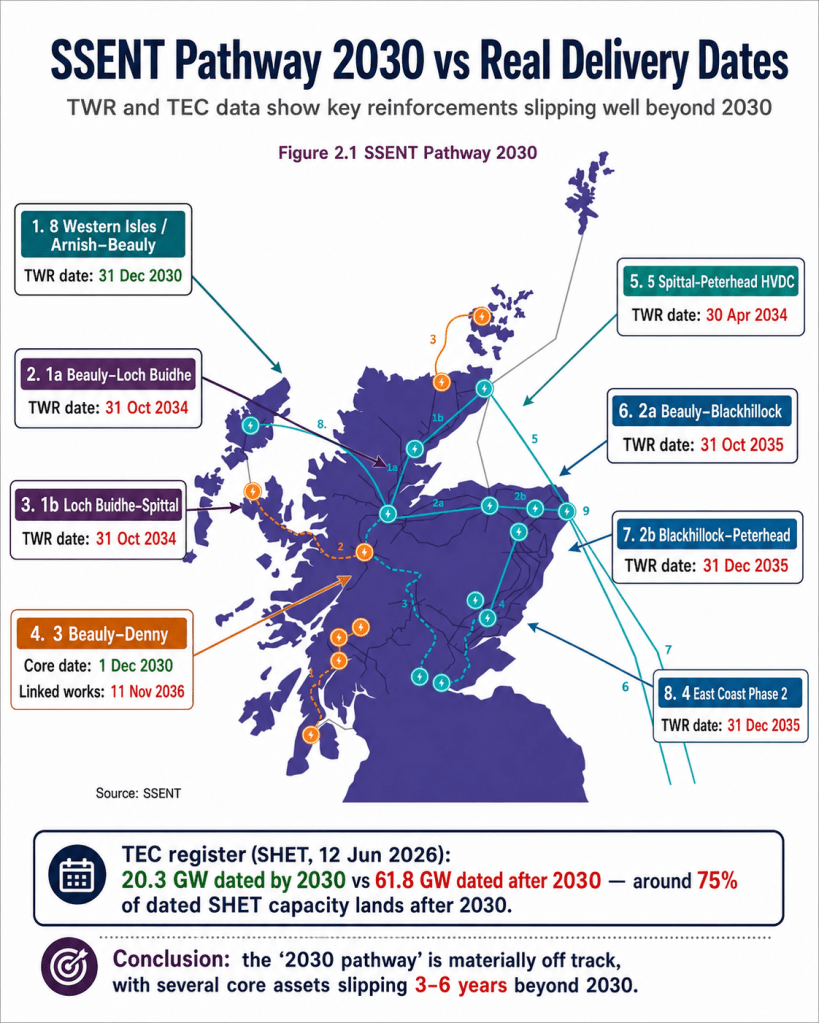
The map may say “SSENT Pathway 2030”.
The actual delivery dates say something closer to 2034, 2035, 2036 and beyond.
That matters, because the whole Clean Power 2030 agenda depends on the assumption that the grid will be ready in time. It depends on new transmission lines, substations, Super Grid Transformers, HVDC links, offshore wind connections, and major reinforcements all being delivered at extraordinary speed.
The evidence now shows that this assumption is unsafe.
Using the SSENT Pathway 2030 map, the TWR data, the TWR equipment quantity register, and the TEC register dated 12 June 2026, we can now compare the public-facing “2030 pathway” with the real dated delivery profile.
The conclusion is unavoidable:
The 2030 pathway is materially off track. Several of the core assets needed to unlock northern Scotland’s renewable capacity are not showing as 2030 assets in the working data. They are appearing years later.
The map says 2030. The data does not.
The SSENT map presents a network of major reinforcements across Scotland, including:
Beauly to Loch Buidhe
Loch Buidhe to Spittal
Beauly to Blackhillock
Blackhillock to Peterhead
Beauly to Denny
East Coast Phase 2
Spittal to Peterhead HVDC
Western Isles / Arnish to Beauly
These are not minor upgrades.
They are part of the backbone infrastructure needed to move large volumes of power from remote renewable generation areas to the wider GB transmission system.
Without these reinforcements, new wind, storage and generation projects may exist on paper, but they cannot be properly absorbed into the system.
That is the central problem with Clean Power 2030.
It is not enough to approve generation projects.
It is not enough to announce offshore wind targets.
It is not enough to point to a map and call it a pathway.
The real question is simple:
When will the grid actually be ready?
The TWR and TEC data answer that question , and the answer is not 2030.
The real delivery dates
The TWR data shows major reinforcements slipping well beyond the public 2030 narrative.
For example, the Beauly–Loch Buidhe reinforcement, linked to route 1a on the SSENT map, shows a latest relevant TWR date of 31 October 2034.
The Loch Buidhe–Spittal reinforcement, route 1b, also shows 31 October 2034.
The Spittal–Peterhead HVDC link, route 5, shows 30 April 2034.
The Beauly–Blackhillock route, route 2a, shows dates extending to 31 October 2035.
The Blackhillock–Peterhead route, route 2b, shows dates extending to 31 December 2035.
The East Coast Phase 2 reinforcement, route 4, also shows 31 December 2035.
And although the Beauly–Denny core date appears around 1 December 2030, linked works associated with that wider corridor extend to 11 November 2036.
That is not a minor slippage.
That is a delivery gap of roughly three to six years across several core parts of the system.
The TEC register confirms the same problem
The TEC register is even more revealing.
For SHET-hosted projects in the TEC register dated 12 June 2026, the dated capacity profile shows:
20.3 GW dated by 2030
versus
61.8 GW dated after 2030
That means around 75% of the dated SHET capacity increase lands after 2030.
This is the killer fact.
The issue is not one delayed project.
It is not one isolated reinforcement.
It is not one localised planning issue.
The bulk of dated capacity in the SHET data is positioned after the very year the public have been told is the target.
In plain English:
The capacity needed to make the 2030 pathway real is largely arriving after 2030.
That undermines the credibility of the whole timetable.
Why this matters for Clean Power 2030
Clean Power 2030 is built on a huge assumption: that Britain can rapidly replace large amounts of reliable generation with weather-dependent renewable generation while simultaneously rebuilding the grid at historic speed.
But the grid is not a slogan.
It is physical infrastructure.
It requires land.
It requires planning consent.
It requires transformers.
It requires switchgear.
It requires HVDC converter stations.
It requires pylons, cabling, substations, busbars, protection systems and grid stability equipment.
It requires skilled workers, supply chains, manufacturing capacity, route approvals and construction time.
These things cannot be wished into existence by political target-setting.
If the key reinforcements are not ready until 2034, 2035 or 2036, then the generation connected to those reinforcements cannot realistically deliver full system value in 2030.
This means Britain risks building a vast portfolio of renewable projects before the grid is able to use them properly.
That leads to three major consequences.
First, more constraint payments. Wind farms may be paid to switch off because the grid cannot move the power to where it is needed.
Second, higher consumer bills. The cost of grid upgrades, balancing actions, curtailment and system management ultimately lands on households and businesses.
Third, worsening security risk. A system built around intermittent generation but lacking the necessary grid infrastructure becomes harder, not easier, to manage.
The public deserve honesty
The phrase “Pathway 2030” gives the impression of a deliverable programme aligned with the Government’s Clean Power target.
But the working data tells a more uncomfortable story.
A genuine 2030 pathway would require the enabling grid assets to be in place before or by 2030.
Instead, the data shows key reinforcements stretching into:
2034
2035
2036
and in some wider connection datasets, even later.
That is not a 2030 delivery pathway.
That is a post-2030 catch-up plan.
There is a major difference between a target date and an engineering delivery date.
The public are being sold the target date.
The grid data shows the engineering reality.
This is why land-based energy expansion must be challenged
Across the UK, communities are being told that huge renewable schemes are necessary because of the rush to 2030.
Solar farms are being pushed onto farmland.
Battery sites are being pushed into rural communities.
Pylons and substations are being forced through countryside.
Local objections are being dismissed in the name of national urgency.
But if the grid itself is years behind the political timetable, then communities are entitled to ask a very serious question:
Why are we sacrificing farmland, countryside and local landscapes for a system that is not even deliverable on the Government’s own timescale?
Approving generation without grid readiness is not planning.
It is speculation.
Approving industrial-scale renewable projects before the network can properly absorb them is not energy security.
It is policy failure.
And forcing the costs onto the public while pretending everything is on track is not honest government.
The real conclusion
The evidence from the SSENT map, the TWR data and the TEC register points in the same direction.
The 2030 pathway is not on track.
Several core reinforcements appear to be slipping three to six years beyond 2030.
The TEC register shows the majority of dated SHET capacity landing after 2030.
That means the public-facing narrative and the operational data are no longer aligned.
This matters because Clean Power 2030 is being used to justify enormous planning, environmental and financial disruption across Britain.
But the numbers now show that the grid is not ready.
The infrastructure is not arriving in time.
The capacity is not aligning with the political promise.
And the public are being asked to pay for a timetable that the data itself does not support.
The conclusion is clear:
The 2030 pathway is already off track by years. Britain needs an honest grid-first energy strategy , not more political targets built on impossible delivery dates.
Shane Oxer. Campaigner for fairer and affordable energy
 SAY NO TO THE DESTRUCTION OF OUR LAND
Leave a comment