When the Protectors Become the Developers
Britain’s historic landscapes were not handed down to us so that one political generation could industrialise them in pursuit of an arbitrary target.
They were entrusted to organisations, charities and public bodies whose purpose was supposed to be clear: to protect places of historic interest, natural beauty and ecological importance for the benefit of future generations.
Yet across the country, the boundaries that once protected those places are being steadily erased.
In Brontë Country, enormous wind turbines are proposed across the moorland that inspired some of the greatest works in English literature.
At Barningham and Hope Moor, another industrial-scale wind development is being promoted across an ancient upland landscape containing peat, archaeology, wildlife habitats and historic features.
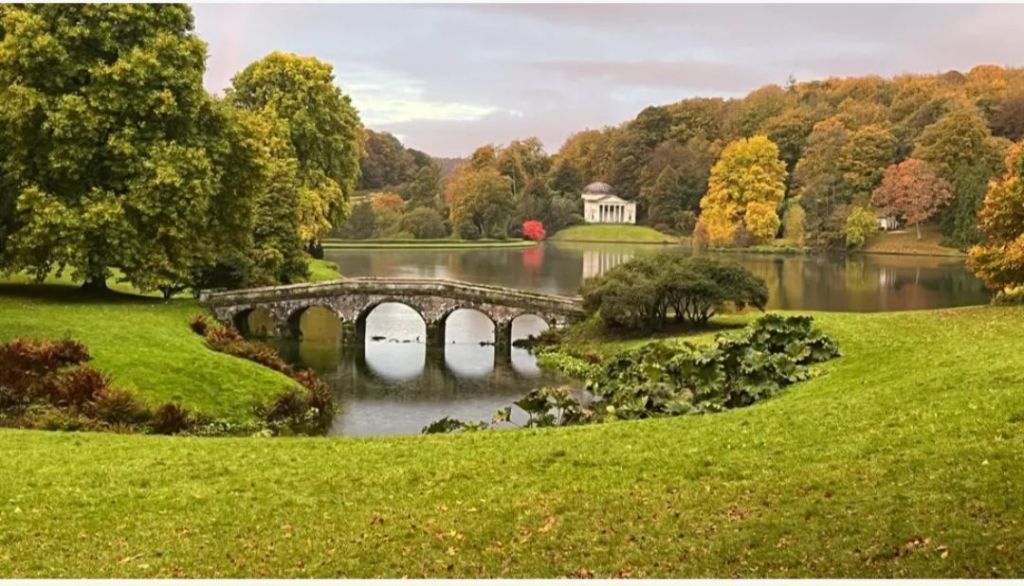
Now the National Trust itself has submitted plans for approximately 300 ground-mounted solar panels within the Stourhead estate—one of England’s most celebrated historic landscapes.
Taken separately, each organisation will insist that its proposal is carefully designed, sensitively positioned and environmentally justified.
Taken together, however, they reveal something far more troubling: the organisations and systems created to protect Britain’s countryside and heritage are increasingly being required—or are choosing—to subordinate that protection to the institutional demands of Net Zero.
The National Trust’s fundamental duty
The full name of the National Trust is the National Trust for Places of Historic Interest or Natural Beauty.
Its charitable objects include preserving lands and buildings of beauty or historic interest for the nation and, as far as practicable, preserving the natural aspect, features, animal life and plant life of the land in its care.[1]
That is not a secondary aspiration. It is the reason the organisation exists.
Its supporters, members and donors reasonably expect the Trust to be the last line of defence against the erosion of historic character and natural beauty—not an organisation seeking permission to introduce modern energy infrastructure into the landscapes it holds in trust.
The proposed Stourhead development consists of around 300 panels, reportedly reaching approximately three metres in height, in an agricultural field known as Brimbles near the visitor car park. According to the National Trust, the installation could provide approximately half of the electricity required to operate the estate.
That benefit should be acknowledged. Stourhead consumes electricity, and the Trust has a legitimate responsibility to control its costs and reduce unnecessary energy use.
But that does not end the discussion. It begins it.
The question is not simply whether solar panels can produce electricity. The question is whether an organisation established to preserve historic landscapes should be putting industrial energy equipment on greenfield land within one of the country’s most important heritage estates.
Before such a proposal is considered acceptable, the Trust should demonstrate publicly that every less harmful alternative has been exhausted: visitor-centre roofs, maintenance buildings, workshops, offices, car parks, canopies, brownfield areas, discreet off-site generation and long-term electricity supply arrangements.
Heritage protection should not mean searching for ways to conceal development after deciding it must take place. It should mean beginning with a presumption against altering the historic landscape and requiring an exceptional justification before that presumption is overturned.
The Trust itself has previously argued in planning representations concerning other renewable developments that such projects must respect the setting and significance of heritage assets.[2]
It cannot credibly demand that standard from external developers while applying a weaker standard to its own land.
Brontë Country: literature reduced to a planning constraint
The Calderdale Energy Park proposal is on an entirely different physical scale from Stourhead, but it reflects the same institutional mindset.
The current proposal comprises up to 34 turbines and an export capacity of up to 240MW. The turbines could reach approximately 200 metres in height across the moorland above Hebden Bridge and Haworth.[3]
This is not an anonymous stretch of vacant land.
It is part of Brontë Country—a landscape of international literary and cultural significance. The moors surrounding Haworth are inseparable from the work and imagination of Charlotte, Emily and Anne Brontë.
The landscape is not merely the backdrop to that history. It is part of the history.
It is also environmentally sensitive. Yorkshire Wildlife Trust has stated that the proposed development would affect land carrying Special Protection Area, Special Area of Conservation and Site of Special Scientific Interest designations, including areas of deep peat and blanket bog.[4]
The Trust has objected in principle, describing the proposal as poorly thought through and warning of avoidable, severe and long-term harm to nature and habitat.
That objection is important because it demonstrates that opposition to badly located renewable energy is not opposition to environmental protection.
Yorkshire Wildlife Trust supports Net Zero. Yet it has still recognised that renewable infrastructure must not be permitted to override the protection of irreplaceable habitats.
That should have been the starting point of national energy policy.
Instead, the process has been reversed. The demand for renewable capacity is treated as the national priority, while peat, landscape, archaeology, cultural identity, local communities and wildlife are treated as impacts that may be calculated, mitigated or compensated.
A literary landscape known throughout the world becomes a “zone of theoretical visibility.”
Ancient peat becomes an engineering condition.
Wildlife becomes a survey entry.
Public attachment to place becomes a consultation response.
Once everything is converted into a planning metric, the value of the landscape itself is gradually lost.
Hope Moor and Barningham: industrialisation by instalment
Hope Moor Wind Farm provides another warning.
The current proposal includes 23 turbines and an anticipated generating capacity exceeding 150MW. The site contains areas of peat, blanket bog, wetlands, heathland, archaeological features, a scheduled prehistoric cairn and dozens of non-designated heritage features.[5]
The developer says the scheme will be sensitively designed, will avoid the most sensitive areas where possible and will include habitat restoration and mitigation.
Those statements will be familiar to communities living near almost every major infrastructure development.
The difficulty is that a wind farm is not confined to turbine footprints.
It requires substantial foundations, crane hardstandings, access roads, construction compounds, drainage works, underground cabling, substations and grid infrastructure. Turbine components must be transported into an upland landscape by vehicles capable of carrying blades, towers and generating equipment of exceptional size.
The effect cannot therefore be judged by counting turbine bases alone.
It is the transformation of the character and function of the wider landscape that matters.
A moor that has existed for centuries as open country becomes an electricity-generating complex. Its historic, ecological and cultural identity becomes subordinate to an industrial purpose.
Developers describe this as a temporary use because turbines may eventually be decommissioned. But a generation is not temporary in the life of a community. Roads, drainage changes, foundations and disturbed ground may remain long after the machinery has ceased operating.
We should also ask where the cumulative limit lies.
If one moor can accommodate 23 turbines because of national energy need, and another can accommodate 34, what principle prevents the next historic landscape being treated in the same way?
Once national targets override local character, there is no natural stopping point.
The failure is institutional, not accidental
The underlying problem is larger than any individual planning application.
Britain’s conservation system has been pulled away from the simple principle of preservation and drawn into a system of target delivery.
Organisations that once asked, “How do we protect this place?” are increasingly being encouraged to ask, “How can energy infrastructure be accommodated here?”
The difference is fundamental.
Under the first approach, the landscape is the priority.
Under the second, development is assumed to be necessary and the landscape must adjust.
This is how mission drift occurs.
Carbon targets are written into strategies, funding arrangements, investment policies, planning guidance and organisational performance measures. Executives are expected to demonstrate climate leadership. Renewable installations become visible evidence of institutional compliance.
Meanwhile, the loss of beauty, tranquillity, historic character and cultural meaning is much harder to place on a spreadsheet.
The National Trust has committed itself to reaching net zero carbon across its own operations by 2030.[6]
That commitment creates an obvious risk of conflict. What happens when the quickest or most visible way to meet an organisational carbon target conflicts with the older duty to preserve the natural and historic character of the land?
The Trust may believe that both objectives can always be reconciled.
Stourhead suggests they cannot simply be assumed to be compatible.
Protection must mean saying no
A conservation organisation that never says no to development is not protecting the countryside. It is administering its transformation.
Responsible environmental policy requires choices. It requires the courage to distinguish between suitable and unsuitable locations.
Rooftops, warehouses, commercial estates, transport depots, car parks, previously developed land and industrial sites should be considered before historic estates, protected peatland, agricultural fields and culturally important landscapes.
Some places should be treated as effective no-go areas for industrial-scale energy development—not because energy security is unimportant, but because heritage and nature cannot always be recreated elsewhere.
A solar panel can be installed in another location.
A turbine can be built on a less sensitive site.
A historic landscape, once industrialised, cannot simply be moved.
National policy should therefore require a genuine hierarchy of land use. Developers and landowners should be required to prove that less damaging alternatives have been properly investigated—not merely state that their preferred site is commercially or technically convenient.
There should also be a clear separation between carbon accounting and conservation judgment.
A claimed reduction in carbon emissions must not automatically outweigh the destruction or degradation of a specific place. Carbon calculations are estimates based on assumptions about output, displacement, grid operation and future energy generation. The damage to a historic view, an archaeological landscape or a peatland habitat may be immediate and irreversible.
We are being asked to sacrifice what environmentalism was supposed to protect
The great contradiction of modern environmental policy is now impossible to ignore.
We are told that the countryside must be industrialised to save the environment.
Peat may be disturbed to reduce carbon.
Historic views may be transformed to protect future generations.
Agricultural land may be covered with energy infrastructure in the name of sustainability.
Natural beauty may be sacrificed to achieve environmental targets.
This is not conservation in any traditional understanding of the word.
It is the replacement of place-based environmental stewardship with target-based infrastructure policy.
Climate change is a legitimate concern. Energy security is essential. Historic buildings must be heated, maintained and operated affordably.
But none of those truths requires us to accept that every moor, field, heritage estate or protected landscape is potentially available for energy development.
Britain needs an energy policy that works with the character of the country rather than against it: reliable generation, modern nuclear power, domestic energy resources, properly planned grid investment, rooftop solar, brownfield development and local generation placed close to demand.
What it does not need is a policy that turns organisations established to protect beauty into agents of its gradual industrialisation.
Brontë Country should be protected.
Barningham and Hope Moor should be protected.
Stourhead should be protected.
And the organisations holding these places in trust should remember that their first duty is not to a political target, a corporate strategy or an institutional carbon calculation.
Their duty is to the land, the history, the wildlife and the generations who will inherit what remains.
The question is no longer simply who will protect Britain’s heritage.
It is becoming:
Who will protect our heritage from the organisations that were supposed to defend it?
Shane Oxer. Campaigner for fairer and affordable energy
 SAY NO TO THE DESTRUCTION OF OUR LAND
Leave a comment