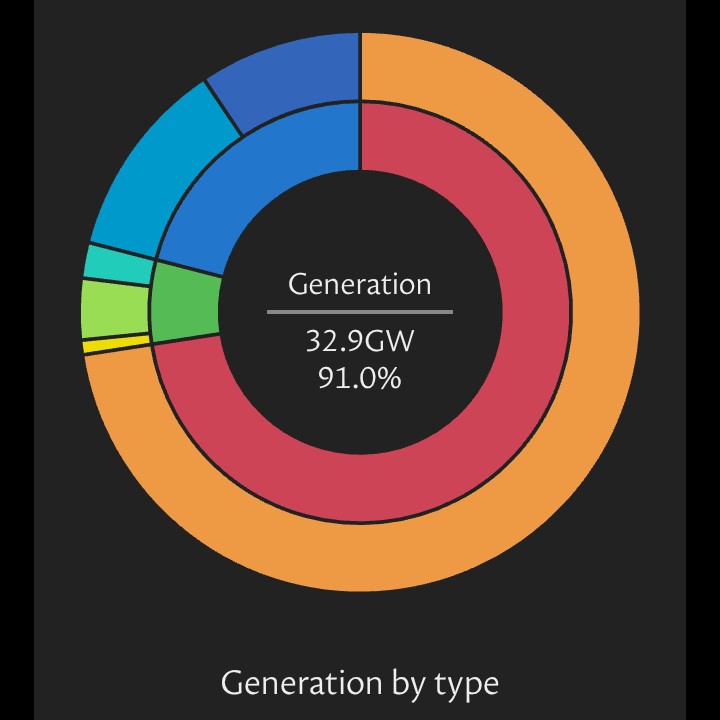
Britain was not facing an immediate blackout. But on a hot June evening, low wind, falling solar production and power-station outages forced the system operator to secure 1.7GW of imported electricity at extraordinary prices. This exposed the difference between cheap intermittent generation and an affordable, dependable electricity system.
The screenshot that should concern everyone
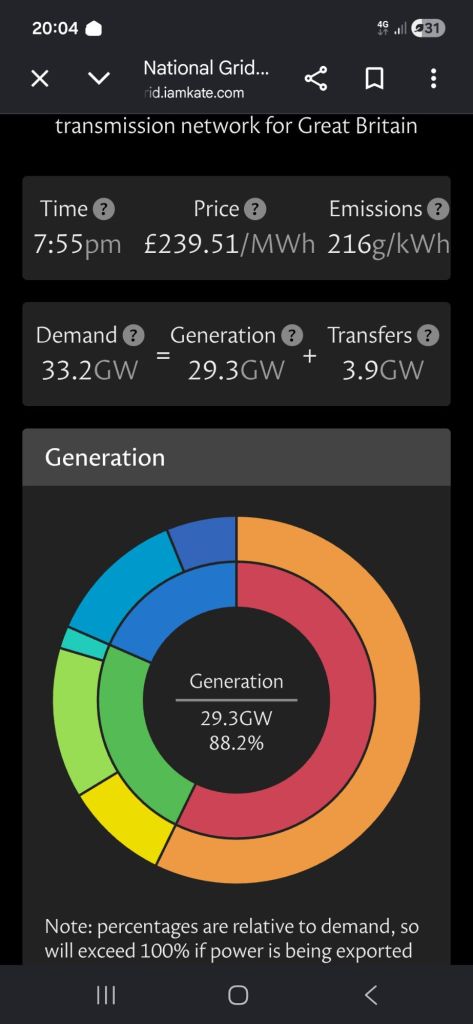
At 7:55pm on 24 June 2026, live electricity data for Great Britain showed:
Demand: 33.2GW
Domestic generation: 29.3GW
Transfers into the system: 3.9GW
Short-term market price: £239.51/MWh
Carbon intensity: 216g/kWh
This was the middle of summer, not a freezing January evening.
Wind production was weak. Solar generation was declining with the evening sun. Britain was relying heavily on gas generation and almost 4GW of transfers to meet demand.
The £239.51/MWh shown in the screenshot was the short-term market price. It was not the average price paid for every unit of electricity that day, and it was not the same as the household retail tariff.
Nevertheless, it was an unmistakably expensive period.
More concerning was what had happened behind the scenes.
NESO needed an additional 1,900MW safety margin
The National Energy System Operator had issued an Electricity Margin Notice after identifying a forecast shortfall of approximately 1,900MW against the operating margin it wanted for the evening.
An Electricity Margin Notice does not mean that blackouts are inevitable. It is a signal to electricity generators and market participants that the anticipated supply margin has become tighter than the system operator considers desirable.
NESO subsequently cancelled the notice after securing around 1.7GW of additional imported electricity from continental Europe.
The reported price for some of those imports was approximately:
£1,400 per megawatt-hour
That was not the price of every unit of electricity consumed across Britain. It was the price reportedly required for particular balancing and import actions needed to restore the operating margin.
However, the distinction does not make the intervention inexpensive.
Purchasing 1.7GW for one hour at £1,400/MWh would represent a gross cost of approximately £2.38 million. If comparable volumes were required over several hours, the cost would escalate rapidly.
Industry estimates placed the total cost of the day’s additional actions at around £10 million.
Britain did not run out of electricity—but security came at a remarkable price
It is important not to exaggerate what occurred.
Electricity supplies were not cut off. NESO stated that the notice did not mean a blackout was imminent. The operator did its job by taking action before the situation became more serious.
That is how a properly managed electricity system is supposed to function.
But the need for the intervention still raises a fundamental question:
«Why did Britain need electricity costing around £1,400/MWh to protect its operating margin on a summer evening?»
The answer was a combination of circumstances.
A large high-pressure weather system reduced wind speeds across Britain and parts of continental Europe. Hot weather increased electricity demand from air-conditioning and fans. Some British gas-fired generation was unavailable, while high river-water temperatures reportedly reduced output from several French nuclear stations.
As evening approached, solar production inevitably declined.
Britain therefore needed more electricity at precisely the moment when neighbouring countries were also experiencing high demand and reduced generation.
Imports are not the same as energy independence
Interconnectors can be extremely useful. They allow Britain to trade electricity with neighbouring markets and can help balance differences in supply and demand.
But an interconnector does not generate electricity.
It is a cable giving Britain access to electricity generated somewhere else.
Imports are affordable and dependable only when another country has surplus electricity available and is willing to sell it at a reasonable price.
When the same weather system affects several countries simultaneously, that assumption becomes much weaker. Britain is then competing with its neighbours for a restricted pool of dispatchable power.
On this occasion, Britain could secure the electricity , but at an exceptional price.
What happens during a more widespread shortage? What happens when European countries need their available power for their own consumers? What happens when interconnectors suffer faults, market disruption or political intervention?
Interconnection should complement domestic dependable generation. It should not become a substitute for it.
So, do renewables bring prices down?
The honest answer is that wind and solar can reduce wholesale prices when they are producing strongly.
Their fuel is free, and their immediate operating costs are comparatively low. During periods of high renewable production and modest demand, wholesale electricity prices can fall sharply and may occasionally become negative.
But that is only one part of the system.
Electricity must be available every second of every day—not merely when the weather is favourable.
When wind output falls and solar disappears during the evening, Britain still needs generation capable of responding immediately. That normally means gas, storage, imports, hydroelectricity or other dispatchable sources.
Under Britain’s marginal pricing arrangements, the wholesale market price for a period is generally influenced by the most expensive source still required to meet demand. Ofgem acknowledges that gas generation is often the final and most expensive source needed and can therefore set the wholesale electricity price.
Consequently, adding more wind and solar capacity does not automatically guarantee low prices during periods of scarcity.
The crucial distinction is this:
«Wind and solar may produce inexpensive electricity when available. That does not automatically create an inexpensive electricity system capable of supplying power whenever required.»
The costs that disappear from the headline
Public claims about cheap renewable energy frequently concentrate on the generation price of an individual megawatt-hour.
They rarely present the complete system cost with the same prominence.
Consumers must ultimately fund:
– reserve generation;
– frequency and voltage control;
– balancing interventions;
– transmission reinforcements;
– new substations and converters;
– constraint payments;
– backup for periods of low renewable production;
– and replacement electricity when generation is unavailable or located behind a network constraint.
House of Commons Library analysis shows that balancing costs are already included within household electricity bills. For the second quarter of 2026, balancing costs represented an estimated £42, or approximately 5%, of the capped annual electricity bill for a typical direct-debit household.
Network infrastructure charges represented a further £214, or around 23%.
These are not theoretical costs. They appear in bills, taxation or public borrowing.
When wind output is excessive in a constrained part of the network, consumers can pay generators to reduce production and then pay other generators , frequently gas stations , to increase production elsewhere.
When wind output is too low, consumers pay for gas generation, imports, storage or demand reduction.
The consumer pays in both directions.
A summer warning with winter implications
This episode was driven partly by exceptional heat and generator outages. It should not be presented as proof that Britain is constantly on the edge of blackouts.
But it should be treated as a warning.
Summer demand is generally lower than winter peak demand. Solar production is also far more substantial in June than during a dark December evening.
Yet a combination of low wind, declining evening solar, power-station outages and increased demand was enough to require a rare summer margin notice and costly imports.
Britain’s future electricity demand is expected to rise as transport, heating, industry and data centres become increasingly electrified.
If demand rises while dependable domestic generating capacity fails to keep pace, interventions of this kind could become more frequent and more expensive.
Installed capacity figures will not protect the country if the capacity is unavailable at the time of greatest need.
One gigawatt of weather-dependent capacity is not operationally equivalent to one gigawatt of dependable generation.
Energy policy must recognise that difference.
What Britain should do
Britain requires a balanced electricity strategy based on engineering reality rather than headline capacity announcements.
First, the Government and NESO should publish the complete cost of electricity-system interventions in a form the public can understand. That should include wholesale costs, balancing costs, constraint payments, reserve procurement and exceptional interconnector purchases.
Second, new renewable development should be aligned with available grid capacity. Continuing to connect generation in areas where the network cannot transport its output merely increases curtailment and balancing costs.
Third, Britain must retain sufficient dispatchable generation during the transition. Existing gas stations should not be forced out before dependable replacements are operational.
Fourth, nuclear development , including the proposed Rolls-Royce small modular reactor programme. must be treated as essential national infrastructure rather than a distant aspiration.
Finally, energy-security modelling must examine simultaneous low-wind conditions, falling solar production, generator outages and scarcity across interconnected European markets. Assuming that neighbouring countries will always have inexpensive surplus power is not a resilience strategy.
Cheap when available is not the same as cheap when needed
The events of 24 June did not demonstrate that wind and solar have no value.
They demonstrated that the political slogan of “cheap renewable energy” is incomplete.
A secure electricity system must operate during calm evenings, cold winter peaks, heatwaves, power-station outages and periods when neighbouring countries face the same pressures.
The real measure of affordability is not the advertised cost of renewable electricity when production is abundant.
It is the total cost of delivering dependable electricity whenever consumers need it.
On this summer evening, Britain’s short-term market price reached approximately £240/MWh, nearly 4GW was being transferred into the system, and NESO reportedly secured additional imports at around £1,400/MWh to protect its operating margin.
That is not evidence of an electricity system that has already become cheaper through renewable expansion.
It is evidence that Britain still depends on gas, dispatchable generation and foreign electricity when the weather does not cooperate , and that the price of maintaining security can become extraordinary.
The question is not simply how cheaply electricity can be produced when the wind blows.
The question is:
«Who keeps the lights on when it does not , and how much are consumers required to pay?»
Shane Oxer. Campaigner for fairer and affordable energy
Sources
1. National Energy System Operator statements concerning the June 2026 Electricity Margin Notice.
2. Live Great Britain electricity data displayed by National Grid: Live.
3. The Guardian, reporting on the 24 June 2026 margin warning, balancing actions and electricity imports.
4. Ofgem, “Wholesale energy costs and your bills.”
5. House of Commons Library, “What costs make up an electricity bill?”
6. NESO, Annual Balancing Costs Report.
 SAY NO TO THE DESTRUCTION OF OUR LAND
Leave a comment