The organisation charged with scrutinising Britain’s biggest projects is reducing oversight just as infrastructure spending, subsidies and long-term consumer liabilities reach extraordinary levels.
A revealing report in Construction News has exposed the thinking now taking hold inside the National Infrastructure and Service Transformation Authority. NISTA.
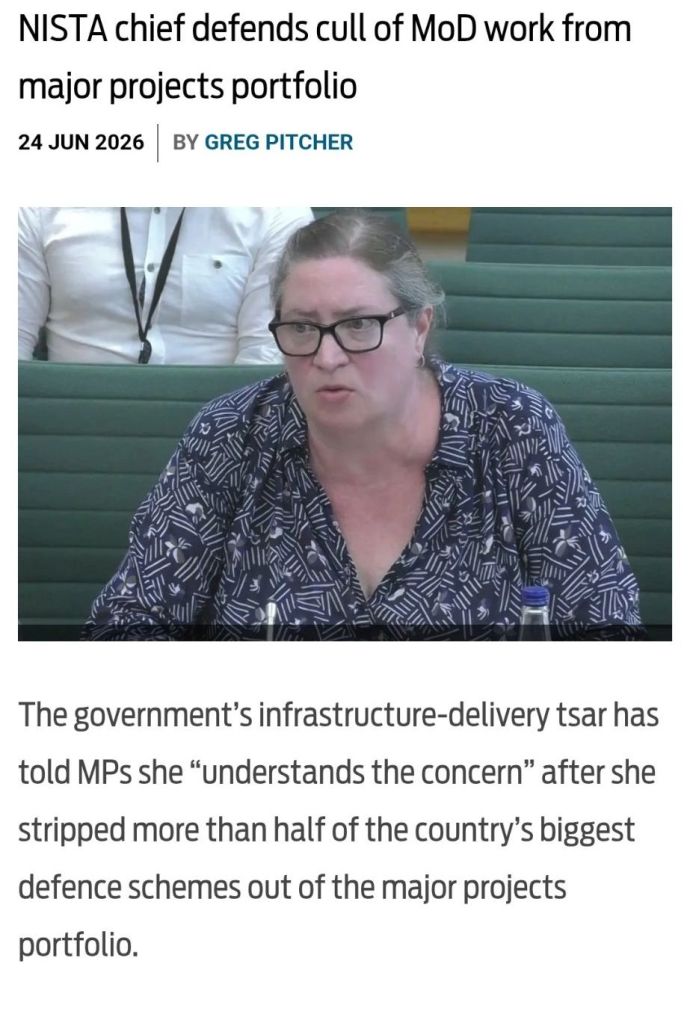
NISTA has removed 27 major Ministry of Defence programmes from the Government Major Projects Portfolio, cutting the number under its direct oversight from 47 to just 20.
This would be concerning under any circumstances. It becomes even more alarming when we learn that 39 of the previous 47 defence programmes had been rated amber or red for delivery.
In other words, many of the projects facing the greatest problems, delays and delivery risks are precisely the projects being removed from central scrutiny.
NISTA chief executive Becky Wood defended the decision by arguing that there was a balance between oversight and “true, targeted and active oversight”. She suggested that too many layers of assurance could blur responsibility and slow decision-making.
That may sound reasonable in the language of Whitehall management consultancy.
But the public should ask a much simpler question:
When major projects are already running into trouble, is the answer really to reduce independent oversight?
Experts at spending money they never earned
NISTA does not personally write every government cheque. Its role is to oversee and provide assurance for some of the country’s largest, most complex and strategically important projects.
That makes its attitude towards transparency and accountability extremely important.
Britain is entering one of the largest periods of infrastructure expenditure in its history. NISTA’s own March 2026 infrastructure pipeline identifies around £718 billion of projects and programmes, of which an extraordinary £365 billion is allocated to energy infrastructure.
Energy therefore represents more than half of the entire headline pipeline.
Yet our detailed bottom-up examination of that £365 billion figure found that it could not be fully reconciled from the information publicly provided.
The investigation identified approximately £222.4 billion to £229.5 billion of nuclear, offshore wind, electricity transmission, solar construction, interconnection and named energy-storage investment.
That left between £135.5 billion and £142.6 billion unresolved against NISTA’s headline figure.
This does not automatically mean the money has disappeared or been stolen. It means the public information is not sufficiently detailed, consistent or transparent to allow taxpayers, consumers or Parliament to independently audit what the £365 billion figure actually contains. �
Brief.docx
That is the central problem.
NISTA is promoting a vast national infrastructure programme while failing to publish a clear, asset-by-asset account showing:
what each project costs;
what price base has been used;
when the money will be spent;
who provides the initial finance;
what costs overlap with other programmes;
and who ultimately pays.
At the same time, it is now arguing that oversight can be reduced in the name of efficiency.
That is not a reassuring combination.
The £365 billion figure is only the beginning
The £365 billion energy headline is not the total cost of Britain’s energy transformation.
It is largely a capital-infrastructure figure. It does not provide a complete account of the additional costs being imposed through subsidies, regulated returns, financing arrangements, backup capacity, grid balancing, constraint payments and long-term liabilities.
Our evidence briefing identified approximately £15.6 billion of selected non-overlapping energy support and system costs in 2024/25 alone.
These included:
£7.7 billion through the Renewables Obligation;
£1.73 billion through Feed-in Tariffs;
£2.2165 billion through Contracts for Difference;
£1.2543 billion through the Capacity Market;
and £2.7 billion in electricity-system balancing costs.
Together, those selected mechanisms produced an annual total of approximately £15.6008 billion. �
Brief.docx
For public discussion, that can reasonably be described as a £16 billion annual support and system-cost burden.
However, we should remain precise: not every pound is technically a subsidy, and not every element is necessarily waste.
The Capacity Market, for example, pays dependable generators and other resources to remain available when required. Some network balancing expenditure is necessary to keep the electricity system secure.
But much of this expenditure exists because Britain has created an increasingly complex, fragmented and intermittency-dependent energy system.
Consumers are paying to subsidise renewable generation.
They are paying to guarantee prices through Contracts for Difference.
They are paying conventional generators and storage providers to remain available as backup.
They are paying for balancing actions when electricity is generated in the wrong place or at the wrong time.
They are paying for grid expansion to connect geographically dispersed power sources.
And they are paying constraint costs when the network cannot transport the electricity already being generated.
The public is therefore not paying once for the energy transition.
It is paying repeatedly at every layer of the system.
£156 billion over ten years
If the selected £15.6 billion annual total were repeated for ten years at the same nominal level, the simple arithmetic would reach approximately £156 billion.
That is not a formal forecast. Scheme costs, electricity prices, demand and government policy will change.
But it demonstrates the scale of recurrent expenditure sitting outside NISTA’s £365 billion capital headline.
A £365 billion infrastructure programme accompanied by around £16 billion a year in selected support and system costs is not a minor adjustment to the energy system.
It is a fundamental transfer of financial risk from developers and government policy-makers to households and businesses.
The true national commitment is therefore not merely the cost of building wind farms, solar developments, nuclear stations, batteries, substations, pylons and transmission cables.
It also includes:
financing returns;
guaranteed revenues;
construction-phase levies;
backup generation;
balancing services;
grid-constraint payments;
decommissioning liabilities;
and decades of contractual support.
No single official government document currently presents this cumulative bill.
Privately financed does not mean privately paid
One of the most misleading phrases in modern infrastructure policy is “privately financed”.
Private capital is not free money.
An investor provides capital because that investor expects the original investment to be repaid with a return.
For regulated networks, that return is recovered through network charges added to electricity bills.
For wind farms and other Contracts for Difference projects, developers receive electricity-market revenue together with contractual protection funded through suppliers and ultimately consumers.
Sizewell C consumers are being charged through the Regulated Asset Base model during construction.
Hinkley Point C will receive revenue protection through a 35-year Contract for Difference once it begins operating.
Capacity Market assets are paid to remain available.
CCUS and hydrogen projects are being supported through government-backed contracts and potential levy arrangements.
The initial financing may appear to come from banks, investment funds, energy companies or pension funds.
The ultimate payment comes from the public.
The contradiction at the heart of NISTA
NISTA was created to improve infrastructure delivery and strengthen government assurance.
Its stated responsibilities include overseeing the most complex and strategically important government programmes.
Yet it has reduced its major-project portfolio from 213 schemes to 81.
It has removed more than half of the Ministry of Defence programmes previously subject to central oversight.
And this comes as its own infrastructure pipeline expands to hundreds of billions of pounds.
There may be a legitimate argument for concentrating specialist oversight on the riskiest and most important projects.
But that is not what the public appears to be seeing.
The defence schemes being removed were not universally healthy, straightforward programmes. A large proportion were already rated amber or red.
The danger is that “clarity of accountability” becomes a convenient phrase for transferring scrutiny back to departments that have repeatedly demonstrated weak project management, cost escalation and delivery failure.
The same risk applies to energy.
NISTA’s energy pipeline mixes individual projects, regulatory settlements, programmes and funds. Costs are reported using different price bases and timescales. Some project allowances remain confidential. Capital expenditure is separated from the subsidies and financing mechanisms required to make projects commercially viable.
That is exactly the environment in which strong scrutiny is needed.
Britain does not suffer from a shortage of plans
Britain has energy strategies, infrastructure pipelines, carbon budgets, grid plans, investment roadmaps, regulatory settlements and departmental targets.
What it does not have is one complete, auditable national account.
There is no single ledger showing:
the full construction cost;
the annual subsidy burden;
the cost of finance;
the cost of backup capacity;
the cost of balancing intermittent generation;
the cost of network expansion;
the cost of decommissioning;
and the final impact on household and business bills.
There is also no complete public assessment proving that Britain has enough engineers, manufacturing capacity, transformers, cables, switchgear, vessels, ports and specialist labour to deliver every project being announced.
NISTA estimates that delivering the wider infrastructure pipeline could require an annual average workforce of between 629,000 and 706,000 full-time equivalents over five years.
Its methodology generally excludes component manufacturing, meaning the real industrial requirement may be even greater. �
Brief.docx
Borrowing money can create purchasing power.
It cannot instantly create skilled engineers, transformer factories, cable plants, heavy-lift vessels or experienced project managers.
Accountability must increase, not decrease
The lesson from Britain’s history of major-project failure is not that oversight should be removed.
It is that oversight must become more transparent, more technically competent and more independent of departmental politics.
Before another major energy commitment is approved, the government should publish a complete asset-level account showing:
the project cost;
the price basis;
the delivery timetable;
the grid dependency;
the financing mechanism;
the expected subsidy or regulated return;
and the ultimate payer.
Parliament should also receive an annual energy-cost statement covering the Renewables Obligation, Feed-in Tariffs, Contracts for Difference, the Capacity Market, nuclear RAB charges, network revenues, constraint costs, balancing expenditure, CCUS support and hydrogen subsidies.
Without that information, the public is being asked to sign a blank cheque.
The public pays for every failure
NISTA may describe the removal of projects from its central portfolio as streamlining.
Departments may describe privately financed infrastructure as investment.
Energy companies may describe subsidies as market support.
Regulators may describe higher bills as allowed revenue.
But behind every piece of administrative language stands the same person:
the consumer and taxpayer.
The public finances the construction.
The public finances the guaranteed revenues.
The public finances the backup generation.
The public finances the balancing actions.
The public finances the grid expansion.
And when projects are delayed, badly designed or over budget, the public finances the failure.
Britain should not accept reduced oversight at the very moment public exposure is becoming larger, more complex and more difficult to audit.
NISTA’s decision over defence projects is therefore more than an internal Whitehall reorganisation.
It reveals a dangerous institutional mindset: government bodies believe scrutiny can be reduced while spending commitments continue to grow.
With a £365 billion energy pipeline, an unresolved public accounting gap of more than £135 billion, and around £16 billion a year in selected energy support and system costs, the case for greater accountability could hardly be stronger.
Shane Oxer. Campaigner for fairer and affordable energy
 SAY NO TO THE DESTRUCTION OF OUR LAND
Leave a comment