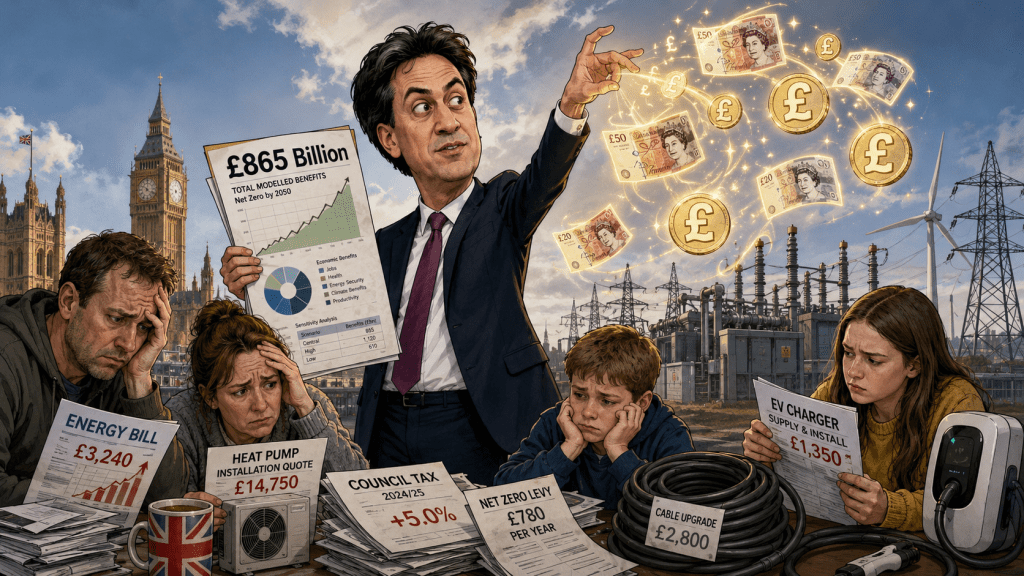
The Government wants the public to believe that imposing another legally binding carbon target will produce an extraordinary £865 billion economic benefit.
It sounds wonderful.
Spend hundreds of billions of pounds replacing heating systems, changing vehicles, rebuilding electricity networks, constructing new generation, installing storage, expanding substations and altering the way people live , and somehow the country emerges £865 billion richer.
There is only one problem.
The £865 billion does not exist as money.
It is not tax revenue. It is not household income. It is not a reduction in the national debt. It is not money that can be spent on hospitals, pensions, schools or social care.
It is a theoretical value created inside an economic model.
In metaphorical terms, the Climate Change Committee and the Government have discovered how to create imaginary money from thin air.
They assign monetary values to emissions that might be avoided, climate damage that might not occur and fossil-fuel shocks that might be escaped. They then place those hypothetical benefits on one side of the ledger and use them to outweigh hundreds of billions of pounds of real expenditure on the other.
This is economic alchemy.
The public pays in pounds.
The model pays in assumptions.
What the £865 Billion Claim Really Contains
The Government’s impact assessment for the Seventh Carbon Budget examines the CCC’s recommended emissions limit for 2038 to 2042.
Its central calculation, covering the period from 2025 to 2050, identifies approximately:
£880 billion in capital and financing costs.
After assumed reductions in operating and fuel costs, this becomes:
£755 billion in total net implementation costs.
The model then claims approximately:
£1.62 trillion in total benefits.
Subtract the £755 billion of costs from the £1.62 trillion of benefits and—abracadabra—the Government announces an £865 billion net economic benefit.
But look more closely at where the £1.62 trillion comes from.
Approximately £1.495 trillion is attributed to “carbon savings”. A further £80 billion is assigned to air-quality improvements and £50 billion to natural capital.
That means more than nine-tenths of the claimed benefits are generated by putting a monetary value on carbon emissions that the model assumes will be avoided.
This is not cash generated by building a factory, producing a product, exporting goods or improving productivity.
It is a social value assigned to a theoretical outcome.
The assessment itself makes clear that these carbon values are not the price the Government expects carbon to command in the emissions-trading market. They represent an estimated social value placed on avoiding an additional tonne of emissions.
There may be a legitimate academic argument for valuing environmental harm. Cleaner air and reduced pollution can produce genuine benefits. Exposure to international fuel-price shocks also carries real economic risks.
But none of that makes £1.495 trillion of modelled carbon value equivalent to £1.495 trillion in the bank.
A household cannot buy a heat pump with avoided carbon value.
A pensioner cannot pay an electricity bill with the estimated social benefit of a tonne of carbon dioxide.
A small manufacturer cannot meet its payroll using climate damage that a computer model predicts might have been avoided in 2047.
The costs arrive in sterling.
The benefits arrive in a spreadsheet.
Change the Assumption and the Magic Begins to Disappear
The most revealing part of the impact assessment is its sensitivity analysis.
Using the Government’s central carbon values, the preferred option produces the famous £865 billion net present value.
Use the higher carbon-value series and the theoretical benefit rises dramatically to approximately £1.615 trillion.
Use the lower carbon-value series and it collapses to only £120 billion.
The physical programme has not suddenly changed. The cables, heat pumps, vehicles, substations and power stations remain broadly the same.
What changed was the monetary value assigned to carbon.
Against the Government’s Energy and Emissions Projections baseline—which already includes firm and funded policies , the same lower carbon values turn the preferred option into an estimated £160 billion net loss.
That is extraordinary.
The headline can move from a vast economic prize to a substantial economic loss largely because an analyst changes the social value attributed to a tonne of carbon.
That does not prove that reducing emissions has no value. It proves that the £865 billion headline is not an objective pot of money waiting to be collected.
It is a model-dependent result.
The number reflects assumptions about carbon values, technology costs, fossil-fuel prices, discount rates, deployment speed and the counterfactual future against which the policy is compared.
Choose one set of assumptions and the policy appears spectacularly profitable.
Choose another reasonable set and much of the supposed benefit disappears.
That is why describing the £865 billion as an economic benefit without explaining its composition is deeply misleading.
The Target Is Binding , But the Bill Has Not Been Written
The most astonishing admission appears in section 9.2 of the Explanatory Memorandum.
It says that when setting the carbon-budget level, the Government does not yet need to agree the package of policies and proposals required to meet it.
That comes later.
The Government is therefore fixing the legally binding destination before finalising the route, the vehicle, the fare or who will be forced to pay.
The same memorandum says that there is no significant impact on businesses, charities, small companies or the public sector at this stage , because those impacts will be dealt with in the future delivery plan and individual policies.
This is not evidence that the impacts do not exist.
It means they have not yet been allocated.
The Government cannot currently tell an ordinary household precisely how much the target will cost through:
higher electricity-network charges;
tax-funded grants and subsidies;
compulsory or encouraged heating changes;
vehicle replacement;
property-efficiency requirements;
higher business costs passed through consumer prices;
or the financing of generation, storage and grid infrastructure.
The impact assessment openly admits that it cannot provide a detailed quantified distributional assessment because it is not examining a specific policy package.
It recognises that the effects will depend upon income, housing type, tenure, heating system, vehicle ownership, access to charging and geographical location.
It also acknowledges that lower-income households have less access to savings and finance, making it harder for them to purchase technologies such as heat pumps and electric vehicles.
So the Government has produced an £865 billion national benefit , but cannot say what an individual family will have to pay.
That is not a minor omission.
It is the central question.
A Model Operating Under “Perfect Foresight”
The Government’s principal energy-system model, UK TIMES, is described as a least-cost optimisation model. It calculates the least expensive theoretical combination of technologies capable of meeting an emissions constraint.
But the assessment’s own technical annex contains a list of major limitations.
The model assumes a deterministic world operating under “perfect foresight”.
Its pathways are least-cost and achievable only if the assumptions underpinning them prove correct across the whole period.
It does not fully account for behavioural barriers, practical complications, system feedbacks or the diversity of consumer choices.
It has limited geographical and time resolution.
Most significantly, it cannot model all the costs and practicalities of constructing, maintaining and decommissioning electricity, gas, hydrogen and carbon-transport networks.
The core modelling also does not quantify the wider economic upside or downside risks involving job creation, job retention, energy security or material security.
So the model used to present the least-cost future cannot fully model the physical distribution networks needed to deliver that future.
It does not know where every cable must be installed.
It does not fully capture when demand will peak on individual local networks.
It does not model every excavation, planning delay, supply-chain bottleneck, skills shortage or failed technology assumption.
Yet its theoretical results are presented with the confidence of a national balance sheet.
This is the difference between modelling an energy system and actually building one.
Britain’s Physical Grid Is Not a Spreadsheet
Millions of British homes are connected to an ageing electricity-distribution system built for a very different pattern of demand.
Government-commissioned research estimates that between 3.1 million and 4.7 million homes may have looped electricity connections.
A looped supply is one in which two or more properties share a service cable from the local electricity main. The arrangement was a cost-effective way of connecting homes when domestic electricity demand was comparatively modest.
It becomes more complicated when households are expected to install high-demand equipment such as heat pumps and electric-vehicle chargers.
A typical home charger can draw approximately 7kW. A heat pump adds another substantial electrical load, especially during cold weather. Ordinary household appliances must operate alongside them.
The Government’s own research says looped connections can constrain available electrical capacity and may require properties to be unlooped. That means new service cables, upgraded fuses, excavation of gardens, paths or driveways and, in some circumstances, work in the public highway.
The Distribution Network Operator may not send the individual householder a direct bill for standard unlooping work.
But that does not make it free.
The research explains that network operators generally recover these costs through electricity bills under the regulated price-control system.
Once again, the public pays.
It may be called network investment, regulated expenditure or reinforcement rather than a household purchase, but the money ultimately comes from consumers.
The Government’s model may identify an elegant least-cost pathway. The physical world still requires somebody to manufacture the cable, dig the road, upgrade the equipment and finance the work.
The System Is Already Paying to Remain Balanced
The events of 24 June 2026 provide a useful real-world warning.
During extreme heat, NESO issued an Electricity Margin Notice after high demand, low wind and reduced generator availability tightened the operating margin.
It is important to be accurate: supplies remained secure, and the notice did not mean a blackout was imminent.
The system worked.
But keeping it secure reportedly required approximately 1.7GW of imports bought at prices of around £1,400 per megawatt-hour. Industry estimates reported that securing additional electricity cost approximately £10 million.
That was one summer evening, before the proposed mass electrification of heating and transport has taken place.
NESO’s annual balancing-cost report projects that balancing costs could peak at approximately £8 billion in 2030. It says as much as £4 billion of that peak could be avoided if critical network projects are accelerated and wider grid delays are prevented.
That is hardly reassuring.
The cheaper outcome depends upon completing an enormous construction programme on time.
NESO’s projections also state that, if no further network reinforcement took place, constraint costs alone could peak at £12.7 billion in 2030.
These are not arguments for doing nothing. They are evidence that the physical system carries enormous costs, risks and dependencies that cannot be dismissed as delivery details.
The Jobs Narrative Deserves Scrutiny Too
During the Commons debate, Claire Coutinho challenged claims that the net-zero economy supports 1.1 million jobs.
Her argument was that the definition includes people already working in sectors such as waste management, recycling, nuclear power, soil restoration and land management.
That does not mean those workers are not valuable.
It means they should not automatically be presented as new jobs created by the latest carbon target.
There is a fundamental difference between:
a job that already exists in an established industry;
a job reclassified as “green”;
a temporary construction role;
and a genuinely additional, durable job created because of a specific policy.
The Government’s assessment contains discussion of possible employment growth, but its central TIMES modelling does not calculate the economy-wide upside and downside risks to employment.
It therefore cannot tell Parliament with confidence how many jobs will be created, how many will disappear, where they will be located, what they will pay or whether new industries will replace lost industrial capacity.
That uncertainty is particularly important for communities dependent upon manufacturing, refining, steel, chemicals, oil and gas or energy-intensive industry.
A national total can look positive while individual towns are devastated.
The Reply Cannot Simply Be “Doing Nothing Costs More”
Supporters of the target will argue that climate change, air pollution and dependence upon imported fossil fuels also carry costs.
They are correct.
Flooding, extreme heat, pollution and volatile international energy prices can cause real economic and human damage.
But recognising the cost of inaction does not justify weak accounting for the cost of action.
It does not permit the Government to treat uncertain future benefits as guaranteed wealth.
It does not remove the obligation to show how costs will fall across households, taxpayers, landlords, tenants, motorists, businesses and regions.
And it certainly does not justify approving a binding target first and working out the policy package afterwards.
A credible national energy strategy should compare realistic alternatives.
It should account for nuclear power, domestic gas, grid reinforcement, rooftop generation, energy efficiency and different rates of electrification.
It should distinguish unavoidable investment from ideologically preferred investment.
It should test what happens when projects are delayed, consumers refuse to participate, technology costs rise or supply chains fail.
Most importantly, it should tell the public who pays.
Show Us the Real Bill
Before claiming an £865 billion economic benefit, the Government should publish a full national implementation account showing:
the gross capital expenditure required;
the amount recovered through household energy bills;
the amount funded through taxation and borrowing;
the direct expenditure expected from homeowners and motorists;
the cost of local and national grid reinforcement;
the cost of balancing, backup and reserve generation;
the consequences of delayed infrastructure;
and the impact on employment, industry and household living standards.
Until then, the £865 billion headline should be treated for what it is: a theoretical output from a model whose result depends heavily upon values and assumptions chosen by government.
It is not imaginary in the sense that no calculation has taken place.
It is imaginary in the sense that it is not spendable money, it is not guaranteed wealth and it cannot compensate a household facing immediate costs.
The public is being asked to spend real money chasing legally binding targets whose detailed delivery costs have not yet been allocated.
The Government then claims that this expenditure will make the nation richer by counting theoretical avoided harm as though it were a financial asset.
That is the trick.
Real cables.
Real excavations.
Real taxes.
Real consumer bills.
Real household expenditure.
But when the Government needs to prove that the programme is profitable, it reaches into the model and produces £1.495 trillion of carbon value.
Real money out of household pockets. Imaginary money into the Government spreadsheet.
Shane Oxer. Campaigner for fairer and affordable energy
 SAY NO TO THE DESTRUCTION OF OUR LAND
Leave a comment