There is a contradiction at the heart of Britain’s energy policy, and it is becoming impossible to ignore.
On one side, government agencies, conservation bodies and climate campaigners tell us that peatlands are among the most important natural assets in the country. They store carbon. They hold water. They slow flooding. They support rare wildlife. They preserve thousands of years of natural history. They are, we are told, essential to climate resilience.
On the other side, the same political machine is now encouraging the rapid expansion of industrial renewable infrastructure across uplands, moorlands and peat landscapes , the very places we are supposed to be restoring.
That is not environmentalism. That is ideology.
Natural England describes England’s peat deposits as one of the country’s most valuable national assets: the largest carbon store, a filter for fresh water, a defence against flooding, and home to irreplaceable plants and wildlife. It also says degraded peat soils are estimated to produce around 2% of England’s total greenhouse gas emissions, while 80% of UK peatlands are degraded and in need of urgent action.
In Wales, Natural Resources Wales says peatlands cover only around 4% of the land but store around 30% of Wales’ land-based carbon. Yet around 90% of Welsh peatland is degraded, meaning it leaks greenhouse gases instead of storing them. NRW also states that restored peatlands lock in carbon, support wildlife and hold water more effectively.
So why, in the name of Net Zero, are policymakers allowing huge wind schemes to be pushed into peat, blanket bog and protected moorland?
The answer is simple: the target has become more important than the terrain.
The Government’s Clean Power 2030 plan calls for 27–29GW of onshore wind by 2030, alongside 43–50GW of offshore wind and 45–47GW of solar. It also says this rapid deployment must be supported by 80 network and enabling infrastructure projects.
The Government says it must take “radical action, quickly” to accelerate delivery and remove blockages from the development process.
That language matters. Once the political command becomes “accelerate”, everything else becomes an obstacle: landscape, drainage, birds, peat, local democracy, flood risk, cultural heritage and common sense.
The Government has also made clear that onshore wind is being pushed back into the planning fast lane. Its own announcement says the sector had faced a “de-facto 9-year ban” in England and that the new strategy includes more than 40 actions to get onshore wind building again. It also says onshore wind has been reintroduced into the Nationally Significant Infrastructure Projects regime, putting it on an equal footing with offshore wind and nuclear so projects can be built quicker.
That means large schemes can be pulled away from proper local control and treated as nationally significant infrastructure.
For example, the Hope Moor proposal near the Yorkshire Dales is described by the Yorkshire Dales National Park Authority as up to 23 turbines, up to 200 metres high, generating over 150MW. The Authority says the Secretary of State confirmed in July 2025 that it would be treated as a Nationally Significant Infrastructure Project, requiring consent from the Secretary of State rather than the National Park Authority.
This is the democratic problem. These are not small farm turbines. These are major industrial structures with access roads, crane pads, borrow pits, substations, underground cables and concrete foundations. The Government’s own EN-3 National Policy Statement says onshore wind proposals are likely to include exactly those components.
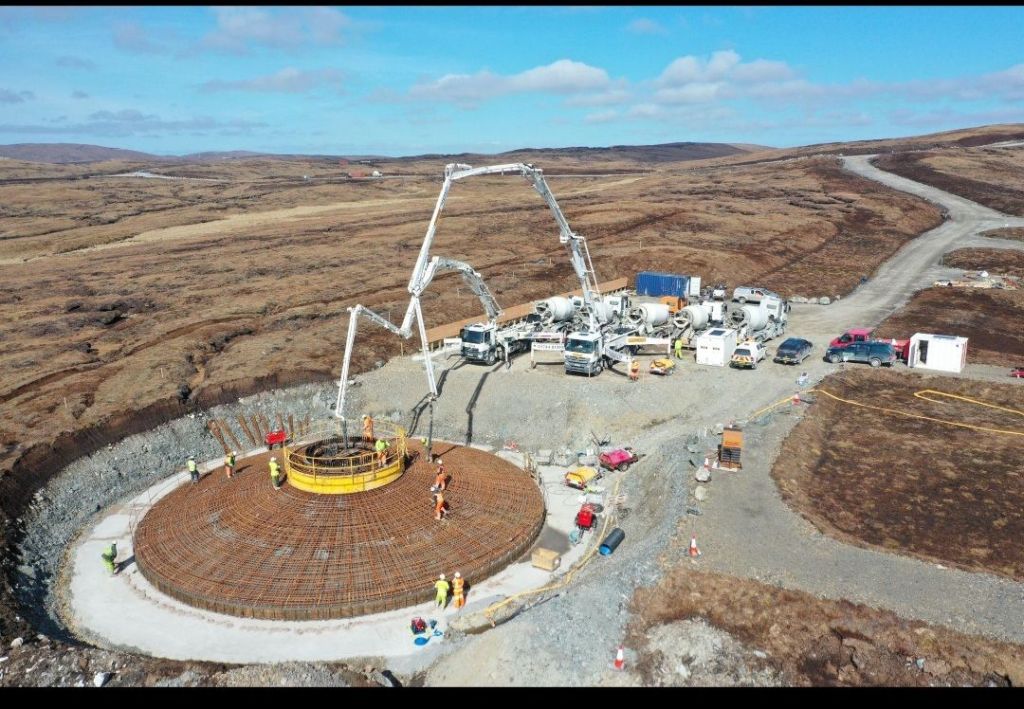
Look at the image above. Concrete wagons, haul roads, aggregate, steel reinforcement, machinery and a vast foundation being poured into open moorland. This is the physical reality behind the phrase “clean energy”. It is not a meadow. It is not restoration. It is not a light-touch intervention. It is industrial construction.
And when that construction takes place on peatland, the issue is not just visual damage. It is hydrological damage. Peat is a water system. Disturb it, drain it, compact it, trench it, cut roads through it, and you risk changing the whole behaviour of the landscape.
The Government knows this. EN-3 admits that peatlands are sensitive habitats, important for species, water benefits and climate adaptation. It acknowledges that peat is carbon-rich and can extend several metres deep. It warns that soil disturbance, compaction, removal and changes to peat profiles can alter local hydrology, damage biodiversity and release CO2.
Yet the same policy does not ban wind farms on peatland.
It says onshore wind sites in England “may be proposed on peatland”, provided applicants rule out other locations first. It says areas of deep peat should be avoided, and that developers must conduct peat surveys and justify why infrastructure needs to be sited there.
That is the loophole.
A genuine nature-first policy would say: no industrial wind farms on deep peat, blanket bog, protected uplands or flood-sensitive moorland. Instead, the current policy says: you may propose it, survey it, justify it, mitigate it, compensate for it and then ask the Secretary of State to approve it.
That is not protection. That is managed destruction.
Walshaw Moor shows the danger. Yorkshire Wildlife Trust says Calderdale Energy Park proposes 34 wind turbines on Walshaw Moor above Hebden Bridge, via the NSIP process. It describes the site as highly protected: Special Protection Area, Special Area of Conservation, Site of Special Scientific Interest and deep peat, with irreplaceable blanket bog, merlin and golden plover. It also warns that the peat stores thousands of years of carbon and provides flood defences by slowing water flow from the uplands.
Yorkshire Wildlife Trust’s dedicated Calderdale Energy Park page goes further. It says Walshaw Moor is part of the South Pennine Moors SAC, SPA and SSSI, and that areas of the moor have peat three metres deep, locking up carbon taken in by plants up to 6,000 years ago. It also says development on deep peat and designated sites sets an alarming precedent.
That word , precedent , is crucial.
Because this is not just about one site. It is about a political doctrine that says carbon targets justify almost anything.
If one protected moor can be industrialised for wind, why not another?
If one deep peat landscape can be sacrificed for a Net Zero spreadsheet, why not the Pennines, the Welsh uplands, the Scottish hills and the moorland edges of our National Parks?
The great irony is that peatland restoration is itself now being promoted as a climate policy. Wales has a National Peatland Action Programme. NRW says the aim is to move faster to safeguard peatland because it retains 30% of Wales’ land-based carbon despite covering only 4% of the land, and because damaged peat releases greenhouse gases. The programme is being expanded to improve resilience to flood and fire risk as well as climate and nature recovery.
So the contradiction is brutal.
One arm of the state says: restore peatland because it stores carbon, protects communities from flooding and improves resilience.
Another arm of the state says: accelerate renewable infrastructure and allow major wind schemes to be proposed on peatland, provided the paperwork is good enough.
That is not joined-up government. It is institutional schizophrenia.
And the people who pay the price are not the ministers writing targets in Whitehall. It is the communities downstream when water flows faster off damaged hills. It is the farmers and residents whose landscapes are changed permanently. It is the wildlife pushed out by roads, turbines, cables and construction compounds. It is future generations who inherit a country where the language of “green” was used to justify the destruction of natural carbon stores.
No one serious argues that Britain does not need energy. We do. We need secure, affordable, reliable power. But energy policy must be grounded in engineering, landscape reality and environmental honesty. It cannot be reduced to a race to install capacity wherever developers can make the numbers work.
A wind turbine on a peat bog is not automatically green. A solar farm on productive farmland is not automatically sustainable. A battery compound next to a village is not automatically progress. These things have real land costs, real ecological costs, real grid costs and real community costs.
The first principle should be avoidance.
Avoid deep peat. Avoid blanket bog. Avoid protected landscapes. Avoid flood-sensitive uplands. Avoid carbon-rich soils. Avoid sites where the natural system is already doing the job government claims to value: storing carbon, holding water, supporting biodiversity and protecting communities downstream.
If Net Zero policy destroys natural carbon stores in order to meet an artificial deployment target, then it has lost the plot.
The test for every wind proposal on peat should be simple:
Has every non-peat alternative genuinely been ruled out?
Has deep peat been avoided entirely?
Has the hydrology of the whole bog system been assessed, not just the turbine pads?
Has the carbon calculation included concrete, steel, access tracks, crane pads, cabling, drainage, peat excavation, maintenance and decommissioning?
Has downstream flood risk been assessed honestly?
Has the Secretary of State considered the precedent being created for every other protected moorland landscape?
And above all: why are we damaging natural carbon stores in the name of carbon reduction?
That is the question ministers do not want to answer.
Because once the public sees the contradiction, the whole moral case begins to collapse.
You cannot call peatland a climate solution in the morning and industrialise it for wind turbines in the afternoon.
You cannot tell farmers and landowners to restore bogs, then let developers pour concrete into peat landscapes.
You cannot claim to protect communities from flooding while allowing upland sponge systems to be cut by roads, trenches and foundations.
And you cannot keep calling this “green” when the countryside is being treated as an expendable platform for political targets.
Net Zero was supposed to protect the environment. Increasingly, it is being used to override it.
That is why peatland must become a red line.
Not a mitigation exercise.
Not a compensation scheme.
Not another chapter in an Environmental Statement.
A red line.
Because once peat is damaged, it does not come back in a parliamentary term.
NRW notes that peat forms at around 1mm a year. One metre can take roughly 1,000 years.
That should humble every policymaker in Britain.
A minister can sign a consent order in a day. A developer can pour concrete in hours. But the peat beneath it may have taken thousands of years to form.
That is the difference between nature and ideology.
Nature works in centuries.
Net Zero politics works in headlines.
And Britain’s carbon stores, flood defences and protected uplands should not be sacrificed to meet a target written by people who will never live with the damage.
Shane Oxer. Campaigner for fairer and affordable energy
 SAY NO TO THE DESTRUCTION OF OUR LAND
Leave a comment