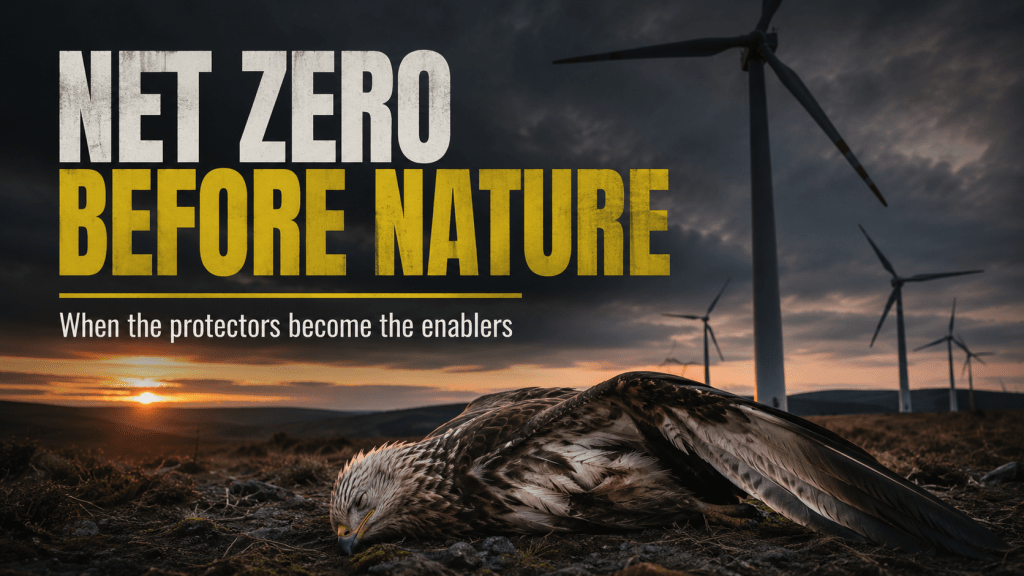
When the Protectors Become the Enablers
When t
There was a time when Britain’s environmental organisations existed to protect birds, wildlife, rivers, farmland, ancient landscapes and historic places from industrial damage.
Today, too many of them appear to have accepted a different role.
They no longer ask the most important question: should this countryside, habitat, marshland, river corridor, green belt or bird-feeding ground be industrialised at all?
Instead, they ask a weaker question: how can it be industrialised in a way that can be called “sustainable”?
That is the quiet betrayal at the heart of modern environmental politics.
Across Britain, the language is familiar. “Clean energy.” “Nature-positive development.” “Biodiversity net gain.” “Mitigation.” “Compensation.” “Environmental management plans.” “Renewables in harmony with nature.”
But beneath the soft language, the hard reality remains: wind turbines kill birds, solar farms consume habitat, battery compounds industrialise rural land, substations scar landscapes, pylons cut through countryside, cable corridors disturb soils and drainage systems, and so-called green infrastructure is being forced into places that are already under ecological pressure.
This is not nature protection. It is nature surrender, dressed up in Net Zero language.
The RSPB says it supports an increase in solar, onshore wind and offshore wind to reach Net Zero, while also saying development should avoid areas important for nature. That sounds reasonable until we look at what is happening on the ground and at sea. The same organisation has warned that the Berwick Bank offshore wind farm could kill tens of thousands of seabirds, describing it as potentially the “deadliest single windfarm for birds” it is aware of anywhere on the planet.
That is the contradiction.
How can an organisation created for the protection of birds support the wider policy machine that is driving the very infrastructure now threatening birds?
The answer is that Net Zero has become the overriding doctrine. Once an organisation accepts Net Zero as the supreme objective, everything else becomes negotiable. Birds become negotiable. Habitat becomes negotiable. Landscape becomes negotiable. Food-producing farmland becomes negotiable. Even protected species become something to be mitigated, offset or monitored.
The same problem applies to solar.
The RSPB says new solar developments should support nature and should not harm existing wildlife. It also says nature-protected sites and other sites important for rare or declining species must not be developed for solar farms. But that does not solve the problem. Many of the landscapes now being targeted are not empty industrial sites. They are lowland farmland, marshland, river corridors, drainage networks, hedgerow systems, grazing land, floodplains, winter feeding grounds and habitat mosaics.
The Kent marshes, Lincolnshire Wolds, Norfolk, Suffolk, Yorkshire, Nottinghamshire, Derbyshire and the wider Trent, Ouse, Don, Rother and Humber corridors are not blank spaces on a developer’s map. They are living landscapes. They hold birds, mammals, insects, reptiles, amphibians, soil life, watercourses, ditches, hedgerows and seasonal feeding grounds. They are part of a wider ecological system.
A solar farm is not just panels. It is fencing, CCTV, access tracks, trenching, cabling, substations, inverter stations, drainage alteration, vegetation change, construction traffic, security lighting and, increasingly, battery storage. It changes the character and function of land.
To call that “nature-positive” simply because a developer promises wildflower strips or sheep grazing is not serious conservation. It is planning language.
Natural England should be one of the strongest defenders of the natural world. Yet its current public language is increasingly about making clean power and nature recovery work together. In May 2026, Natural England Chair Tony Juniper wrote about a visit to a solar farm and argued that clean solar energy can be delivered alongside measures to support biodiversity and nature recovery. Natural England says it gives advice to developers to get the best outcomes for nature.
That is revealing.
The posture is no longer: we are here to stop the wrong development in the wrong place.
The posture is increasingly: we are here to advise developers how to make development acceptable.
That is a profound shift. It turns the protector into a facilitator.
The National Trust has also placed itself firmly inside the Net Zero framework. It says it aims to be carbon net zero by 2030 across its own emissions, supply chain, tenanted land and buildings, and investments. Again, the issue is not whether the National Trust does good conservation work in places. It does. The issue is whether climate targets are now shaping the entire environmental establishment so strongly that landscape and heritage protection become secondary to carbon accounting.
Historic England says it “firmly supports urgent climate action” and has a programme of work to help manage that change. Its advice now includes decarbonising and improving the energy efficiency of historic buildings, including guidance to help planning authorities determine proposals for carbon reduction while conserving significance.
Again, the language sounds balanced. But the direction of travel is clear. Every institution is being pulled into the same framework: climate action first, protection second, mitigation always.
The Wildlife Trusts have also accepted the scale of the Net Zero infrastructure push. Their energy policy briefing says the UK must transition quickly to a low-carbon economy and notes that, to reach the legal Net Zero target, it has been estimated that Britain would need to build more than one wind turbine every day for the next decade, along with a radical transformation of the electricity grid.
Read that again.
More than one wind turbine every day. A radically transformed grid. Vast new infrastructure. More pylons. More substations. More cabling. More land pressure. More development across countryside, coast and sea.
And this is being discussed by organisations whose public identity is supposedly the protection of wildlife and habitat.
CPRE has been more honest than many about the solar problem. It has warned that two-thirds of mega solar farms are being built on productive farmland and has called for at least 60% of solar energy to come from rooftops, car parks and brownfield land, as well as a ban on ground-mounted solar on scarce Grade 1 and Grade 2 farmland. That is a stronger and more defensible position. But even there, the wider Net Zero framework is rarely challenged. The argument becomes about where to put the infrastructure, not whether the current scale of infrastructure is rational, deliverable or environmentally justified.
This is the great weakness in Britain’s environmental establishment.
It has accepted the premise that Net Zero must happen at speed and at scale. Once that premise is accepted, the countryside becomes a resource to be managed for delivery. Land becomes capacity. Sea becomes energy zone. Farmland becomes solar yield. Hills become wind resource. Rivers become drainage constraints. Wildlife becomes a planning consideration. Heritage becomes a balance-of-harm exercise.
And when the public objects, they are told the same thing again and again: the damage is unfortunate, but necessary.
Necessary for Net Zero.
Necessary for clean power.
Necessary for climate leadership.
Necessary for future generations.
But who speaks for the nature being destroyed now?
Who speaks for the bird of prey cut down beneath a turbine? Who speaks for the lapwing pushed from its feeding ground? Who speaks for the skylark, yellowhammer, curlew, marsh harrier, barn owl, bat, newt, water vole, hare, pollinator, hedgerow, ditch, soil system and wetland edge? Who speaks for the village hemmed in by panels? Who speaks for the green belt when the very organisations meant to defend landscape become cautious partners in its conversion?
This is not an argument against protecting the environment. It is the opposite.
It is an argument that the environment must be protected from Net Zero industrialisation.
The official evidence shows that nature is already in trouble. The Office for Environmental Protection warned in 2026 that government remains largely off track in achieving its legal environmental commitments. So why, at the very moment Britain is failing to restore nature, are we adding a new wave of land-take, grid corridors, solar estates, wind farms, battery compounds and transmission infrastructure?
That is the question the environmental establishment does not want to answer.
Because the answer is uncomfortable.
The organisations that should be saying “enough” are too often saying “with mitigation.”
The organisations that should be defending countryside are too often accepting its conversion.
The organisations that should be protecting birds are too often supporting the energy system that kills them.
The organisations that should be defending nature from industrial pressure are too often helping that pressure pass through the planning system.
This is why the phrase matters:
Net Zero Before Nature.
It captures the reversal that has taken place. Nature is no longer the priority. Net Zero is. Nature is considered, assessed, managed and offset — but Net Zero drives the machine.
The public can see what is happening. They can see the solar farms spreading across farmland. They can see the battery storage compounds appearing beside villages. They can see pylons planned across rural landscapes. They can see wind turbines proposed in sensitive areas. They can see the same organisations issue statements of concern while remaining loyal to the wider policy causing the harm.
That is not enough.
Britain does not need environmental organisations that merely soften the language of destruction. It needs environmental organisations willing to challenge the destruction itself.
It needs bodies prepared to say that some places are too important to industrialise. Some habitats cannot be offset. Some landscapes should not be sacrificed. Some bird populations cannot absorb more losses. Some farmland should remain farmland. Some marshes, wolds, valleys, river corridors and green belt land should be defended absolutely.
If the RSPB will not put birds before Net Zero, who will?
If Natural England will not put nature before solar industrialisation, who will?
If the National Trust will not put landscape and heritage before carbon targets, who will?
If Historic England will not defend historic settings from the pressure of climate infrastructure, who will?
And if all the great environmental bodies now accept the same Net Zero framework, then perhaps the public must become the new conservation movement.
Because nature does not need more slogans.
It does not need more glossy biodiversity plans.
It does not need more developer-funded mitigation promises.
It needs defenders.
Real defenders.
Defenders who are willing to say that the countryside is not an energy estate, farmland is not a sacrifice zone, marshland is not spare capacity, and birds are not collateral damage in the race to meet a political target.
Net Zero cannot be allowed to become an excuse for the industrialisation of nature.
If the protectors have become the enablers, then it is time for ordinary people to become the protectors.
Shane Oxer. Campaigner for fairer and affordable energy
 SAY NO TO THE DESTRUCTION OF OUR LAND
Leave a comment