A 50GW electricity queue, power-station-scale private demand, water-stressed regions and no credible national plan explaining who will generate the power , or who will pay for the infrastructure.
Britain is being promised an artificial-intelligence revolution.
Ministers speak enthusiastically about AI Growth Zones, digital infrastructure, international investment, technological leadership and thousands of new jobs. Data centres have been designated as Critical National Infrastructure, placing them alongside essential systems such as energy, water and transport.
But behind the language of innovation lies an infrastructure story that the public has barely been told.
Modern hyperscale and AI data centres are not ordinary offices, warehouses or business parks. They are enormous industrial electricity consumers. Some individual campuses are seeking hundreds of megawatts. Clusters of data centres can require as much power as a substantial town, city or conventional power station.
They may also require new substations, transformers, transmission cables, battery compounds, backup generators, cooling systems, water-treatment facilities, access roads and security infrastructure. Where developers promise that the power will be “renewable”, the physical footprint can extend further into solar farms, wind infrastructure, grid connections and additional storage.
The Government promotes the economic opportunity. Developers promote investment. Planning documents emphasise visual screening, landscaping and theoretical carbon savings.
What is still missing is a transparent national answer to five basic questions:
Where will the electricity come from?
How much water will be required?
What additional grid infrastructure must be built?
What land and communities will carry the physical burden?
And who will ultimately pay?
After examining the national data-centre pipeline, the Thames Valley–Oxford–Cambridge corridor and the wider alignment between AI demand, renewable generation, battery storage and grid reinforcement, the conclusion is unavoidable:
Britain is encouraging power-station-scale private demand before it has published a credible, reconciled national plan for the electricity, water, land and infrastructure required to support it.
A 50GW queue for data centres alone
In February 2026, Ofgem published the results of work examining the rapidly expanding electricity demand queue.
It identified around 140 data centres seeking approximately 50GW of grid capacity.
Of those, 71 data-centre projects representing around 20GW reported that they had achieved financial commitment or Final Investment Decision.
Ofgem also acknowledged that part of the overall demand queue is likely to contain projects that will never proceed. That qualification matters. A connection queue is not the same as actual operating demand, and it would be wrong to suggest that every proposed data centre will be built.
But the scale of the queue still matters enormously.
Projects in the queue influence grid planning, connection priorities, investment decisions, land markets and the case being made for new substations and transmission reinforcement. The majority of the approximately 140 data centres identified by Ofgem were considered likely to receive a Gate 2 offer under the reformed connections process.
The 50GW figure is larger than the approximately 45GW Great Britain peak-demand benchmark used in Ofgem’s analysis.
That does not mean 50GW of data-centre demand will suddenly appear on the system tomorrow. It means that one industrial sector has requested connection capacity on a scale comparable with , and nominally greater than , the present peak demand of the entire Great Britain electricity system.
This should have triggered a national debate.
Instead, the projects continue to appear through separate planning applications, development portfolios, AI Growth Zone announcements and grid-connection processes.
The public is shown the pieces.
It is rarely shown the total.
The identified pipeline is already system-scale
Our conservative public-project analysis identified approximately 12.61GW of named data-centre capacity.
When published expansion or peak capacities are included, the figure rises to approximately 14.21GW.
This is not the whole market. It is a cautious total built from named schemes and portfolios where a usable power figure could be identified. Possible duplication within the Iver cluster was excluded from the conservative total, as were infrastructure projects without a stated data-centre load.
The projects and portfolios examined included developments or proposed capacity associated with:
Innova’s national Gate 2 portfolio;
the Uxbridge Moor and Iver cluster;
the proposed Devon Data Campus and Alverdiscott corridor;
Elsham Tech Park;
QTS Cambois;
the Humber technology corridor;
Lanarkshire;
Culham and Didcot;
Sutton-in-the-Isle;
Wilton International;
Norwich;
South Mimms;
Slough;
and several former power-station and strategic-grid locations.
Some projects are approved. Some are under construction. Some remain proposals, connection applications or longer-term expansion concepts. They should not all be treated as equally certain.
Nevertheless, the named pipeline demonstrates the order of magnitude now under consideration.
If the conservative 12.61GW pipeline operated continuously at its stated capacity, it would consume approximately 110.4 terawatt-hours of electricity per year.
The expanded 14.21GW scenario would require approximately 124.5TWh per year.
These are stress-test calculations, not forecasts of actual annual consumption. Data centres do not necessarily operate permanently at maximum import capacity, and utilisation will vary.
But the comparison is still remarkable.
Official energy statistics show that all UK domestic electricity consumption amounted to approximately 94.4TWh in 2024. In other words, the conservative named data-centre pipeline, if continuously loaded, would consume more electricity than every UK household currently uses.
That is the scale of industrial demand being discussed.
Yet no national statement sets out which power stations, interconnectors or firm generating assets will supply it.
The queue is not a power station
A grid connection is not a source of electricity.
A data centre can obtain planning permission. It can receive a connection offer. It can build a private substation and sign a renewable electricity contract.
None of these things creates the physical electricity required to operate the servers.
The power must still be generated somewhere, at the same time it is consumed.
This is where much of the public debate becomes dangerously vague.
Developers frequently refer to renewable electricity procurement, power-purchase agreements, batteries, carbon offsets and future clean-power capacity. These arrangements may contribute to carbon accounting or investment in generation, but they do not remove the fundamental engineering requirement for a reliable physical supply every hour of the day.
AI data centres are particularly demanding because expensive computing equipment is expected to operate at high availability. Interruptions can have significant financial and operational consequences. Their demand is less tolerant of the seasonal and hourly variability that characterises wind and solar generation.
A solar farm does not supply a data centre during a winter evening.
A wind farm does not guarantee output during a prolonged low-wind period.
An electricity certificate does not keep servers running.
And a battery is not a power station.
A battery does not generate electricity
Britain’s connection registers contain an enormous volume of proposed battery energy storage.
The integrated grid analysis identified more than 202GW of battery or storage capacity within the relevant TEC categorisation and more than 228GW in the Existing Agreements summary. Again, these are queue and agreement figures, not a prediction that the full capacity will be constructed.
Battery storage can perform valuable functions. It can respond quickly, shift electricity between periods, provide grid services and help manage short-term imbalances.
But it cannot create energy.
A battery attached to a data centre must first be charged from a generator, the grid or another power source. Its usefulness depends not only on its megawatt rating but on its megawatt-hour capacity.
A 500MW battery might sound enormous. But if it stores 1,000MWh, it could theoretically sustain a 500MW load for only two hours before losses and operating restrictions are considered.
Every large data-centre application involving battery storage should therefore answer:
What is the battery’s duration?
Where will the charging electricity come from?
At what times will it charge?
Will it charge when national demand is already high?
Is it intended to support the data centre, provide grid services or trade electricity commercially?
How long can it sustain the data centre during a grid failure or low-renewable-output period?
And what supplies the facility when the battery is empty?
Without those answers, the presence of a battery compound can create an illusion of energy independence where none exists.
The grid is already undergoing enormous reconstruction
The data-centre boom is not arriving on an empty or unconstrained electricity system.
Our wider analysis combined the Transmission Entry Capacity Register, Existing Agreements Register and Transmission Works Register with the known AI data-centre pipeline.
The June 2026 TEC data examined contained approximately 614.2GW of additional listed capacity. The Existing Agreements data contained approximately 493.8GW, while the transmission works evidence included 5,380 reinforcement rows across 966 project groups.
These numbers should not be added together as though they represent guaranteed new generating capacity. The registers overlap, contain projects at different stages and include schemes that may be delayed, altered or cancelled.
Their significance lies elsewhere.
They show the extraordinary scale of competing demands now driving grid planning: offshore wind, onshore wind, solar, batteries, interconnectors, industrial demand, electrification and data centres.
The clearest pressure period in the analysed records is 2031 to 2035. Approximately 307GW of TEC-listed capacity, 233GW of Existing Agreement capacity and 2,214 transmission work items fell into that period.
This means data centres are not being added to a completed and comfortably supplied system.
They are being added to a grid that is already scheduled for one of the largest and most disruptive transformations in its history.
New substations, supergrid transformers, overhead lines, underground cables, reactive compensation equipment and network reinforcement will be required across the country.
The crucial public-interest question is whether Britain is building a balanced electricity system for households, manufacturing, hospitals, transport, food production and national resilience—or reorganising the system around an unprecedented wave of private digital demand.
Uxbridge Moor: the warning Britain should not ignore
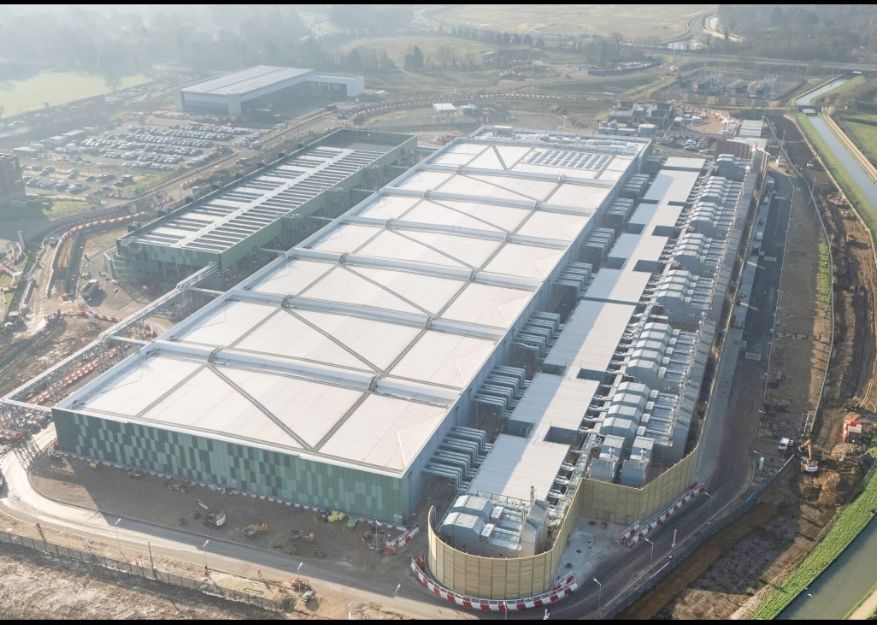
The Uxbridge Moor and Iver area provides one of the clearest illustrations of what the data-centre expansion means physically.
National Grid says its Uxbridge Moor project will support more than a dozen new data centres and deliver approximately 1.8GW of new capacity—an amount it compared with the electricity required to power a mid-sized city.
This is not a case of developers quietly using surplus electricity that was already available.
The infrastructure is being constructed because the existing system could not accommodate the requested level of data-centre demand.
The wider West London and Thames Valley area is already the country’s most concentrated data-centre market. The pressure extends through Slough, Iver, Reading, South Mimms, Abbots Langley and other locations around the M25 and Thames Valley technology corridor.
Our conservative analysis identified approximately 2.37GW of named capacity in the Thames Valley and West London zone alone, excluding projects believed likely to be included within the larger Iver cluster figure.
National Grid may be able to construct the necessary substations and connections.
But building a connection is only one part of the problem.
The electricity must still be generated and transported to the area. Water must still be supplied. Backup arrangements must still be provided. The cumulative implications for housing, industrial development and existing customers must still be understood.
Calling the development “digital” does not make its physical consequences disappear.
The Oxford–Cambridge–London corridor
The same pattern continues west and north-east from London.
The Government selected Culham in Oxfordshire as the first AI Growth Zone. Its response to the AI Opportunities Action Plan described an initial data-centre capacity of 100MW, with plans to scale to 500MW.
Nearby Didcot is also becoming part of the same infrastructure landscape.
The former Didcot A power-station area has been associated with a planned data campus, while grid works around Didcot are intended to support data-centre and battery connections. The old geography of electricity generation is increasingly being repurposed for high-load digital demand.
Further east, the reported Sutton-in-the-Isle proposal in Cambridgeshire reaches approximately 330MW at full build-out.
At continuous full load, a single 330MW facility would consume around 2.9TWh of electricity in a year. Again, this is a scale comparison rather than a predicted operational figure.
The important point is that Sutton should not be viewed merely as an isolated rural planning application.
It sits within a wider economic and infrastructure pull connecting Cambridge, Oxford, London and the M25 data-centre market.
The corridor combines:
high-value technology demand;
strategic fibre routes;
existing and planned substations;
Green Belt and agricultural land pressure;
housing demand;
and some of England’s most serious water-supply concerns.
Planning each facility separately risks missing the cumulative consequences.
Water is not a secondary issue
Electricity receives most of the attention, but water could become an equally serious constraint.
Data centres can use water directly for cooling and indirectly through electricity generation. Consumption varies widely according to cooling design, local climate, operational load, reuse systems and whether potable or non-potable supplies are used.
That variation is sometimes used to dismiss concern.
It should instead be the reason for greater transparency.
Affinity Water told Parliament that approximately 125 data centres were proposed or under construction within its region, which includes the heavily developed Slough–West London corridor.
Some individual facilities had requested supplies of up to 35 litres per second. Affinity said this was equivalent to the peak water demand of around 3,500 homes.
One proposal sought 21 million litres per day, which Affinity compared with the needs of approximately 147,000 people.
These are not environmental campaign estimates. They are figures given by a water company responsible for supplying one of Britain’s principal data-centre regions.
Water demand is also most likely to become acute during hot weather, precisely when households, agriculture and the wider water network are under greatest pressure. Evidence presented to Parliament in July 2026 specifically noted that data-centre water demand can peak at the same time as general water demand.
Our modelling therefore used a range rather than pretending that one figure applies to every facility.
At the lower national-average benchmark of around 7 million litres per day for each gigawatt, a 50GW queue would imply approximately 350 million litres per day.
At a higher traditional evaporative-cooling stress-test assumption, the same queue could imply approximately 3.493 billion litres per day.
The higher figure is not a prediction that every UK data centre will adopt water-intensive cooling. Some operators will use closed-loop, air-cooled or hybrid systems that reduce direct water consumption.
But the enormous gap between the two scenarios proves the central point:
Britain cannot sensibly plan this industry while site-specific water figures remain inconsistent, incomplete or hidden.
Every application should disclose average daily consumption, peak summer consumption, litres per second, the source and quality of the water, wastewater arrangements, drought restrictions and the effect on planned housing and existing customers.
Without this information, local councillors are being asked to approve nationally significant water demand partly in the dark.
From data halls to countryside industrialisation
The land impact of a data centre does not end at the walls of the data hall.
A large campus may require security zones, internal roads, substations, cooling plant, diesel or gas generators, water-treatment equipment, cable corridors and construction compounds.
If it is accompanied by a battery, further land is required for battery containers, inverters, transformers, fire-separation distances and emergency access.
If it claims to be supplied by dedicated or additional renewable generation, the real footprint may extend into solar farms, wind developments, transmission routes and further storage.
This creates a chain of infrastructure that may cross several council boundaries and affect communities far from the data centre itself.
Our analysis identified repeated concentration around former power stations, 400kV substations and strategic grid nodes, including Cottam, Drax, Drakelow, High Marnham, Thorpe Marsh, East Claydon, Norwich, North Anglia, Walpole, Alverdiscott and the Humber corridor.
These locations are attractive because they already possess some combination of high-voltage infrastructure, industrial land, grid identity or established transmission routes.
But an old power-station site should not automatically be treated as proof that spare firm electricity exists.
The generating units may have closed. Existing capacity may already be allocated. Transformers and circuits may require replacement. New demand may trigger reinforcement far beyond the site.
Former generation sites can be sensible locations for redevelopment, but the public must be shown the complete engineering position rather than a comforting reference to historic grid infrastructure.
Policy convergence , not a single conspiracy
It would be unsafe and unnecessary to claim that every data centre, solar farm, battery and transmission project is part of one centrally controlled master scheme.
The evidence supports a more defensible conclusion.
Separate government and commercial policies are converging in the same places and across the same period.
AI policy creates demand for vast quantities of reliable electricity.
Clean Power policy drives accelerated wind, solar and storage development.
Transmission policy expands the network to connect generation and new demand.
Water companies must then attempt to accommodate new cooling and industrial requirements.
Planning policy must absorb the physical footprint.
Finally, nuclear and gas generation return to the discussion because large AI loads require dependable power when wind and solar output is low.
The practical result can be summarised simply:
AI is becoming the demand justification. Net Zero is the policy framework. Grid expansion is the delivery mechanism. Rural and edge-of-settlement communities carry much of the physical burden.
Data centres were designated as Critical National Infrastructure in September 2024. The designation recognises their importance to cloud services, communications, health information, finance and the wider economy.
But Critical National Infrastructure status must not become a blank cheque.
Being important does not remove the need for scrutiny.
It increases it.
Who receives priority when electricity is limited?
Data-centre development also raises a question that politicians have largely avoided.
When network capacity is constrained, who should receive priority?
A hyperscale data centre?
A hospital?
A new housing development?
A steelworks or manufacturing plant?
An electrified railway?
A port?
A food-production business?
Or an existing community already waiting for reinforcement?
The connections system cannot be understood merely as a private transaction between a developer and a network company. Connection decisions can influence what else is built, where it is built and when it can operate.
A large data centre may bring substantial investment, business-rate revenue and construction activity. It may also occupy network capacity that could have supported other forms of economic development.
The public should therefore be shown the opportunity cost.
A serious planning assessment should state how many permanent operational jobs will be created, not only the total number of temporary construction roles and indirect national jobs claimed in publicity.
It should also disclose:
electricity demand per permanent job;
water demand per permanent job;
business-rate treatment;
public subsidy or tax support;
local procurement commitments;
and what alternative industrial uses of the land and grid capacity were considered.
Data centres are highly capital-intensive. That does not make them economically worthless, but it does mean that headline investment figures can give a distorted impression of long-term local employment.
Who pays for the grid?
Developers are normally required to contribute towards their immediate connections.
That does not automatically answer who pays for wider reinforcement.
A new data-centre cluster may require upstream substations, transmission upgrades, replacement transformers, new cable routes or system-wide balancing measures. Different costs may be allocated differently under network charging and regulatory arrangements.
Some will be paid directly by developers.
Some may become part of wider regulated network investment.
Some may be recovered over time through charges ultimately reflected in consumer bills.
The public therefore needs a clear project-by-project breakdown showing:
the direct connection cost;
the developer contribution;
the wider reinforcement required;
which works would have occurred without the project;
which assets enter the regulated network;
and the expected effect on electricity customers.
The phrase “privately funded investment” should not be allowed to conceal publicly supported infrastructure.
The same principle applies to water.
Where a data-centre development requires new mains, treatment capacity, abstraction, wastewater infrastructure or resilience works, the public should be told who finances them and whether other customers bear any portion of the cost.
Backup power and the green label
Data centres require resilience.
Many rely on large banks of backup generators to maintain operations during grid interruptions. Traditionally these have often been diesel-powered, although gas engines, fuel cells and other systems are increasingly discussed.
Backup generation may operate infrequently, but large campuses can contain substantial installed capacity.
Applications should therefore disclose:
the number and output of generators;
the fuel used;
fuel-storage capacity;
expected testing hours;
maximum emergency operating hours;
air-quality impacts;
noise;
and the carbon consequences of prolonged operation.
A data centre should not be marketed simply as “green” because it has a renewable electricity contract while its physical resilience depends on fossil-fuel backup and grid power during periods of low renewable generation.
Carbon-accounting claims and physical power-system reality are not always the same thing.
We need a national register
Britain urgently needs one publicly accessible register bringing together the information currently scattered across planning portals, grid documents, developer announcements, water-company evidence and commercial reporting.
For every substantial data centre, the register should state:
the developer and beneficial owner;
the location and planning reference;
the maximum import capacity;
the anticipated average operational load;
the grid connection point;
the connection date and status;
whether the connection is firm, phased or interruptible;
the cooling technology;
average and peak water consumption;
the source of the water;
the backup-generation capacity and fuel;
the battery power and duration;
associated renewable or private-wire arrangements;
the required network reinforcement;
and the division between developer-funded and consumer-funded infrastructure.
It must also distinguish clearly between confirmed projects, planning proposals, speculative connection applications and longer-term expansion ambitions.
Without such a register, national totals can be understated, local overlap can be missed and the same capacity may be counted more than once.
Most importantly, councils cannot properly understand the cumulative impact of decisions being taken one application at a time.
No consent without the numbers
This is not an argument against computing, cloud services, artificial intelligence or technological development.
Britain needs secure digital infrastructure. It needs investment, innovation and productive use of AI.
But technological enthusiasm is not an energy policy.
A press release is not a grid plan.
A battery is not a power station.
A renewable certificate is not firm electricity.
A connection queue is not proof of deliverability.
And a collection of isolated planning applications is not a national strategy.
Before the country commits land, water and grid capacity to an unprecedented expansion of private digital infrastructure, the Government must publish a reconciled national assessment of the total consequences.
No AI Growth Zone should proceed without an identified and deliverable source of firm power.
No large data centre should receive consent without publishing average and peak electricity demand.
No application should be approved without independently verified water requirements and drought arrangements.
No battery should be used to imply self-sufficiency unless its duration and charging source are disclosed.
No rural community should be shown only the data-centre boundary while associated substations, cables, generation and water infrastructure are assessed elsewhere.
No minister should celebrate private investment without explaining how much supporting infrastructure may ultimately be funded by consumers.
And no planning authority should be expected to make decisions of national significance using incomplete local information.
The Government wants Britain to win the AI race.
But a country does not become more secure by building vast new electricity demand without first securing the electricity.
It does not become more resilient by approving water-intensive infrastructure in water-stressed regions without publishing the demand.
It does not become greener by surrounding data centres with batteries that must be charged, renewable projects that require more countryside and backup generators that disappear from the publicity.
The AI gold rush is already reshaping Britain’s grid, industrial land and infrastructure priorities.
The public deserves to know the full price before the digging goes any deeper.
Shane Oxer — Campaigner for fairer and affordable energy
 SAY NO TO THE DESTRUCTION OF OUR LAND
Leave a comment