What Parliament and the Commons refuse to admit
Parliament’s own researchers have assembled almost every fact required to expose Britain’s coming data-centre crisis. What they will not do is join those facts together. The result is a national infrastructure programme whose true demand for electricity, water, land and public support remains hidden in plain sight.
“Father, forgive them; for they know not what they do.”
It is a generous sentiment. Perhaps too generous.
Britain’s environmental and energy policy has long been presented as a sequence of unavoidable responses to a planetary emergency. First came legally binding carbon targets. Then renewable generation. Then batteries. Then thousands of miles of transmission lines and new substations. Then the return of nuclear power because weather-dependent generation could not provide continuous electricity.
Now comes artificial intelligence.
AI data centres require power on the scale of towns, cities and, collectively, countries. They need it continuously. They need vast grid connections, cooling systems, backup generation, secure water supplies and physical sites large enough to house warehouses full of servers.
And suddenly the entire programme begins to make rather more sense.
The Commons Library has now published a 75-page briefing on data centres, planning, sustainability and resilience. It is not a dishonest report. In fact, it is surprisingly candid.
It admits that the grid is congested.
It admits that data centres have consumed spare electricity capacity needed for housing.
It admits that permanent employment is modest.
It admits that power-purchase agreements may not produce genuine additional decarbonisation.
It admits that data centres could require nuclear and onsite generation.
It admits that AI Growth Zones may receive reserved grid capacity, relaxed planning requirements and cheaper electricity.
It even records an official queue of around 50 GW of data centres, compared with an existing British data-centre sector of only about 1.6 GW in 2024.
CBP-10315.pdf
But the report performs one very important trick.
It refuses to assemble those admissions into a single conclusion.
That conclusion is increasingly unavoidable:
Britain is not merely decarbonising its existing electricity system. It is constructing an enlarged, state-directed power system to accommodate an unprecedented class of private digital demand.
And the countryside, electricity consumer and taxpayer will be expected to carry much of the burden.
The arithmetic Parliament prefers you not to compare
The Commons briefing prominently tells MPs that Britain had approximately 1.6 GW of co-location data-centre capacity in 2024.
It says preliminary government analysis suggests that capacity might rise to between 3.3 GW and 6.3 GW by 2030.
That sounds substantial, but manageable.
Then, much later, comes the figure that changes everything.
Ofgem and NESO have identified around 140 data centres seeking approximately 50 GW of grid capacity.
Total contracted demand offers , not merely data centres , rose from 41 GW in November 2024 to 125 GW by June 2025.
Britain’s peak electricity demand is typically discussed in a range of roughly 45 to 60 GW, depending upon the benchmark and season used.
The data-centre queue alone is therefore comparable with the peak demand of the electricity system that currently serves the whole country.
Not every project will be built. Some will be speculative. Some will be duplicated. Some developers may have applied for more capacity than they will ever use.
But queue capacity is not meaningless simply because it is uncertain.
It influences where National Grid designs substations, which circuits are reinforced, where land is optioned, what water companies forecast, and which regions are told to prepare for growth.
Our own conservative schedule of publicly identifiable projects already totals approximately 12.61 GW, rising to 14.21 GW where stated expansion figures are included. Approximately 20 GW of the official queue relates to projects reporting financial commitment or Final Investment Decision.
If the conservative 12.61 GW pipeline operated continuously, it would consume approximately 110.4 TWh of electricity a year.
That is greater than Britain’s annual domestic electricity consumption in 2024.
This is a stress test, not a prediction that every facility will run at full importn capacity every hour. Yet it demonstrates the order of magnitude.
These are not sheds on industrial estates.
They are power-station-scale loads.
A new protected class of electricity consumer
Ordinary households are repeatedly told to use less energy.
They are encouraged to install smart meters, alter when they run appliances, replace gas heating, purchase electric cars and accept time-sensitive pricing.
Manufacturers are told that they must electrify while facing some of the highest industrial electricity prices in the developed world.
Housing projects have been delayed because sufficient grid capacity is unavailable.
Yet the Commons briefing reveals that government policy is moving in the opposite direction for AI data centres.
AI Growth Zone applicants are expected to identify sites capable of supporting at least 500 MW of AI infrastructure, with sufficient power, water, land and internet connectivity. More than 200 applications were reportedly received.
The Government has proposed:
streamlined planning approval;
a National Policy Statement establishing the need for data centres;
special planning support teams;
safeguarding land from conflicting development;
reserving newly added grid capacity for AI Growth Zones;
enabling developers to construct their own generation;
and reducing electricity prices in designated zones.
The policy paper cited by the Commons Library said these measures represented the “floor, rather than the ceiling” of the Government’s ambitions for simplifying AI Growth Zone planning.
Data centres in qualifying areas may receive electricity discounts worth as much as £24 per MWh in Scotland, £16 in Cumbria and £14 in north-east England.
This is not a neutral market responding organically to consumer demand.
It is the state actively choosing a preferred industry, directing infrastructure towards it, altering planning rules for it and potentially reducing its energy costs.
The public is being asked to conserve.
AI is being invited to consume.
The grid is already full
The Commons report admits that electricity availability is a “critical bottleneck” for data-centre construction.
One developer has reportedly had its connection postponed to 2038.
In West London, housing developers were warned that new connections might not be available until 2035 because data centres had absorbed the remaining grid capacity for much of the decade.
Uxbridge Moor provides the clearest evidence of what this means physically.
The existing Iver 400 kV substation reached its limit. National Grid is therefore constructing a new substation to accommodate more than a dozen data-centre connection requests requiring approximately 1.8 GW.
That is not surplus electricity waiting to be used.
It requires new transformers, switchgear, circuits, access roads, drainage works and land.
The wider Thames Valley, Oxfordshire and Cambridgeshire corridor already contains a conservatively identified 2.88 GW of proposed data-centre demand. It includes Iver and Slough, South Mimms, Abbots Langley, Culham, Didcot and the proposed Sutton-in-the-Isle development.
The same region is also experiencing:
grid congestion;
water stress;
Green Belt pressure;
battery-storage expansion;
new substation construction;
and increasing difficulty connecting housing and conventional industry.
Yet Parliament discusses each difficulty in a separate chapter.
Power in one section.
Water in another.
Planning somewhere else.
Resilience near the end.
The cumulative picture is never allowed to become the headline.
The flagship supercomputer without electricity
The absurdity is now visible at Loughton in Essex.
Nscale’s proposed £2 billion AI data centre has been promoted as Britain’s largest AI supercomputer, backed by Microsoft and championed by the Prime Minister.
It has planning permission.
It has an anchor customer.
It has finance.
It has a public opening target.
What it does not have is deliverable grid electricity on that timetable.
The company is now reportedly considering gas-powered solid oxide fuel cells as an emergency or bridging source of power.
Think about what that means.
Britain has spent years insisting that homes, cars, heating and industry must be electrified to satisfy legally binding climate targets.
Renewable projects have flooded the connection queue.
Thousands of transmission works have been programmed.
Yet a flagship AI facility may have to generate electricity onsite using natural gas because the supposedly transformed grid cannot power it when promised.
The result is almost comic in its contradiction:
Build renewable generation to decarbonise the grid; fill the grid queue; invite enormous new AI demand; discover that the grid cannot supply it; and then install gas generation behind the meter.
This is not a minor administrative delay.
It is a warning that political ambition has raced far ahead of engineering reality.
Our own risk brief already classified Loughton at 90 MW and warned that every data-centre proposal should disclose its precise connection point, connection date, firm or non-firm status, reinforcement dependency and backup-generation plan.
That information should have been available before the investment headlines were issued , not after.
The renewable illusion
The public is encouraged to believe that a data centre signing a renewable power-purchase agreement has somehow solved its electricity problem.
It has not.
A PPA is principally a commercial arrangement. It can support a renewable generator’s revenues and allow the buyer to match consumption against renewable output over a period.
It does not necessarily mean that electricity from a named wind farm physically travels down a dedicated wire to the data centre.
Nor does it guarantee that wind or solar output will be available at the moment the servers require it.
Data centres operate continuously.
Wind and solar do not.
Batteries help shift electricity between time periods, but batteries are not generation. They must first be charged, they lose energy in the process and their usefulness depends upon their duration.
A battery rated at 1 GW may sound like a power station. If it holds only two hours of energy, it cannot support a large digital campus through several low-wind days.
The questions that matter are rarely asked clearly:
What is the battery’s MWh capacity?
What charges it?
When does it charge?
What supplies the data centre when renewable output is low?
Is the connection firm?
Is gas generation required?
Does the project depend upon future nuclear power?
Will homes or industry be displaced in the connection queue?
The master alignment brief puts the issue bluntly: AI creates constant demand; BESS shifts electricity but does not create it; and nuclear and gas return because data centres are less tolerant of weather-dependent supply.
That is the engineering reality hidden beneath the slogans.
Parliament’s carbon-accounting trick
The Commons briefing contains one of its most revealing passages in its discussion of carbon emissions.
It reports research suggesting that annual emissions from ten large data centres could effectively wipe out the 2.7 million tonnes of savings attributed to electric-vehicle uptake in 2025.
The Government’s answer is that its emissions modelling does not produce detailed sector-specific estimates. Instead, it takes a “comprehensive view of the system”.
The Climate Change Committee assumes an additional 81 TWh of annual electricity demand in its baseline scenario as the economy electrifies.
NESO’s estimate of between 30 and 71 TWh of data-centre demand by 2050 is said to fit within that total.
There lies the accounting trick.
A vast new industrial load is absorbed inside a general electrification baseline.
The public is not shown what proportion of new wind farms, solar farms, batteries, nuclear stations, substations and pylons is required for:
homes;
electric vehicles;
heat pumps;
manufacturing;
hydrogen;
or data centres.
Everything disappears into “the system”.
That may be convenient for modelling.
It is disastrous for democratic accountability.
A community facing a new solar farm is not told whether the power is needed for local homes, national industry or a multinational data centre.
A family paying higher network charges is not told which customer triggered the reinforcement.
A farmer losing land sees only one planning application, never the full chain of generation, storage, data demand and transmission infrastructure.
A Lake District of land pressure
The physical cost cannot be hidden forever.
The master evidence brief records:
614.2 GW of capacity in the uploaded TEC-derived register;
493.8 GW in Existing Agreements;
5,380 transmission-work rows;
and 604 direct TEC–TWR matches representing approximately 184.7 GW.
The greatest visible concentration falls between 2031 and 2035, when the data shows around:
307.2 GW of TEC capacity;
233.5 GW in Existing Agreements;
and 2,214 transmission-work items.
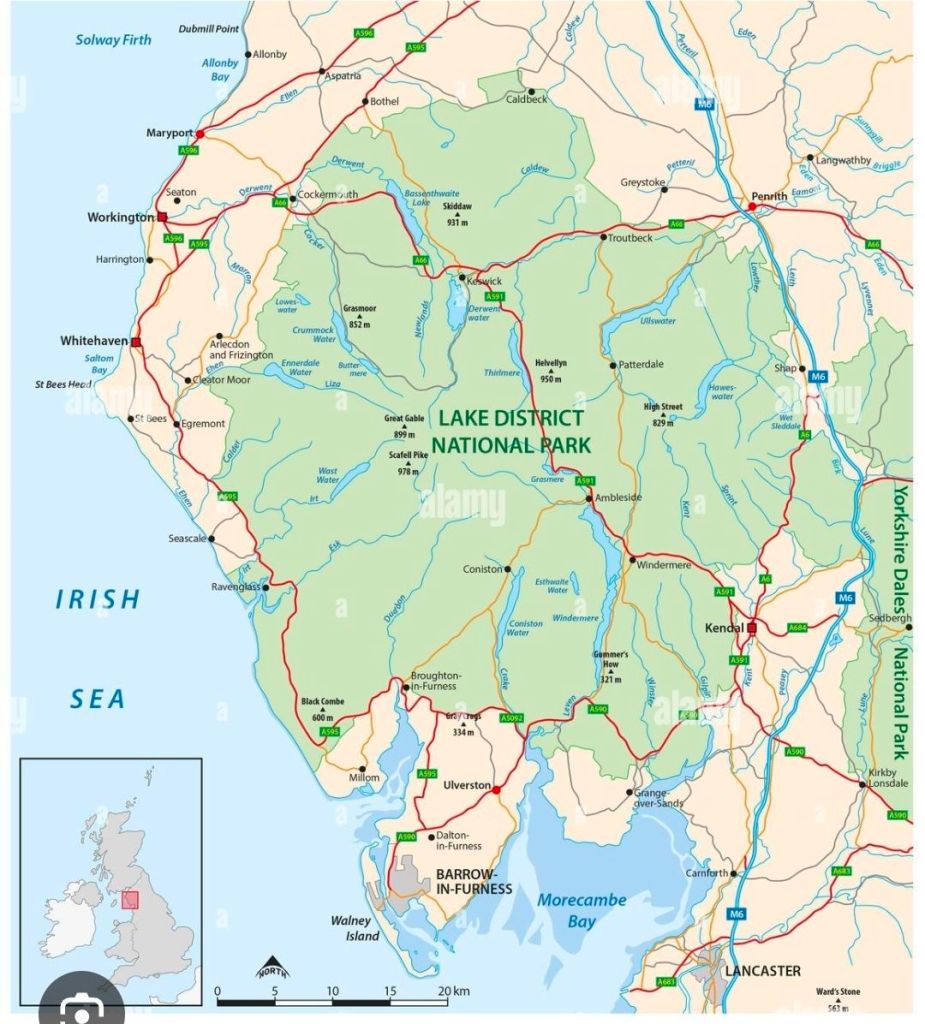
The solar and hybrid entries, if stress-tested using the Government’s four-acres-per-megawatt ground-mounted solar assumption, imply approximately 238,000 hectares of land pressure.
That is roughly comparable with the area of the Lake District National Park.
It is not a forecast that every queued megawatt will be built. Some entries overlap, some projects will fail and hybrid schemes must be treated carefully.
But it shows the scale of land potentially implicated by the queue.
And solar is only one layer.
Add:
BESS compounds;
data-centre campuses;
substations;
pylons;
offshore landing points;
cable corridors;
access roads;
water pipelines;
gas infrastructure;
and nuclear facilities.
The policy described as environmental begins to look like the greatest planned industrialisation of the British landscape in generations.
Water: the next crisis
Data centres generate heat.
Heat must be removed.
Some facilities use water-intensive cooling. Others use air cooling or hybrid systems. Public information is inconsistent and developers often disclose little more than generic commitments to efficiency.
The corridor risk brief records a Thames Water high-growth scenario under which data centres could produce approximately 270 million litres per day of additional demand.
Affinity Water has said that around 125 data centres are proposed or under construction within its region. Individual projects have requested as much as 21 million litres per day.
The full 50 GW queue could imply approximately 350 million litres per day under a lower national-average benchmark.
A high-side evaporative-cooling stress test produces a far greater figure of around 3.493 billion litres daily. That higher figure is not a prediction and should never be represented as one. It illustrates how strongly the result depends upon cooling technology.
Yet that uncertainty is itself the problem.
Britain is accelerating large digital projects without a compulsory national register showing:
peak daily water demand;
summer consumption;
drought contingency;
cooling technology;
potable-water reliance;
wastewater discharge;
and the public infrastructure required.
The policy appears to be “consent first, discover the full utility burden later”.
Few jobs, enormous privileges
The Commons report is refreshingly blunt about employment.
Data centres are highly automated.
The £10 billion Northumberland campus, capable of containing up to ten facilities, is expected to create only about 400 permanent onsite jobs when fully operational.
Government announcements quoted thousands of jobs, but those totals included temporary construction employment and indirect or induced work.
There may be strategic reasons to host data centres in Britain. National security, cloud resilience, sovereign computing and low-latency services all have value.
But those benefits do not justify misleading communities about permanent employment.
Nor do they excuse providing enormous quantities of reserved power, land, water and planning privilege without a transparent public-interest test.
A 500 MW data centre may consume power comparable with a substantial industrial city while directly employing only a few hundred people.
Parliament should ask whether that electricity would produce greater national value if allocated to steel, chemicals, advanced manufacturing, housing or public infrastructure.
Instead, AI is treated as self-justifying.
A law that makes resistance futile
Behind this entire programme stands the Climate Change Act.
The Act established a legally binding direction extending across successive governments.
Carbon budgets created deadlines.
Government departments were required to develop delivery policies.
The target was tightened to Net Zero.
Courts can order government to reconsider plans judged inadequate.
This does not mean the Act was originally drafted to supply AI data centres.
It means it created the legal and investment framework required for decades of generation, transmission and storage construction.
Once that framework existed, it could be repurposed.
AI data centres are now entering not as ordinary commercial applicants, but as strategically important infrastructure.
They may receive:
priority connections;
designated growth zones;
safeguarded land;
planning assistance;
energy discounts;
private generation rights;
and protection as critical national infrastructure.
The legal obligation sits underneath the investment.
The investment drives the infrastructure.
The infrastructure enables the demand.
The land and consumer absorb the cost.
The truth Parliament will not state
The Commons Library has done much of the investigative work.
It has recorded the queue.
It has recorded the grid congestion.
It has recorded the weak jobs case.
It has recorded the water uncertainty.
It has recorded the planning privileges.
It has recorded the energy discounts.
It has recorded the possibility of gas and nuclear generation.
It has recorded the fact that West London data centres consumed electricity capacity needed by housing.
But it refuses the final sentence.
So let us write it for them:
Britain is constructing a vast, legally supported electricity and infrastructure system in which AI data centres are becoming privileged strategic consumers, while the environmental, financial and spatial costs are dispersed among rural communities, households, manufacturers and future taxpayers.
That does not mean every project will be built.
It does not prove one secret controller designed the whole programme.
It does mean the alignment is now too extensive to dismiss as coincidence.
Renewable generation provides the approved supply narrative.
Batteries provide the illusion of firm power.
The transmission network delivers the electricity.
Nuclear and gas supply reliability.
Planning reform provides the land.
Climate law guarantees the direction.
And AI provides a vast new demand capable of justifying the entire build-out.
That is the inconvenient truth.
Not that Parliament lacks the information.
But that the information is scattered across enough reports, registers, departments and technical categories to ensure that almost nobody sees the complete picture.
No more consent without the numbers.
No data-centre approval without firm power.
No AI Growth Zone without published water demand.
No new substation without disclosure of the customers that triggered it.
No renewable claim without separating physical electricity from accounting certificates.
No infrastructure programme without a cumulative account of land, minerals, cost and beneficiaries.
The public has been told that all of this is necessary to protect the future.
It is entitled to know whose future is really being powered.
Shane Oxer. Campaigner for fairer and affordable energy
 SAY NO TO THE DESTRUCTION OF OUR LAND
Leave a comment