For years, critics of the UK’s Net Zero energy strategy were dismissed as alarmists. We were told the transition was fully costed, the infrastructure was ready, private investment would flood in, and renewables would deliver cheaper, cleaner and more secure energy for Britain.
Now the narrative is beginning to crack.
Not because campaigners said so.
Not because opposition politicians raised concerns.
But because the renewable energy industry itself is starting to admit the system is under severe strain.
Across Europe, major developers are questioning whether flagship offshore wind projects still make economic sense. Grid operators are warning of delays, broken processes and spiralling costs. Investors are beginning to see what many engineers already understood: generation targets were announced long before the infrastructure required to support them actually existed.
What we are witnessing now is beginning to resemble another great British political project built on optimism, headlines and unrealistic assumptions:
The High Speed 2 model.
And Ed Miliband’s Clean Power 2030 pathway is increasingly showing the same warning signs.
Germany Is Flashing a Warning Light
The most significant recent development came from Germany.
Reports emerged that TotalEnergies is preparing to walk away from several major German offshore wind leases due to deteriorating economics.
This matters enormously.
Germany has been presented as one of Europe’s flagship renewable success stories. Offshore wind expansion was supposed to prove that large-scale decarbonisation could be achieved rapidly through private capital and market-led investment.
Instead, the cracks are appearing.
According to industry reporting, the problems are familiar:
Construction costs have surged
Financing costs have risen sharply
Supply chains remain constrained
Grid expansion is running behind schedule
Revenue assumptions no longer stack up
Subsidy-free offshore wind is becoming increasingly difficult to justify
Germany is now reportedly reconsidering Contracts for Difference (CfDs) for future offshore developments because the economics of “merchant exposure” no longer appear stable enough.
That should alarm policymakers in Britain.
Because the UK’s Clean Power 2030 pathway depends on exactly the same assumptions.
Britain’s Renewable Industry Is Now Sounding the Alarm
One of the clearest admissions came not from campaigners, but from within the renewables sector itself.
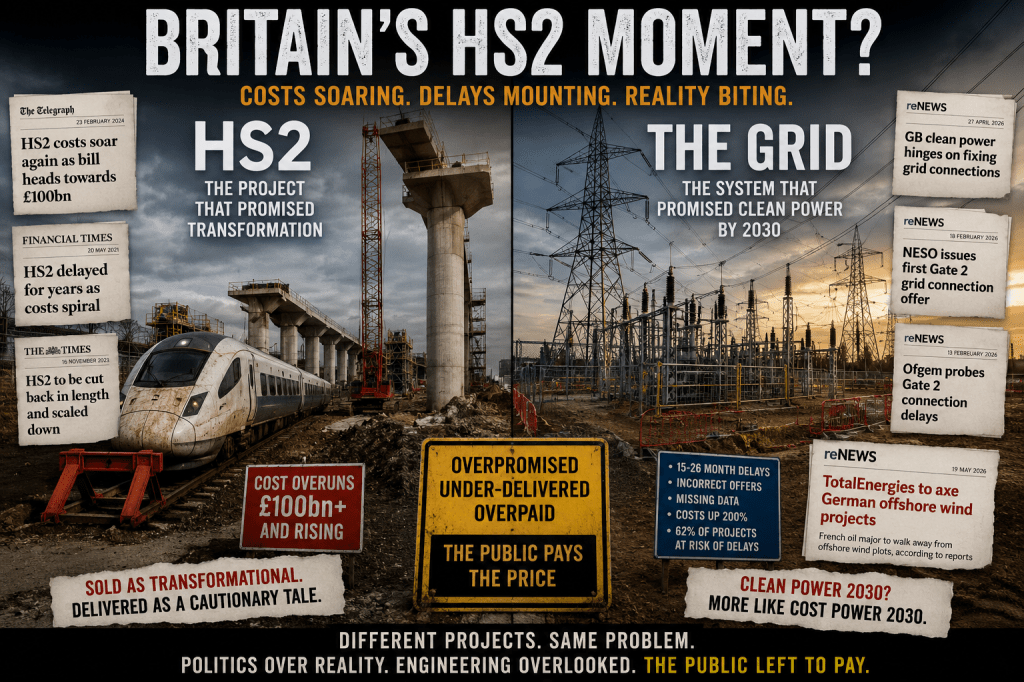
In April 2026, Graham Pannell of BayWa r.e. openly warned that Britain’s grid connection system is now suffering severe failures.
His warnings were extraordinary.
He described:
Grid delays of 15 to 26 months
Incorrect connection contracts
Missing technical information
Broken data systems
Major process failures
Connection cost increases of up to 200%
These are not minor administrative problems.
They are symptoms of a system under structural pressure.
For years, politicians assumed renewable generation could simply be connected at unprecedented speed while simultaneously rebuilding Britain’s entire transmission system.
The reality is proving far more difficult.
Britain is attempting to:
Expand offshore wind
Expand solar generation
Build battery storage
Electrify transport
Electrify heating
Construct massive new transmission corridors
Install HVDC infrastructure
Reinforce substations
Upgrade distribution networks
Maintain grid stability
Replace synchronous generation
, all at the same time.
No modern industrial nation has ever attempted an energy transformation of this scale within such compressed political timelines.
The Grid Was Never Built for This
The most revealing part of the industry warnings is that the problem is no longer generation alone.
The problem is the grid itself.
Britain’s electricity network was designed around large, stable synchronous power stations:
coal
gas
nuclear
Those systems produced predictable alternating current with rotational inertia that naturally stabilised the grid.
The new model is fundamentally different.
Modern renewables are:
weather dependent
geographically dispersed
inverter driven
intermittent
transmission intensive
That means the country now requires:
huge transmission reinforcements
synchronous compensators
grid-forming technologies
battery balancing systems
reactive power management
expanded substations
massive cabling projects
This is not a simple “green transition”.
It is a complete rewiring of the national electricity architecture.
And the infrastructure is not arriving fast enough.
The Queue Crisis Exposes the Reality
The growing crisis around NESO’s Gate 2 reforms exposes the scale of the problem.
Developers are now facing:
delayed offers
uncertain connection dates
incomplete contracts
conflicting data records
redesign requirements
escalating costs
Ofgem has reportedly warned that over 60% of protected projects may fail to retain their original connection dates.
That statistic alone should trigger serious political concern.
Because Clean Power 2030 depends entirely on synchronisation: generation must arrive when transmission capacity arrives.
If it does not:
wind farms are curtailed
solar farms cannot export fully
batteries become locally saturated
balancing costs rise
consumers pay the difference
Britain is already spending enormous sums on constraint payments because infrastructure cannot keep pace with deployment.
The more disconnected the system becomes, the more expensive it becomes to operate.
The Economics Are Beginning to Collapse
The original political sales pitch was simple: renewables would reduce bills.
But reality has become increasingly uncomfortable.
Consumers are now seeing:
rising standing charges
expensive transmission upgrades
grid reinforcement costs
curtailment payments
subsidy exposure
balancing mechanism costs
increasing system complexity
At the same time, developers themselves are warning that projects no longer stack up economically without stronger state guarantees.
This is a critical turning point.
Because once governments must increasingly intervene to guarantee profitability, the market-led narrative begins to collapse.
The system gradually shifts toward:
state-backed risk
subsidy dependence
socialised infrastructure costs
politically managed investment
In effect, the public carries the downside risk while private developers retain the upside potential.
That becomes politically dangerous during periods of economic pressure and high household bills.
The HS2 Parallel Is Becoming Impossible to Ignore
The comparison with High Speed 2 is now becoming increasingly relevant.
HS2 began with:
ambitious political deadlines
underestimated engineering complexity
optimistic cost assumptions
centralised planning
promises of economic transformation
Over time, reality intervened:
costs escalated
timelines slipped
redesigns multiplied
public confidence weakened
political support fractured
Clean Power 2030 is beginning to display many of the same symptoms.
The warning signs are now visible:
infrastructure bottlenecks
delivery delays
spiralling grid costs
supply chain constraints
investor nervousness
technical complexity beyond political slogans
The difference is scale.
HS2 was a transport project.
Clean Power 2030 touches:
every household
every electricity bill
national industry
manufacturing competitiveness
farming
land use
planning systems
grid infrastructure
energy security itself
If the pathway begins to fail publicly, the political consequences could be enormous.
The Central Contradiction
The fundamental contradiction at the heart of the Net Zero rollout is now impossible to hide.
Britain accelerated renewable deployment targets before securing:
the grid
the substations
the transformers
the balancing systems
the supply chains
the engineering workforce
the manufacturing capacity
Generation is now outrunning infrastructure.
That creates an “infrastructure deficit” a widening gap between political ambition and physical delivery capability.
Once that gap appears in major national projects, costs tend to compound rapidly.
That is exactly what happened with HS2.
And increasingly, it is what is happening with Britain’s energy transition.
The Industry Has Started Saying the Quiet Part Out Loud
Perhaps the most important development is this:
The warnings are no longer coming solely from critics.
They are now coming from:
renewable developers
grid specialists
infrastructure consultants
transmission engineers
energy investors
The very industry tasked with delivering Clean Power 2030 is now warning that:
the grid is not ready
costs are escalating
timelines are slipping
systems are failing
investor confidence is weakening
That changes the debate completely.
Because this is no longer an ideological argument between “pro” and “anti” renewables.
It is becoming an engineering and economic reality check.
Britain Needs Energy Realism
None of this means Britain should abandon modernisation.
But it does mean the country urgently needs realism instead of political theatre.
A serious national energy strategy would begin with:
grid capability first
reliable synchronous generation
long-term infrastructure sequencing
engineering feasibility
affordability
energy security
industrial competitiveness
Instead, Britain risks pursuing headline-driven targets detached from delivery reality.
The danger is that by the time the system fully exposes its weaknesses, consumers will already have absorbed enormous costs.
And just as with HS2, politicians may eventually discover that announcing grand projects is much easier than physically delivering them.
The question is no longer whether Clean Power 2030 sounds ambitious.
The question is whether the grid, the infrastructure, the economics and the engineering can actually support it.
Increasingly, the evidence suggests they cannot , at least not within the promised timescale, not at the promised cost, and not without placing enormous financial risk onto the British public.
Shane Oxer. Campaigner for fairer and affordable energy
 SAY NO TO THE DESTRUCTION OF OUR LAND
Leave a comment